• Hello MLAers! We've re-enabled auto-approval for accounts. If you are still waiting on account approval, please check this thread for more information.

Here's a surprise

Quadraman

68030
I got a used G3/375 Sonnet upgrade a few days ago and put it in my 7600/132 today and system profiler is reporting a G3 at 417mhz! I didn't know these could be overclocked. :)

 
Don't the Sonnet upgrades automatically increase in speed depending on the bus speed? The 7600/120 has a 40 MHz bus, while the 7600/132 has a 44 MHz bus, so I think the upgrade is just scaling up for the faster bus. The "375 MHz" ascribed to the model is probably just provided as a baseline for 7600/120 owners.

 
That's backward, isn't it? The system has to be in-time, and that's given by a master oscillator crystal to which the memory and processor must obey. In Apple IIs and the early Macintoshes, the system bus, processor, and RAM all ran at the same speed. Today, we have processors which run twice as fast as the RAM, and must then wait, leading to some inefficiency. Therefore, on-board processor caches become much more necessary, since they can be accessed more quickly than the external RAM.

 
The processor card is what determines the system bus speed.
My only experience is with the Crescendo Nubus G3 cards and the automatic configuration of their separate bus based upon host motherboard bus speed. I guess I shouldn't be speculating.

 
The processor card is what determines the system bus speed.
That's backward, isn't it? The system has to be in-time, and that's given by a master oscillator crystal to which the memory and processor must obey. In Apple IIs and the early Macintoshes, the system bus, processor, and RAM all ran at the same speed. Today, we have processors which run twice as fast as the RAM, and must then wait, leading to some inefficiency. Therefore, on-board processor caches become much more necessary, since they can be accessed more quickly than the external RAM.
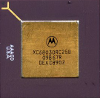
If cost weren't an issue, the memory bus would run at its own optimal speed, the CPU and the CPU's bus at their own, I/O on its own, et cetera. In many systems this happens, but it's just as easy to clock everything from one source so everything is some multiple, fraction, or combination. Sometimes synchronous busses can be more efficient when they're shared and the sharing is based on the synchronized access by alternating uses - that way the bus gets 100% usage.

In the case of PowerMacs with CPU cards, the CPU card has the main oscillator which is used for the CPU, the memory bus and the L2 timing. Of course it'd have been nice if all machines ran the memory bus at 50 MHz, but it'd be hard to get 120, 166 or 233 MHz from a 50 MHz base clock.

In every instance since the late 1980s, CPUs are faster than memory, which is why the CPU speed is decoupled from memory speed. But using one clock base to drive memory and CPU just simplifies things.

 
In every instance since the late 1980s, CPUs are faster than memory, which is why the CPU speed is decoupled from memory speed. But using one clock base to drive memory and CPU just simplifies things.
Yeah, I might have been wrong about RAM. I was reading the specs on the old compact Macs, and I think even the II models, where the bus speed and CPU speed were the same. It didn't say about RAM (or I didn't remember).

 
System Profiler is notorious for miscomputing CPU speeds for third-party cards. I'd run Metronome (you can download it from Sonnet) to get the card's actual speed.

 
Back
Top

