Cyanoacrylate is the stuff of superglue, it doesn't do a chemical weld, it doesn't even dry. It cures by pulling a bit of water vapor out of the atmosphere which begins a self-sustaining polymerization process as I understand it. That's why a few individual drops work far better than one big glob, more surface area makes for better curing. It's a really neat exothermic reaction. I discovered its reactivity with some fibers when I set the end of my shoelace on fire with it. [}

]
For ABS plastics you want to use an ABS cement formulation which will weld the parts together. It's mostly MEK with some acetone and ABS in solution. Our resident research chemist, Paralel will hopefully be teaming up with a materials science guy he knows to come up with a proper formulation for
Macintosh Cement. Using pure Acetone for repairs isn't really what you want to do, no matter what "information" you see floating around on the web.
In the meantime: IIRC OATEY sells ABS Cement in Black, White and Yellow. I've only seen black on the shelves of the Big Boxes because that's the color of ABS pipe and fittings. Eventually I'll order a few cans of white and one of yellow online to try to come up a color formulations for Beige, Platinum and the PowerBook colors. The other option I'll be trying is using a proper MEK/Acetone formulation for dissolving some sacrificial Mac case plastics as the properly colored thickening agent. +-
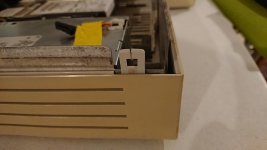
edit: just thought of using various colored ABS filaments for doing MacColor matching. BTW, that particular part may be a lost cause, depending upon whether a thin sheet of ABS can be welded on as a splint.