• Hello MLAers! We've re-enabled auto-approval for accounts. If you are still waiting on account approval, please check this thread for more information.

Finally! Success with an accelerator & ethernet in my SE/30

Haha, excellent. For me the one that works is the only socketed one I got :p

All non-socketed boards I tried so far didn't want to work with the full stack.

Technically all those boards should be the same. Must have to do something with really driving things to the edge with three add-on cards.

 
Last edited by a moderator:
I spent years trying to get my Daystar Turbo to work alongside an ethernet card. I tried every possible software combination, I recapped everything and even built a new power supply - all to no avail.

In a last-ditch attempt, I recently splurged on a DiiMo 50mz 68030 accelerator from Japan... and finally I have success!

View attachment 26331

Above is my Mac, with a DiiMo accelerator, Asante MacCon ethernet, 128mb RAM, Rominator with patched IIsi ROM to disable memory test, a Seasonic PSU, Noctua fan and an OpenWRT wifi card mounted internally.

I also retrobrited the case, keyboard & mouse using the "total immersion" method using diluted peroxide I got from my local spa shop. Although, it could probably do with a second treatment as I had bad luck with the weather.

I had to fabricate a new bracket for my Wifi card, due to the accelerator taking up the existing space:

View attachment 26332

It was a squeeze, but everything just fits!

View attachment 26333

I'm delighted with the outcome. My Spotify player now runs virtually on par with my modern PC! I'm keen to write some more internet enabled apps to run on my fast little SE/30.

Can you run Spotify on an se/30 through a normal ethernet cable rather than wifi?

 
Can you run Spotify on an se/30 through a normal ethernet cable rather than wifi?
The SE/30 CPU is not powerful enough to handle modern HTTPS encryption & decryption in a timely manner (even with an accelerator). To solve this, I delegated the encryption work to the OpenWRT wifi router, which has a 600mhz processor.

So, the Spotify player relies on the wifi card for more than just wifi and unfortunately won't function without it. There is a possibility that other routers could be configured to handle the SSL encryption, but I haven't looked into it yet.

 
The SE/30 CPU is not powerful enough to handle modern HTTPS encryption & decryption in a timely manner (even with an accelerator). To solve this, I delegated the encryption work to the OpenWRT wifi router, which has a 600mhz processor.

So, the Spotify player relies on the wifi card for more than just wifi and unfortunately won't function without it. There is a possibility that other routers could be configured to handle the SSL encryption, but I haven't looked into it yet.
Oh shame :(  id be so so delighted to run Spotify from it
 
 Oh shame :(  id be so so delighted to run Spotify from it
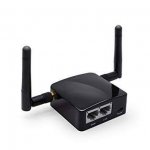
It's worth mentioning that the wifi router does not need to be mounted inside your Mac - I just did it for fun.

The GL-AR300M comes in a box that you can plug externally into your network card:

images (15).jpeg

 
tumblr_lzxh5hrBg51qinhw7o2_1280.png.107394b169be2ccd2e78233417134cf2.png


@ants how did you do the WiFi on this?  I am working on developing a clear case for the Mac SE/30 and I think it would be neat to showcase the machine with WiFi!  Would you consider assisting with setting on up for a cost? 
Great idea, the wrong-angle modded Asante NIC with a second card mounted in the verticalized passthru would be killer.

It's worth mentioning that the wifi router does not need to be mounted inside your Mac - I just did it for fun.

The GL-AR300M comes in a box that you can plug externally into your network card:
That box mounted internally, antennas at the rear of the unshielded clear ABS case would be the bombe, :approve: Added benefit would be that the backplane remains unblocked for something like a video card's breakout board/panel.

View attachment 26424

Haha, excellent. For me the one that works is the only socketed one I got :p

All non-socketed boards I tried so far didn't want to work with the full stack.

Technically all those boards should be the same. Must have to do something with really driving things to the edge with three add-on cards.


I'm going to pester you again here about the two TTL input driving limitation Apple specified for the SE/30 and IIsi 030 PDS. I'll add the 15pF capacitance limit spec for most (all?) of the signals required for Accelerator Adaptation. That's IIRC from ProtoCache development, so it's a little bit different this time around:

Have you compared date stamps on your logic boards against socketed/unsocketed state?

Have you checked the logic technology type of the buffer ICs against socketed/unsocketed state?

I've always thought of the socketed boards as being the first production version and the move to SMT 030 being a later production revision. Dunno date specifics for the relevant ICs, but Don Lancaster's CMOS Cookbook superseded his TTL Cookbook in 1987. If SE/30 driver/buffer ICs transitioned to CMOS at the SMT CPU changeover, that could be a major factor in driving things to the edge when stepping across that 2 to 3 TTL input barrier. Same TTL to CMOS tech migration for production runs of Accelerators, Adapters, NICs and your internal Grayscale card would apply.

I remember having problems in product development related to the TTL to CMOS shift in that time frame, could such be the bugaboo here? Buffer IC rework at the Logic Board level couldn't cause timing concerns you had about imposing an additional level of buffer/driver delay to the bus during ProtoCache development.

 
Last edited by a moderator:
View attachment 26331

Took another peek at your lovely pic, ants. Can't help but think clear cases for KBD and Mouse would be absolutely fabulous. I would only replicate the Tombstone mouse case. The KBD should be a new design integrating BMOW's  Wombat adapter with a USB KBD controller board and ADB passthru for the Mouse. Thinking current mechanical switches set in a laser cut galvanized steel plate that matches the Chassis of the SE/30 here. Dunno if the USB controller board's lower power requirements could allow running LEDs and mouse, but I'd rather not see that. Using Keycaps harvested from the AppleDesign KBD would be my preference if current mechanical switches compatible with them are available. May as well "borrow" far more available AppleDesign KeyCaps and leave the ADB design boards where they are.

 
Back
Top



