• Hello MLAers! We've re-enabled auto-approval for accounts. If you are still waiting on account approval, please check this thread for more information.

Farallon ETHERMAC LC NSC w/NuBus drivers in the SE/30 PDS?

HRMMM???? Wondering where/how the card might be shoehorned into an SE? Later models with the SE/30 compatible chassis would be no problem.

One thing to think about is that a single adapter in the form factor of the MicroMac Performer could be SE/Plus/Classic compatible. I wonder about the cards? Clear plastic Killy Klips beckon! Know anybody with experience applicable to developing the tooling for a run of little clear plastic doodads? Stamping out the metal contacts should be a piece of cake by comparison. How many of these suckers did you say you had? [:P]

 
Interesting, I was not really aware of the chassis differences. That would certainly and some difficulty to that project...   

 
I thought the SE and SE/30 chassis was the same as well. Seems like there’s plenty of room in there. Card position doesn’t really matter... crimp and RJ-45 onto a short CAT5E cable, route to a 3D printed bracket that holds a keystone punch down jack on the back of the SE or SE/30, and you’re good to go. Seems to me like the big hurdle is just seeing if these things are electrically compatible or not.

If there’s anything I can to do help... I’m game. Including 3D printing plastic doodads.

 
SE PDS expansion card position is horizontal, stretched across the logic board. The PDS connector has solid metal overhead. So NIC and adapter can't be located in the upper case. The assembly has to fit below decks like cards designed for the 128k-Plus that were Killy Klipped to the 68000. Not a lotta cubic available under there for matching up cards on EuroDIN connectors on two separate planes needing that much vertical clearance. Of the pics I've posted this one probably shows it best:

View attachment 27005

Any expansion assembly must fit between logic board components and the slanted black line defining the hard deck of the SE Chassis. Whereas the SE/30 and late production SE have that convenient access hatch punched out for the upright  PDS card spec. of the SE/30.

If it can't be fit below decks, maybe some kind of ribbon cable slot extension might work to get it above deck? Dunno, tired and off to bed.

 
I'm keen to start messing with this idea, but I have a bunch of SE's, and no SE/30. On top of that, the SE seems like a good place to start as they seem to be more common than the SE/30. In other words, blowing up an SE would be less heartbreaking than an SE/30. Is there a card out there I should try to find that I'd have better luck trying on an SE?
I think I misinterpreted your question. A driver for the SE would be the first thing you need to nail down. Did Farallon make an SE version of this card? If not, you'll be looking for an SE NIC developed in conjunction with a NuBus version for the 68020 Macintoch II sharing the same chipset making drivers available for both versions.

Availability of NuBus and LC PDS versions of this card/driver combo would be the heart of the matter. Don't recall offhand, but lack of a suitable driver was likely the stumbling point the many times suggestions for the LC NIC to SE/30 conversion came up. The SE/30 is a Macintosh IIcx stuffed into the SE form factor. That made its PDS an outgrowth of the NuBus/Slot Manager architecture. The SE, its PDS and drivers of its cards are not compatible with that architecture and require a very different type of driver.

TLDR: SE PDS is is the natural progression of 68000 architecture expansion. Apple II model slot based expansion had been in the minds of the Macintosh development engineers from day one. SJ and his project managers quashed the notion of expansion for the Macintosh at every turn: folklore.org: Diagnostic Port The workaround for that intentional limitation was likely coming to a boil long before Burrell & co. left Apple to form a startup they named Radius to develop the FPD.  I wonder if they chose that word for its connotations of lengthening/expanding a circle of Macintosh capability far outside the box in every direction?

 
Did Farallon make an SE version of this card?
Great question... I have no idea. The only PDS ethernet card that I know of for the SE is the Asante MacCon (sometimes I see it called the Asante MacCon+). They are typically advertised for $150 on eBay.

Thanks for the background information... I'll have to look and see if a Farallon card exits. But for the SE... I'm starting to think that a custom SCSI ethernet adapter is the way to go. But engineering that is way beyond my skill level (I can might LED's blink in fancy ways on an Arduino, that's about it).

 
The only PDS ethernet card that I know of for the SE is the Asante MacCon (sometimes I see it called the Asante MacCon+). They are typically advertised for $150 on eBay.
There's your missing link, Asante MacCon IIsi SE/30 is the gold standard, also available in NuBus versions.

edit: dang, now I've got 3D models of the compacts banging around in my head playing bi-directional Jenga again. :blink: Good news it that if an SE in your batck has a late production date, you may find the SE/30 compatible chassis inside and your test bed setup is ready for sourcing connectors and doing a board design in the 10cm x 10cm. format. If the requirement extends to a third layer I've got a quantity 250 box of ten position jumpers. Time for a new topic.

 
Last edited by a moderator:
I opened some FDHD and SuperDrive models they both have the same chassis as the SE/30.  But I bet there is a unquie way to make it work that we haven’t thought of yet. I’ll spend some time on that if the wire wrap turns out successful.  

 
I have looked into the issue more, and I think there is a reasonable solution we can do.  As a result, we need not be dissuaded from pursuing that goal as well.  Let's just wait and see what the final wire wrap reveals for us.  I bet when complete TattleTech will see it, but the drivers won't work. 

 
That would be my prediction as well, but still holding some hope out for the NuBus driver working. I've yet to mention the fourth header in the address line block on the board. That's for the /NuBus line of the 68030/IIsi PDS. SE/30 is BusMaster hostile where the IIsi is not. LC NIC/all LC slot cards sound to be NonMaster implementations?

View attachment 26863

Explanation of the LC NIC's /SLOTIRQ address line above (hardwired $E implementation) as a NonMaster NuBus IRQ address interrupt request presents a possible a detour around SE/30 PDS driver addressing issues when used in conjunction with the address location of the IIsi NuBus Adapter Slot. It was an interesting blurb in the LC II DevNote, may be applicable, may not, but implementation on the board is trivial being but one unused pin on the 030 PDS.

Wire wrap may not be the most current form of prototyping, but rework for connection corrections/modifications to wire wrap circuits on a prototype board is trivial.

 
The original SE has a different chassis without the cutout and mounting tabs to allow vertical expansion cards.

Later SEs and the SE/30 share the same chassis with the cutout and the tabs to properly mount vertical cards.

I have modified a MacCon SE to mount vertically because I have an accelerator mounted on top of the 68000 which blocks the use of a standard horizontal SE upgrade card.

 
The original SE has a different chassis without the cutout and mounting tabs to allow vertical expansion cards.
Thanks for that crystal clear explanation. That hack was my reason for suggesting a vertical slot adapter/card LC NIC installation should such become a feasible proposition. What are your thoughts on /NuBus and chances for its use with the NuBus drivers in a workaround should the need arise?

edit: also wondering about the 8MHz clock issue in the SE. C16M is present on its PDS, but will the NIC clock asynchronous?

 
Last edited by a moderator:
Back to the SE/30 PDS adaptation again for an update!

P1010038.JPG

Something like twenty Blue Control lines and the three Purple IRQ lines left to be hooked up on the 030 PDS side. Everything is wired up on the LC side so I can sort out the wires from those connections and knock them down by the numbers, row by row. That's the easy part, flipping it over for testing and debugging is next up.

 
Last edited by a moderator:
Assembly-20.JPG

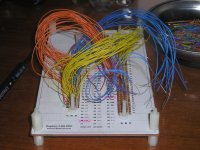
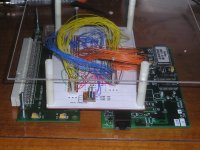
Wire wrap circuit board complete. 68030 PDS and LC 68020 PDS have been joined. Now to buzz, check and recheck every connection before the magic smoke test. :mellow:

 
WOW!

Now comes the exciting part, so much suspense.  What method do you use for buzzing before actual use?  Like an oscilloscope?

 
Nothing so complicated, just a simple continuity tester is needed. While I'm checking each and every connection I hope to have made correctly, I also have to test the surrounding pins to make sure there was no short made to one of them in the wire wrapping process.

I'm also going back to the baseline pinouts of the two PDS slots in copies from the manuals. to mark up a copy of the PDF I just posted against. left and right columns get the data scribbled in from the docs on either side of the pairings That's to check that my wrap map really reflects what it's supposed to, not error that slipped in somewhere along the way.

 
That makes sense, it’s a good idea to test for continuity. Likewise, it’s good to be extra sure that there are no errors. If there are it could give is a bad result when it might not otherwise be.  I like seeing things like this wire wrap board being developed.  I’ve always enjoyed seeing things come to life!

 
This is why I begged several times for someone to double check my pinouts, tables and wrap map. You CANNOT proofread your own work, period. The numbers on the rows on the IIsi pinout I've been using got reversed somewhere along the line. [:I]

Thankfully it wasn't A PCB layout screwup, That would have been a total loss. I have to all but start over. I only have to unwrap the 030 side, re-strip then re-wrap only that side from a corrected map. :mellow:

edit: might have jumped the gun. The wiring may not be wrong at all? The numbers of the rows are inverted on one side, but the positions of all the connections remain the same? The numbers transcribed in the process of signal matching were mis-coded, but the spatial relationships IRL may remain intact. I'll look at it again in the AM  .  .  .  maybe.  :blink:

 
Last edited by a moderator:
Back
Top