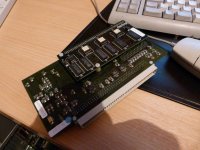
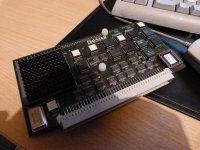
There is an Internal Cache and an External Cache. The 040's had two sets of 4K internal cache - 1 for data and 1 for instruction code. Due to the size size of this 8K Cache, there were some incompatibility problems, but the cache can be turned off or on by control panel in the System 040Cache Control Panel. Turning off the cache restored compatibility with troublesome programs.
External Cache would depend on the system. I would have to look at my Turbo040 to see how big it is. On Apple's Mac IIci cache card I believe if it two rows of 1-bit chips for 16K making up 32K, but there another row of 4, 4 bit chips at the bottom of the board. So its bigger than 16K. There is also another Apple Cache card that is 32K in size.
Of the two - the Apple's Cache card and the Turbo 040, they can't be used together. But on some older Turbo040, there is a slot to add ram to the card for an external cache. This is very different as it connected to the Turbo040 card and not the PDS Slot. This external cache adds to the 8K cache inside the '040.
The Mac IIci's 030 has a 256byte cache for both data and instructions. The Apple's Cache card adds its memory to the processor's cache. This is compared to the 020 and the 68K which both has no internal or external cache. The cache makes the CPU run the programs a bit faster, especially for loops within a program so that there is little time wasted getting instructions from RAM or ROM. This can be just microseconds for each instructions, but 4K would save 1 second for every few seconds it could take. A 16K cache would save 4x as much and a 32K cache would save 8X as much. The numbers look small but it makes a big difference, from either 3 minutes to process a file without a cache or 2 minutes 15 seconds with a cache.
The same applies with the Turbo040, making that same 3 minutes of a stock Mac IIci take less than a minute on the Turbo040 with the cache on. The numbers are still small, but they add up in the long run.