• Hello MLAers! We've re-enabled auto-approval for accounts. If you are still waiting on account approval, please check this thread for more information.

Converting a USB KVM Switch to ADB KVM Switch - Wiring ONLY

Trash80toHP_Mini

NIGHT STALKER
68040
I've never considered this before, but I ordered an inexpensive 4-Port USB KVM Switch and another caffeine deprivation, haziness mode crazy notion came up. I'm not all that leary of killing a $25 ( approx. shipped cost) hunka junk. [}:)] ]'>

Pic of a similar KVM Switch: note VGA INPUT of switch is mislabeled as an output:
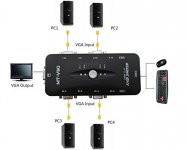
411Az82Dp-L.jpg

USB Pinout:

1 _____+5 V

2 _____Data -

3 _____Data +

4 _____Ground

ADB Pinout:

1_____ADB

2_____PSW Power Switch

3_____ +5V

4_____GND

Dunno, seems like a little bit of line conditioning done at a USB connector (female) wiring/signal level to ADB connector (male)wiring/signal level conversion PCB might be all that's needed?

RA Female USB Connector <-> electronics kluge <-> S-Video Cable (say 6" chopped off each end of 3 cables req.)
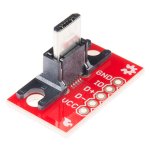
10031-01a1.jpg

The best pic I could find quickly.

I'm finally waking up a bit now, so I need a reality check on this one. Semi consciousness period was more than twice as long as usual. Not sure if posting this would have been easier if I hadn't run Mr. Coffee with the carafe sitting next to him again or not.  ::)

 
Both Anthon and BMOW have direct experience in converting ADB to USB. I'm curious to hear what they have to say.

And, with the exception of one of the Kensington Mouse-in-a-box mice (64475?), all of the ADB-USB converters seem to have more than simple re-wirings. Unless the iMate was made more complicated looking than it needed to be.

BTW, what's the difference between Data- and Data+? Does USB have two data lanes?

 
Dunno anything about the + - thing, first guess would be differential signalling? one or the other would be sufficient for the "ADB" signal, whichever would be more convenient.

I'm not worried about USB bus to ADB bus conversion, just re-purposing of the KVM's electron plumbing for the flow of ADB bus signalling on all sides of the proposed ecosystem's I/O.

BMOW's or Anthon's conversion units could be used as the "ADB" input for the KVM switch, though I'll assume that doing so would void any warranties. [;)] ]'>

 
Now I'm curios about the 5 line USB pinout on that breakout PCB and how it differs from the four line USB signal diagram from pinouts.ru?

edit: USB2 vs. USB3???

 
Last edited by a moderator:
Honestly, there is no way to know without tearing the KVM apart to see what it actually does to switch signals, but my guess is no.

IF it's a completely dumb 'electronic switch" and all it does is use a multiplexer IC to rudely 'cut the wires' when the button is pressed and move the connections to the next port then, sure, maybe? But I have personally never used a USB KVM that dumb. Every one I've ever used have an IC inside that basically looks like a USB hub with a keyboard and mouse attached to all the client computers and has a tiny microcontroller in it that buffers the input devices and watches for special keystrokes to change outputs...

So, I went to Amazon and think I found reviews for this thing. They're generally terrible (lots of complaints of it corrupting the video signal and breaking after a week) but it is indeed apparently lacking any 'smart' functions. So... still not a slam dunk, but I suppose you have little to lose by trying to, say, run a continuity test through it while switching ports and seeing if actually passes through a non-USB signal unmolested. I do imagine best case it *only* switches the two data lines.

 
... actually, no, looking at it further at the very least it has a USB 2.0 hub on the keyboard/mouse side. (It has three ports it "switches" with only a single USB cord running to each computer.

So unless you can disable that hub and wire your ADB peripherals upstream of it to a raw multiplexer you are boned. (And I would strongly suspect that the hub and multiplexer are inside the same chip.)

 
Last edited by a moderator:
Hrmmm???? Would a USB hub really care what data is flowing through the serial stream on one of its lines?

Buffering the invading "ADB stream" from the offline CPUs doesn't sound all that bad, but I'm only barely conscious ATM.

zzzzzzzzzzzzzzzzzzzzzz

edit: this is the one I bought, not the one in the picture. I've got a DOA IOGEAR four-port to crack open for a look see in the meantime:

COOLEAD 4 Port USB 2.0 KVM VGA Switch Box Adapter for PC Keyboard Mouse Monitor + 4 USB VGA Cables

Reviews don't seem too bad for mine. I'll be using it for 1600 x 1200 max, the only complaints were about HD signals, not a problem for ADB Macs, 1600 x 1200 Cards are few, far between and pricey for NuBus Architecture and PCI Macs can use the vanilla USB feature set. [;)] ]'>

 
Last edited by a moderator:
Hrmmm???? Would a USB hub really care what data is flowing through the serial stream on one of its lines?

Buffering the invading "ADB stream" from the offline CPUs doesn't sound all that bad, but I'm only barely conscious ATM.
Yes, USB would "care". USB hubs are not completely "dumb" devices. Here is a datasheet for a hub controller IC. At the very least they have an active state machine (IE, a semi-microcontroller) that has to handle a minimum set of requirements: it needs to reply to identification requests from the host saying that it's an "endpoint" and enumerating that it has downstream ports, it has to handle passing along insert/unplug events from the downstream ports, it has handle and pass along power/reset events commanded by the host to the connected peripherals, and in the case of the full "high-speed" capable 2.0 hub it has to do protocol translation so devices hanging off its ports that use the low/full speed protocols have their communications updated to high-speed. In other words, a USB hub, even the dinky one inside of this thing, isn't just like a bunch of outlets on the end of extension cord. You might as well be asking if you could carry ADB through an Ethernet switch.

The link you threw out is the one I found on Amazon myself (it looks like it's the same device you pictured with a different name slapped on it so I assumed it actually was identical.) One of the reviews points out that, yes, it *does* identify itself as an "endpoint device" (IE, a hub.). (Which some of the other reviews complained about, because what that means is when you switch ports the OS on the computer you left thinks the keyboard and mouse were unplugged (or, more specifically, the hub the keyboard and mouse were plugged into was unplugged) and the computer you connect to thinks that a set was plugged in. This can be a problem with some operating systems, etc; at the very least it introduces an initialization delay that isn't there when you use a smarter KVM that pretends to be a keyboard and mouse constantly plugged into every port.) Which, again, means there's a protocol-aware chunk of electronics between the input port and the output port that I'm pretty darn sure throws a monkey wrench into your plans.

The *one* possibility, I suppose, would be if the USB hub was a separate chip from a generic analog-signal multiplexer switch that handles the VGA circuit, and the way it handles the USB switch is it *actually* uses the same analog multiplexer to essentially physically unplug the USB hub IC from one downlink and plug it into another. *If*, and only if that's the case then I suppose it might be possible for you to hijack the *two* lines it's switching by carving into the circuit board between those two ICs. But I'm pretty darn skeptical that's what's going on, because it appears that they do make ICs specifically to do what this does, IE, hub controller ICs with multiple switchable uplink ports.

 
Here's an idea for you. I used to have a cruddy little KVM that in addition to USB keyboard/Mouse and VGA included switched audio out and mic jacks. Like this:

https://www.amazon.com/IOGEAR-2-Port-Switch-Cables-GCS72U/dp/B002K0TU2C

How about getting one like that and looking into carrying ADB over the audio port wires? I would assume that they're switched via an analog multiplexer. Granted, determining whether they're suitable for end-to-end carrying ADB signals would be an exercise for the reader. I also suspect you'd have to plug the USB ports into a power source.

 
Last edited by a moderator:
Very clever, G. I haven't used them for sound, but the IOGEAR2-port I'm using now has speaker/mic switching. Re-purposing those lines for ADB would be a lot cleaner approach to this exercise.

Even more interesting, I just unpacked and cracked the case on this puppy:

https://www.ebay.com/itm/222669336115

2007 build, no USB power complications with standard PSU on board, DIP IC and discrete component level tech. Six port Mac KVM switch testing commences! [:D] ]'>

 
Back
Top