
-
 Hello Guest! We're hosting a challenge to welcome vintage Intel macs to the MLA during the month of July! See this thread for more information.
 -
We've made some quality of life improvements to the Trading Post. More info here.
You are using an out of date browser. It may not display this or other websites correctly.
You should upgrade or use an alternative browser.
You should upgrade or use an alternative browser.
AppleCD 8x from my 6360 not working
- Thread starter Machead
- Start date



Just wondering, is it possible to source new replacements and replace them? Eventually there will not be any replacement drives...

No, usually the optical pickup units are proprietary to the drives.
We are having that problem in the collectible CD player world. No optical pickup units to be had.
A couple cases I had to physically change the laser diode, got lucky because the diode is separate from the detector IC, and since the diode itself isnt collimated, and the collimator is internal to the assembly, you dont lose optical alignment.
Some of the oldest high-end CD players, like the CDP-701ES units from Sony, the glue holding the prisms together is beginning to deteriorate and fog up, blocking the laser beam itself. I have not found a solution for that.
We are having that problem in the collectible CD player world. No optical pickup units to be had.
A couple cases I had to physically change the laser diode, got lucky because the diode is separate from the detector IC, and since the diode itself isnt collimated, and the collimator is internal to the assembly, you dont lose optical alignment.
Some of the oldest high-end CD players, like the CDP-701ES units from Sony, the glue holding the prisms together is beginning to deteriorate and fog up, blocking the laser beam itself. I have not found a solution for that.
Last edited by a moderator:

I think he was talking about Panasonic SCSI and IDE drives that were used by Apple for many years. The drives seem very similar, main difference being the (obvious), different controller board, even then that has some similarities too.
Might have been built on the same 'platform' so to speak, differed only by the connector on the end of the drive?
Might have been built on the same 'platform' so to speak, differed only by the connector on the end of the drive?

One of my Technics 5 disc CD changers died from a bad laser I think (just quit working one day). I purchased it new in the 90's and used it daily since then till a couple years ago. Luckily you can find replacement units cheap, and I lucked into a Technics SL-MC400 100+ disc unit cheap (just needed a new 0-ring to replace a worn out belt).No, usually the optical pickup units are proprietary to the drives.
We are having that problem in the collectible CD player world. No optical pickup units to be had.
A couple cases I had to physically change the laser diode, got lucky because the diode is separate from the detector IC, and since the diode itself isnt collimated, and the collimator is internal to the assembly, you dont lose optical alignment.
Some of the oldest high-end CD players, like the CDP-701ES units from Sony, the glue holding the prisms together is beginning to deteriorate and fog up, blocking the laser beam itself. I have not found a solution for that.
I guess any warehouse that would have kept vintage audio parts went out of business a long time ago.
The chinese have cloned the hell out of the KSS-2XX lasers so luckily they are fairly plentiful. and those units are used from about 1995 up until some of the last units made.
But they are NOT the same as far as the pickup is concerned. I already know this because I tried to swap one out from 2 very similar drives but the pickup unit was different. I have an 8X drive that wont obtain focus lock, and thats how I discovered this. Turned out it was actually the RF Amp IC. Once I changed that out from a similar drive, it fired over.I think he was talking about Panasonic SCSI and IDE drives that were used by Apple for many years. The drives seem very similar, main difference being the (obvious), different controller board, even then that has some similarities too.
Might have been built on the same 'platform' so to speak, differed only by the connector on the end of the drive?
the traverse deck varied from drive to drive, and the optical pickup is part of the traverse deck. which contains the sled, spindle, optical pickup, and all its associated mechanical supports and slides/gears.
I cant speak for every drive in existence, but from my experience as a repair tech, the lasers tend to be ever so slightly different from drive model to drive model. Even the PS/3 had 4 or 5 different versions of optical pickup assemblies.
Anyways, I do remember googling the optical pickups, and they are out there, but 99% of them are housed in those "parts brokers/RFQ" style sites. Then there was an audio CD version of that same pickup used in the 8X drive, and they are all over ebay! But turns out, they arnt compatible. Even though they look identical. But they are not.
Last edited by a moderator:
Had to replace the laser in my PS3 last year...fun times.And the PS3, and the xbox, and probably the PS4 by now.
I have a dead (Yellow light), CECHA01 PS3 hanging around here somewhere. I would have tossed it years ago, except it has a Emotion Engine CPU in it for PS2 compatibility. It might be possible to repair maybe, who knows.
My friend has 5 PS2 slims that all suffered from DVD diode burn-out.
My friend has 5 PS2 slims that all suffered from DVD diode burn-out.
no, it needs a complete flux and reflow to fix it. But it will do it again. And again and again.... I have fixed a many of them. Albeit only temporarily. Too much heat for too little of a surface area. its actually the GPU.
I havent serviced a PS2 in ages. I mean AGES... So I cant be for certain, the only thing I can recall on the PS2 is one of the SMD pico fuses popping because of a CD drive chip failing, or other causes.
I had to change the LD and recalibrate this little gem:
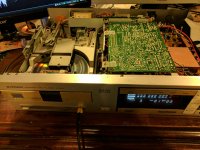
Trust me, its not for the faint of heart! Lots of swearing, oscilloscope plotting, pot twiddling and optic adjustments later she finally runs like it was new. Even reads heavily scratched disks.
Only thing left to do now, is to build a new 7-pole chebyshev filter for the left channel. old one has a bad connection internally and goes noisy, but its potted so it cannot be repaired. Already have the new one designed just not built yet.
Trust me, its not for the faint of heart! Lots of swearing, oscilloscope plotting, pot twiddling and optic adjustments later she finally runs like it was new. Even reads heavily scratched disks.
Only thing left to do now, is to build a new 7-pole chebyshev filter for the left channel. old one has a bad connection internally and goes noisy, but its potted so it cannot be repaired. Already have the new one designed just not built yet.
the only thing you need to reflow is the GPU, and you have to be very careful because the GPU is a double-BGA. the chip itself is a BGA, but the RAM is soldered on top of the chip between the chip and heatspreader, and they too are BGAs. they are also epoxied into place.
IF you let those chips reflow before the board reflows, it will squeeze and bridge all the solder joints so its a delicate process. you need controlled pre-heat, and reflow heat. using a reflow profile you have to bring it up to around 217c which is roughly where lead-free solder melts, and then cool it off. You should use SMD291 or SMD294 flux whatever it is, I cant remember.
warm the board and let the flux run under the chip. When your reflowing the board, the flux will squeeze out and bubble. it will bubble really hard and then quit, thats how you know your at reflow point, then you can shut off the heaters and back off.
IF you let those chips reflow before the board reflows, it will squeeze and bridge all the solder joints so its a delicate process. you need controlled pre-heat, and reflow heat. using a reflow profile you have to bring it up to around 217c which is roughly where lead-free solder melts, and then cool it off. You should use SMD291 or SMD294 flux whatever it is, I cant remember.
warm the board and let the flux run under the chip. When your reflowing the board, the flux will squeeze out and bubble. it will bubble really hard and then quit, thats how you know your at reflow point, then you can shut off the heaters and back off.
Similar threads


- Replies
- 3
- Views
- 397

