Exactly. Just few weeks ago I recapped a LC 475 PSU. I changed every cap, except the main smoother (rated at 180uF 400V I think). When I plugged it in, I saw on the wattmeter that the wattage was very high (around 25W-30W with NO load). I quickly disconnected it, and tried it again, then the wattage started to fall, and it settled at just 7W, after about a minute.
After that I felt around if anything was warm, and guess what, that big main capacitor was bit warm. That cap should not get warm at all by itself.
Luckily all SMPS PSUs implement NTC thermistors to limit the current, and the NTC did its job correctly in this case. The PSU is from 1994, and probably hasn't run since the late 90s, so no wonder the cap got "dirty".
I think they simply used 63V 1uF caps simply because they were abundant and cheap.
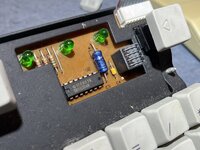
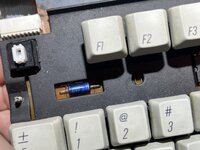
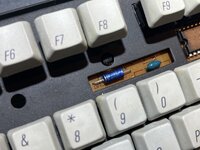
Anyways I added some photos of the caps, those were blue Philips axial caps, which makes sense as my keyboard was made in Ireland. The keyboard received full cleanup (all keys removed and everything washed) after the recap, so it looks like new.
P.S. About the regular exercise of vintage electronics, I lately came across a floppy drive (out of a PM 8100, so also about 1994 vintage) that worked fine, but just wouldn't eject. Mechanism was fine and not gummed up, so I decided to take the eject motor assembly out and plug it in a external 4V power supply (a 18650 cell). The motor struggled to turn by itself, but after every revolution it made, it picked up more speed. You could just hear going faster and faster, and after a minute it reached normal speed. I reinstalled it, put everything back, and now the floppy drive ejected like new.