• Hello MLAers! We've re-enabled auto-approval for accounts. If you are still waiting on account approval, please check this thread for more information.

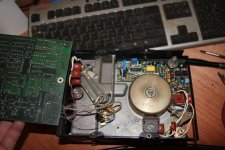
Any thoughts on this....it arrived!!!

Hey Gorgonops - Im only going by what someone said earlier on here  - someone said memory board , someone else said 'MFM to' (just checked, that was you- haha) - i have no idea gorgonops. Im calling in the 'X' board. 
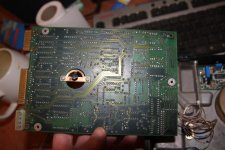
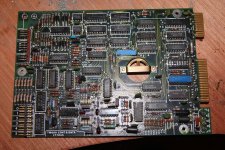
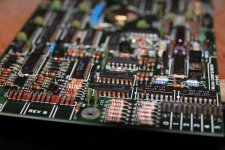
I guarantee it's a hard drive controller. That board assembly was connected to the hard drive via two cables, a 34 pin one and a skinner 20 pin one, right? That is ST-506 cabling:

https://en.m.wikipedia.org/wiki/ST-506

Standard for "inexpensive" MFM and RLL hard disks from the late 1970's up through the end of the 1980's. This is an extremely "dumb" interface, not much more sophisticated than that for floppy drives, and has extremely strict requirements/limitations on cable length, controller latency, etc. Therefore it was very common when these drives were used on slow computers or in external boxes to use a controller board directly attached to the drive that handled the fast, dumb communication there and presented a more forgiving and simpler to interface to connector on the other side. That is what you have there. A common standard for the other side was called "SASI", which was an 8-bit parallel interface similar to SCSI, and I suspect that is what the host adapter card plugged into your motherboard supports.

Crack open an old enough external SCSI case and you'll often find a similar board doing SCSI-to-RLL or SCSI-to-EDSI (another obsolete interface standard) conversion in front of the actual drive.


 
bibilit - thanks for the info and links. Will be needing all thoes links

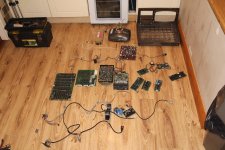
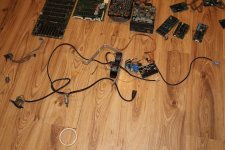
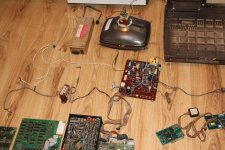
Finally have the whole thing apart

starting to clean it up - that goo is a complete nightmare but its nearly all gone

IMG_8457.JPG

IMG_8458.JPG

IMG_8459.JPG

 
After  rechecking the pinouts of a molex the power supply is working correctly. Tested the power supply on another IDE drive and spun up correctly.

Took the out the blown cap - 10uf 20 volt. Took out the controller board, cant see anything obvious wrong.. looks clean. Platter spins freely (just moved it a bit)

Can i replace this with a standard 10uf 20 volt radial cap or is this some kind of special cap??

think i should of just gifted this to techknight.......but its in bits at this stage!!!  and im having a laugh at trying to eletrecute myself!!

IMG_8473.JPG

IMG_8474.JPG

IMG_8475.JPG

 
after closer inspection can see rust on the pins of some of the ic's and on the back of the board, when you really zoom in there is grit/dirt on the board.

will give a good wash/clean, replace cap and try again

IMG_8476.JPG

IMG_8477.JPG

IMG_8478.JPG

IMG_8479.JPG

 
that crude unregulated power supply that was running the drive scares the hell out of me. Its amazing the guy didnt kill the drive back in the day, who knows, maybe he did? Anyways that was a tantalum capacitor so its no surprise she went pop. They tend to do that from time to time. Tants get more unstable as they age. Sometimes I feel they are worse than the old paper/wax caps from the vacuum tube era. 

I would use a much more modern +5v +12v power supply for the HDD. 

 
Last edited by a moderator:
thanks Techknight - apreciate it man

Theres another tant cap on there as well - ill replace them both with radials. 

yeh........not using those transformers again - will replace with a psu from a pc - i swear man that thing could of exploded.........still not in the better of it. even if i managed to get the whole thing working, all back together in the box like i got it, I would be terrified every time i switched it on!!!

 
hi trash80 - 5am in ireland.......still awake

bad news on the motherboard

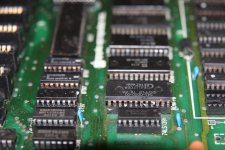
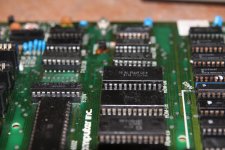
was looking at it after 1hour of cleaning trying to get that goo  off  - noticed allot of rust on many of the chips

decided to start taking them out and give a pins a gentle rub to clean them up......first chip and 3 of the pins broke off still in the socket - moving the chip in my hand and more fell off

tried another..1 pin broke off

74ls153 was the first - the socket was rusted too - took off the socket housing and the contacts  within the housing are grey or brown with rust

should of just bloody plugged it in before i decided to go 'cleaning'!!!

i can replace them - dam slow job - wondering if it is worth wile now

just look at the state of the pins..........there must be hundreds of broken contacts on that board

DAAAAAAAAAANNNNNNNNNNNNNNGGGGGGGGGG!!!!!!!!!

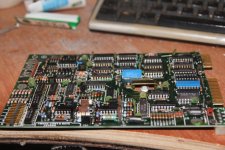
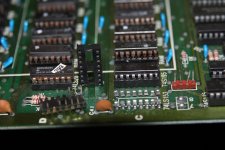
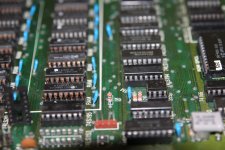
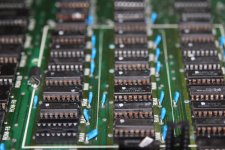
a.JPG

b.JPG

c.JPG

d.JPG

e.JPG

 
looking at the first pic.....i have a plan

this is hacked apple.......so might be able to do a bit of DIY repair.

I can solder the chip back on with the plastic housing removed....pin by pin..straight on to the contacts

the broken missing pins i can use a bit of a leg of a cap to jump the gap

a jasus...i have to go asleep ... this is nuts man

SANTA.....BRING ME AN APPLE II WITH SHINY PINS..... AARRGGGHHHH!

GOOD LUCK PEOPLE

 
Last edited by a moderator:
Whatever happens by the end of this project, I hope to be among the first to purchase a signed copy of "Rust, Goo & Busted Caps: My Apple II-Fueled Descent Into Madness by Falen5"

 
good man huxley!!

any opinions on the motherboard people.......is it a gonner!!
I think, you should re-solder each rusted contact, to almost completely exclude rust from motherboard. I think, if you will not do that, then it will be hard to diagnostic it later when you will try to turn it on and if it will not turn on the first try.

Also, if you know how to test these chips, it will be a good idea to do it while they are dismantled from the motherboard. I suppose, some of them may be broken? Really, you need to look how far corrosion goes. I hope, not too far.

I can solder the chip back on with the plastic housing removed....pin by pin..straight on to the contacts
Completely remove? I don't think it's a good idea. Maybe cut up (with a rasp) the plastic up to not corroded contacts and use thin wires instead original legs?

 
Last edited by a moderator:
Dunno, I think I'd remove all the sockets/solder and put in new ones. Reinstall the sockets AFTER giving the board a thorough going over with every cleanup trick the gang can give you. While at it, check for continuity on all traces you can see while you have the chance to do so. Then install new sockets. Outright replacement of the sockets and that batch of '74LS logic won't be very expensive. Do further testing with mostly all new, known good components.

 
Thanks lads - there will be no easy short cut out of it. Getting the motherboard to work is going to be a dam nightmare

should of just left it and tested it before i pulled the chips

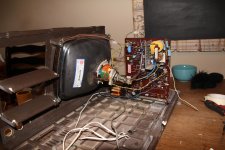
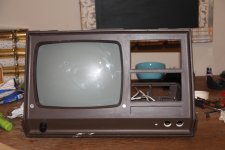
today i repaired the broken plastic dowels for the screen and remounted the screen and analog board

I have learnt that the screen is not the screen from the original  Iskra Delta Partner. This screen fits the curves of the case perfect, but the 4 atachment metal tabs/ holes that screw the screen in situ did not line up

Thats why they all 4 were cut. I thought when the machine must of been  dropped in the past and the screen broke free that the 4 metal tabs had litterly ripped apart. They were cit to bend the 4 tabs to line up with the mounting holes.

anyway - it is all back in and solid.

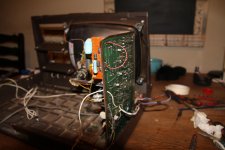
There are 3 small circuits hacked onto this analog board. check all i can see for shorts etc etc. Whoever built this must of really knew electronics. Any writing I have found so far on it is all in english so I dont think it was created in yugoslavia  - who knows!! 

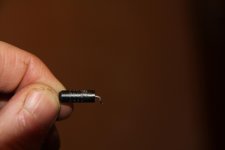
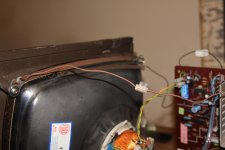
question.....on the back of the crt there is a long spring. I have it running across the top of the crt. Where am i supposed to run this spring- as it is? up/down?, diagonaly?

what is it for anyway??

I have cleaned the board. Cant see any bulging caps, cracked solder. Checked with the pictures i took that everything is wired as it was when i first opened it

Im going to power it up in a while - get the camera rolling for the much anticapated explosion!!

if anyone is looking at this could you please have a look to see if i have done anything stupid before i power it up

If this works ill keep going..........if it blows up......so will I , and ill hit the beer

cheers people

IMG_8487.JPG

IMG_8488.JPG

IMG_8489.JPG

IMG_8490.JPG

IMG_8491.JPG

IMG_8492.JPG

 
Last edited by a moderator:
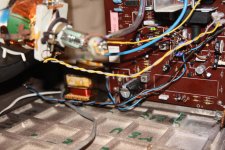
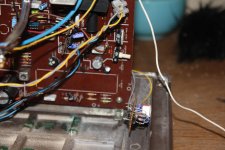
That monitor was an old black and white TV chassis. I can tell by the flyback transformer, they used some custom circuits by the flyback likely to tap off an additional voltage for something added. And then, you can see where the tuner was and it was removed. The little circuit board in the middle is probably a modification to allow composite video instead of IF stage. 

Yeap, someone had some fun! 

 
Last edited by a moderator:
I vaguely want to look up the SAMS manual for the Radio Shack TRS-80 model I and see if it's possible those are the guts from a Trash-80's monitor. (Which was literally TV with the tuner ripped out. The front bezel of the case had holes for the VHF/UHF knobs under the plastic nameplate they tacked on.)

 
... Wait, I forgot the point. Reason it has me curious is Radio Shack used a cheap hot ground TV with no isolation transformer, and instead of adding one for safety (which was kinda a concern when you have wires running to something with a keyboard) they opted to use a high-speed optoisolator on the composite input. Said isolator lived on a little satellite board...

 
Techknight - all you say makes sense - i was lost with the 3 custom boards wired into the analog board - cheers mate.

Gorgonops...i could lie and say i understand what you said ... but man i have no idea.......however I do know that you know more about this stuff than me so I accept all you say.......fair play man

truly apreciate all comments from all....im flying in the blind here people with basic knowledge

heres a vid of the repair of the 2 damaged lugs for the monitor screen supports..........long ass vid,,,, but maybey of some use to someone

 
Last edited by a moderator:
Back
Top