Figured I'd post some notes here instead about options I tested for cooling a 68040 rather than derail another thread.
Per the 68040 datasheet, a heatsink and/or airflow is essential for cooling the 68040 at almost any speed, with some LC models or low frequency models getting a pass. FWIW, I found that a ridiculous amount of airflow was required to keep an OC'd 68040 stable without a heatsink: I think it's safe to say that a heatsink should always be employed if possible.
Heatsinks
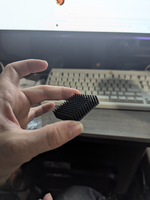
1: Heatsink-only: Generic 45x45x10mm

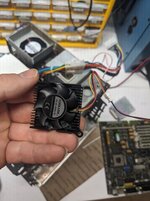
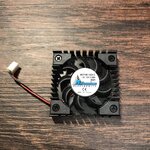
2: Heatsink-Fan: Cool-Cox VC-AL4009(LE)

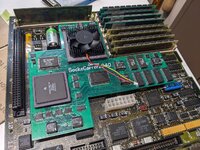
3: Heatsink-Fan: Adda AP4512HX/MX/LX, AP4505HX/MX/LX
Thermal interface options
Thermal paste
Best option, however requires mechanical attachment. Extreme mounting pressure isn't needed, we're not needing to get rid of tens or hundreds of watts here. Simply a heatsink floating on paste was enough to keep things stable for me. It may be possible to apply thermal paste in the center of the heatsink, with some dots of thermal adhesive/or just glue in the corners to keep in place while still being non-permanent.
Thermal glue
One of the better options, but don't plan on removing it without a fight. For that reason I'd personally prefer to never use it...
Thermal pad
I haven't tested on a 68040, but as these are generally not self-adhesive there's not really a point over paste in this application.
Thermal tape
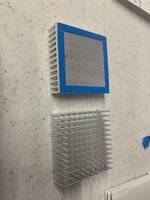
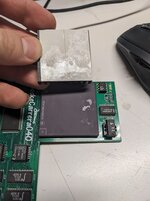
I tried mounting the first heatsink with some cheap thermal tape. The contact was absolutely atrocious as can be seen in this picture. That said, it did seem to be sufficient (with airflow) to keep things in check.
Better quality (and slightly thicker) tape might do better, but it doesn't seem to be easy to come by as compared to the cheap chinese crap I got off amazon.
Per the 68040 datasheet, a heatsink and/or airflow is essential for cooling the 68040 at almost any speed, with some LC models or low frequency models getting a pass. FWIW, I found that a ridiculous amount of airflow was required to keep an OC'd 68040 stable without a heatsink: I think it's safe to say that a heatsink should always be employed if possible.
Heatsinks
1: Heatsink-only: Generic 45x45x10mm
- https://www.digikey.com/en/products/detail/wakefield-vette/628-25AB/5068247
- I believe this is what most folks go for as the size is extremely common and can take a 40mm fan on top with self-tapping screws into the fins. Many similar options are available.
- Ought to be suitable for an 040 in most applications when not overclocking.
- I've attached a STL for some 3D-printable brackets that will clamp onto the side of the 68040 to mount.
- The supplied STL is good for this heatsink or others with around 2.5mm fin spacing and 2.5mm thickness on the base.
- it must be printed in ABS or other temperature tolerant plastic.
- PLA and PETG do not tolerate enough heat for use on a passive heatsink. PETG would probably be fan with a fan.
2: Heatsink-Fan: Cool-Cox VC-AL4009(LE)
- 40x40x11mm + mounting holes. Good for space-constrained scenarios
- Fun fact: OEM replacement for a slot machine's main board.
- Easy enough to come by from Ali* or Ebay.
- Comes with good quality non-adhesive PTM thermal pad.
- The mounting holes aren't immediately useful; I cut them off and instead put a border of thin thermal tape around the supplied thermal material.
- Haven't taken this off yet to verify good contact, but it's been good enough to keep it from reaching the temperature at which the 040 begins crashing
- Temps have measured fine with thermalcouple and IR temp gun, also.
- Runs silently at 5v, definitely audible at 12v. 5v speed is low - sufficient for additional cooling vs a heatsink but not enough to keep an OC'd 040 cool in the bowels of an SE/30.
- 12v + a ~60 ohm resistor brings the speed down somewhat and reduces the noise sufficiently to be masked by HDD/system fan in my use. 5v was too slow for stability when installed in the system.
3: Heatsink-Fan: Adda AP4512HX/MX/LX, AP4505HX/MX/LX
- Ideal for a space-constrained 68040 at 45x45x10mm. Radius rocket?
- These are somewhat harder to come by. Originally used on GeForce 256 cards, but still produced today.
- I got a 12v MX (medium-speed) model, this can be found on ebay or Mouser. It is somewhat loud at 12v, a resistor would be desirable to quiet it down.
- 12v model will run on 5v, however the speed is low. Similarly wasn't enough to keep OC'd 040 in check @ 5v when installed in SE/30, but might be OK in a Mac II.
- No thermal interface supplied. This can be mounted with thermal paste and a close derivative of the clips for the first heatsink.
Thermal interface options
Thermal paste
Best option, however requires mechanical attachment. Extreme mounting pressure isn't needed, we're not needing to get rid of tens or hundreds of watts here. Simply a heatsink floating on paste was enough to keep things stable for me. It may be possible to apply thermal paste in the center of the heatsink, with some dots of thermal adhesive/or just glue in the corners to keep in place while still being non-permanent.
Thermal glue
One of the better options, but don't plan on removing it without a fight. For that reason I'd personally prefer to never use it...
Thermal pad
I haven't tested on a 68040, but as these are generally not self-adhesive there's not really a point over paste in this application.
Thermal tape
I tried mounting the first heatsink with some cheap thermal tape. The contact was absolutely atrocious as can be seen in this picture. That said, it did seem to be sufficient (with airflow) to keep things in check.
Better quality (and slightly thicker) tape might do better, but it doesn't seem to be easy to come by as compared to the cheap chinese crap I got off amazon.