• Hello MLAers! We've re-enabled auto-approval for accounts. If you are still waiting on account approval, please check this thread for more information.

68030 and Counterfeiting?

dv-

6502
I was reading a thread about 68882 counterfeiting and was wondering if similar things happen with 68030 chips? (I would assume yes.)

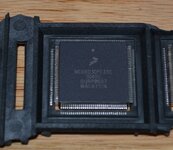
I got a couple 33MHz rated 68030s on eBay for like $7 each thinking I could replace the CPU on my IIsi and "overclock" it to at least the rated speed of the chip. But now I'm wondering if that's likely to fail. Does anyone have some insight on this?
 

Attachments

  • DSC_0188.JPG
    DSC_0188.JPG
    898.7 KB · Views: 34
Last edited:
I was reading a thread about 68882 counterfeiting and was wondering if similar things happen with 68030 chips? (I would assume yes.)

I got a couple 33MHz rated 68030s on eBay for like $7 each thinking I could replace the CPU on my IIsi and "overclock" it to at least the rated speed of the chip. But now I'm wondering if that's likely to fail. Does anyone have some insight on this?

Yes, it absolutely happens (even more so) with CPUs. I wouldn't trust any QFP sourced from a random ebay seller to be what it actually marked as. That particular one looks remarked; that mask is invalid and the date code likewise doesn't make sense. Usually these chips are in fact *a* 68030, but the age/mask of the chip is completely random.

The CPU in your IIsi should be one of the earlier masks which IIRC had a top rated speed of 33mhz. Mine has a 3C43C mask chip. Pretty sure the rest of the system fails before you can hit that speed on the CPU. With 68030s, the maximum speed is dictated by the mask rather than the actual rated speed on the chip.

I should soon have an accelerator option for IIsi which will run at 60mhz, too :)
 
The CPU in your IIsi should be one of the earlier masks which IIRC had a top rated speed of 33mhz. Mine has a 3C43C mask chip. Pretty sure the rest of the system fails before you can hit that speed on the CPU. With 68030s, the maximum speed is dictated by the mask rather than the actual rated speed on the chip.
I was under the impression that the speed of the CPU was controlled separately on the IIsi by its own clock chip? (I mean, I figured the PDS slot might be an issue, but the rest of the computer I assumed was uneffected.)

Do you know what other stuff is controlled by and/or messed up by the CPU clock chip?
 
What astonishes me is that there is a little man somewhere making fake chips for a living. Apparently…. How many people are still buying 68882s?
 
I was under the impression that the speed of the CPU was controlled separately on the IIsi by its own clock chip? (I mean, I figured the PDS slot might be an issue, but the rest of the computer I assumed was uneffected.)

Do you know what other stuff is controlled by and/or messed up by the CPU clock chip?

From what I recall everything but the video pixel clock runs off the 40mhz (/2 for 20mhz) clock. Video pixel clock can be either Portrait, VGA, or 512*384, which are the 3 other oscs.

So by increasing the 40mhz clock you are running ROM, RAM, SCSI, IO, PDS faster. 25mhz operation is a gimmie, it should always work since the chipset was designed to run that fast in the IIci. But PDS cards may or may not play at that speed depending on how their internal logic was designed, and once you go faster than 25 there's a possibility that other things stop working also. I suspect there are other threads detailing what starts going wrong at what speeds.

What astonishes me is that there is a little man somewhere making fake chips for a living. Apparently…. How many people are still buying 68882s?

*cough* ✋

From what I've heard, it's the thinking that "new" clean looking chips are worth more. The logic seems sound.... nobody wants to see a manky looking chip in their new product if they can help it.

For my use case, I absolutely need to know what die mask is used since early chips will not operate at 50mhz where later ones will. So, I'd rather have chips with some scratches that I can trust to operate at the required speed (0% failure rate so far) instead of a 35% failure rate as measured with a batch of 40 remarked chips. With that said, the failure rate of the remarked chips was dictated purely by mask of the chip; all that passed initial testing in turn all passed full burn-in testing, and I have no concerns that they will fail in the long run.

 
Does anyone have some insight on this?
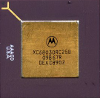
The funny thing to me is that they try and make a ceramic chip look like epoxy, with that textured top.

Try and wipe it with some acetone. Sometimes the original markings are still readable. It could be a 33MHz part, just an older mask.
 
I still need to update this with QFP data, but the masks should be correct here and match PGA as well as QFP:


That's all sourced from Motorola catalogs and process change notifications. I sadly haven't found a great source for dates, but if you find a mask that's not on that list, or date codes/printing that make no sense (like a late model Freescale with an extremely early mask revision), you can bet they're fake.
 
Back
Top