Follow along with the video below to see how to install our site as a web app on your home screen.
Note: This feature may not be available in some browsers.
Hello MLAers! We've re-enabled auto-approval for accounts. If you are still waiting on account approval, please check this thread for more information.
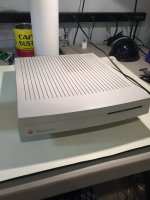
Just picked up a little project after recapping my Mac Plus. $30 on eBay. Stated working on the listing, but with the cap leakage, I didn’t want to press my luck until it was cleaned up. Once I have it up and running, I’ll need one of those monitors that goes so nicely with it.
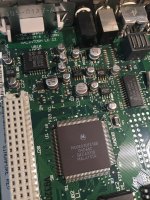
The leakage on your board surprisingly doesn't look too bad . I used to have both an LC and an LC II and the audio regions of both boards were pretty much destroyed.
I at least was able to salvage what was left of the traces. Only three came up to any degree. The reason it is so hard is all the cap crap caked on the solder is a big time insulator and sometimes it is hard to get the solder hot enough for a clean removal.
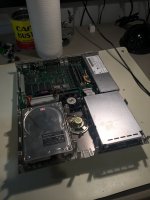
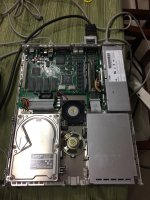
However, the re-cap worked: she is up and running. The SuperDrive needs to be cleaned, it can barely move. The HD is in good repair, and it started into System 7.1. 10 MB of RAM is installed. The HD is very sterile; not much is on there. The inside is almost dustless; either someone made a great effort to use this in a dustless environment, or it wasn’t used much.
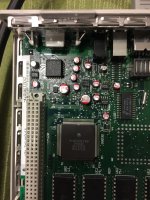
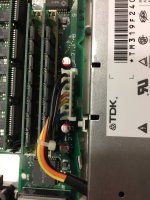
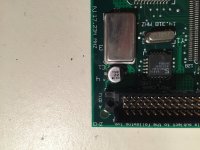
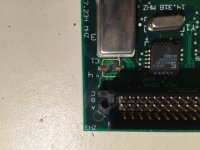
Below are the photos of the re-cap. I always wish it went better every time I do it, but I think it came out pretty well.
I know everybody has their own style but for a board with corroded leaky caps I have had way more luck with gently pushing down on the old caps and using a screwdriver to twist a little bit left then right and back and forth probably 50 times and then the cap comes off at the legs.
I tried two soldering irons, soldering tweezers, even ChipQuik but like you said the cap goo makes it very difficult to heat up the old solder. At the same time, the cap goo makes the capacitor legs very brittle and prone to breaking off. Since I started doing this I haven't lifted a single pad (prob 15+ machines) and it takes about 1/20 of the time.

Thanks for the tip. I think I will give that a go. I also got a tip from a guy I know who said to try and use hot air. I know those things are used for surface mount soldering in general...he suggested it could help with this as well.
Sorry. I just reread what I wrote. I meant pliers. Not a screwdriver, definitely not a screw driver. I twist it clockwise then counterclockwise (ie rotating) but just literally by fractions of a hair at first and then progrsssively more. I think the pads are strongest laterally and that's the direction force is applied by doing it this way.
Ive read with hot air there is a risk the cap could blow and you run the risk of making other nearby components too hot.
Well, I had a chance to use your technique last night.
after cleaning/lubricating the SuperDrive, I thought I’d take my IIe Card out and give it a go. Of course, I saw that thing also has two capacitors and they had leaked! Figures.
so, I got to try it out.
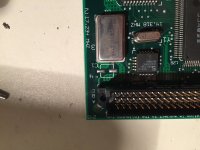
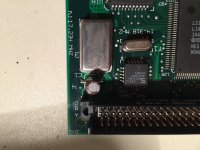
They twisted off crazy easily. You can see the crud that I managed to get off and resolder a few 22mfd caps I had around. It works great!
This site uses cookies to help personalise content, tailor your experience and to keep you logged in if you register.
By continuing to use this site, you are consenting to our use of cookies.