Ok, so for 2048x1536 we're talking >31 million pixels at 8-bit in 3MB
It's three million pixels, not 31. 2560x1440 is 3.6 megapixels, which is more. I'm not sure what resolution you're calling "2k" to get (what I assume you meant) 2.6.
ISTR computing the card would do 4k pixels in Black and White.
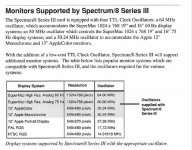
The card is known to be capable of driving a color "Two page" display @24 bit. That resolution is 1152x870, which gives you a pixel clock in the ball park of 110mhz. There's three bytes for every pixel, so our ball-park figure at this point is the circuitry on the card can push around 330mb/second. If we divide that by 60hz (let's use panel-friendly rates here) that means
in theory we could supply refresh for an 8-bit display up to around 2560x1440@60mhz,
as the pixel clock for that is "only" around 312mhz, and it's one byte a pixel. Obviously it's a problem that we don't have enough RAM to store the pixels, but whatever, the RAM subsystem might theoretically be capable if you ripped off the existing RAMDACs and replaced them with ones fast enough to do it. (And, probably, completely reworked all the rest of the card's ASICs, because I'm betting it does some interlace magic with the actual RAM to be able to push what it does with tech that old.) If you want to talk about monochrome, well, in principle at least if you're shoving those bytes into a shift register and clocking them out as a monochrome display you can achieve a resolution 8x that of what it can do in 8-bit mode, so, sure, let's do this:
The card in principle could do a three megapixel 8-bit display (2048x1532) based solely on RAM capacity. It can't actually do it because its RAMDACs can't push it (That's a pixel clock around 230mhz @60hz) but the raw RAM bandwidth seems to be there. That's 3,137,536 pixels. Theoretically that's 25,100,288 monochrome pixels. 8K Ultra HD is 33,177,600, which is too many, but we could theoretically push a "6k" resolution of around 6000x4000 pixels in monochrome @60hz from that framebuffer store. For the record, that would have a pixel clock just over two gigahertz. (I kind of suspect the wiring of a normal VGA cable isn't going to work too well for that, but, well, there you go.)
I think they use 3 RAMDAC because they need one for each primary color (Red, Green, Blue). A RAMDAC that does 256 values for each color would give you 256x256x256=16,777,216 colors (32Bit).
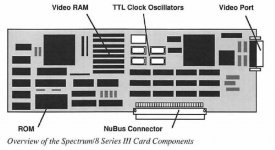
I'm not sure what the deal is. The "RAM" in RAMDAC refers to the palette register, which in the Bt453 is 256 twenty-four bit words, and each part has three eight-bit digital to analog converters for output. You'd have to have all three colors come from one one RAMDAC for the indexed color modes to work, so... that's why I'm speculating that they must be doing something strange like interlacing them to compensate for the fact that their pixel clocks are too low for the resolution the card is capable of. (According to the datasheet it's a 1987 vintage part.)
Looking up the manual for the later bt467/8 it says it supports a mode in which the RAM-part is bypassed and only a single output is used, IE, dumbing it down to a simple DAC, and in this mode it can be paralleled to do 24 bit color. Presumably a card fitted with three of those that supports both indexed and true color has the outputs switched so in indexed mode it runs everything through one while it uses all three otherwise. I'd say that's what the older card does (even though that mode isn't mentioned in the manual), but there's that clock-rate problem? Eh. The datasheet I have is dated 1987, maybe they updated the part to support the 110mhz-ish speed the card needs to do what it's spec'ed to do. If that's the case then forget the interlacing suggestion.
If the main crystal sets the clock lower than VGA's 60Hz output, wouldn't that give the RAMDACs the ability to output higher resolutions at lower frequencies? Is resolution necessarily tied to higher and higher refresh rates? It is in common use today, but was that necessarily the case way back when high resolution color and video standards were the wild, wild west? Medical imaging and CAD could have been done at glacial update pace/refresh rates given persistent phosphors on CRTs tuned for those tasks.
Sure, why not. You could re-engineer the card to display on one of those "permanent persistence" phosphors they used in devices like Tektronics terminals and take weeks to draw each infinitely detailed frame. (Or, well, the roughly 6000x4000 pixel grid you can get in B&W out of 3MB of RAM, see above.) I'm not sure why that's relevant.
Searched for a while for the manual with no joy. IIRC the card's virtual desktop resolutions were far in excess of 1600x1200.
Maybe you should plug this card in and refresh your memory as to what it actually does, you seem to be applying magical qualities to it. You keep describing it as if it's some amazing artifact of Atlantian technology decades ahead of its time, but it sounds to me like it's just an obsolete video card that happened to be high-end when it first went on sale.
Also, be aware of the fact that an arbitrarily-sized virtual desktop wouldn't necessarily have to reside in the RAM on the card. You can do the math yourself (I've already done it above) as to how many pixels would actually fit on it, that number is 2048@1532@8bit. But you could always just set aside an array of RAM in main memory, point quickdraw at that, and have your virtual desktop software use Nubus transfers to pull the active window into the card.






 ] I never realized that there is no dedicated IC for RAMDAC function, which makes me think it was a TTL monitor. It appears to be 74 series logic with the "RAMDAC" type function implemented in a few of what looks something like 9 PALs.