• Hello MLAers! We've re-enabled auto-approval for accounts. If you are still waiting on account approval, please check this thread for more information.

2k/QHD Vidcard for QS/MDD AGP? 2560×1440 or bust!

BT453KPJ66 ... Or not. ;-/
Not.

According the datasheet that part runs at 66mhz. If that's the effective pixel clock then the part would top out at XGA @60hz if it just had one of them. Since it has three and you claim it's capable of higher resolutions I wonder if it does some black magic to run them in some sort of interlace configuration. (Each part outputs every third pixel?) If that was the case then I suppose its effective pixel clock would be be around 192mhz. That's 1600x1200 @70mhz, barely.

 
I think they use 3 RAMDAC because they need one for each primary color (Red, Green, Blue). A RAMDAC that does 256 values for each color would give you 256x256x256=16,777,216 colors (32Bit).

 
I figured they were using one each for RGB or multiplexing the three channels of each RAMDAC to achieve very high resolution output at whatever bit depth and frequency necessary by this incredibly flexible card.

If the main crystal sets the clock lower than VGA's 60Hz output, wouldn't that give the RAMDACs the ability to output higher resolutions at lower frequencies? Is resolution necessarily tied to higher and higher refresh rates? It is in common use today, but was that necessarily the case way back when high resolution color and video standards were the wild, wild west? Medical imaging and CAD could have been done at glacial update pace/refresh rates given persistent phosphors on CRTs tuned for those tasks.

Searched for a while for the manual with no joy. IIRC the card's  virtual desktop resolutions were far in excess of 1600x1200.

____________________________________

Did find the manual and dedicated Panasonic NuBus card for their 1998 PanaPro M1900M2 bundle for the start of a fresh tangent. [}:)] I never realized that there is no dedicated IC for RAMDAC function, which makes me think it was a TTL monitor. It appears to be 74 series logic with the "RAMDAC" type function implemented in a few of what looks something like 9 PALs.

Silly Question: might something as simple as this board be reverse engineered and adapted to the SE/30 PDS for single bit 640x480 on the internal monitor? Is grayscale the Achilles' Heel of Compact video timing? Doing an end run to higher resolution might be worth looking into if that be the case?

Ok, I'm taking off the Dunce cap for the night now. ::)

 
Ok, so for 2048x1536 we're talking >31 million pixels at 8-bit in 3MB
It's three million pixels, not 31. 2560x1440 is 3.6 megapixels, which is more. I'm not sure what resolution you're calling "2k" to get (what I assume you meant) 2.6.

ISTR computing the card would do 4k pixels in Black and White.
The card is known to be capable of driving a color "Two page" display @24 bit. That resolution is 1152x870, which gives you a pixel clock in the ball park of 110mhz. There's three bytes for every pixel, so our ball-park figure at this point is the circuitry on the card can push around 330mb/second. If we divide that by 60hz (let's use panel-friendly rates here) that means in theory we could supply refresh for an 8-bit display up to around 2560x1440@60mhz, as the pixel clock for that is "only" around 312mhz, and it's one byte a pixel. Obviously it's a problem that we don't have enough RAM to store the pixels, but whatever, the RAM subsystem might theoretically be capable if you ripped off the existing RAMDACs and replaced them with ones fast enough to do it. (And, probably, completely reworked all the rest of the card's ASICs, because I'm betting it does some interlace magic with the actual RAM to be able to push what it does with tech that old.) If you want to talk about monochrome, well, in principle at least if you're shoving those bytes into a shift register and clocking them out as a monochrome display you can achieve a resolution 8x that of what it can do in 8-bit mode, so, sure, let's do this:

The card in principle could do a three megapixel 8-bit display (2048x1532) based solely on RAM capacity. It can't actually do it because its RAMDACs can't push it (That's a pixel clock around 230mhz @60hz) but the raw RAM bandwidth seems to be there. That's 3,137,536 pixels. Theoretically that's 25,100,288 monochrome pixels. 8K Ultra HD is 33,177,600, which is too many, but we could theoretically push a "6k" resolution of around 6000x4000 pixels in monochrome @60hz from that framebuffer store. For the record, that would have a pixel clock just over two gigahertz. (I kind of suspect the wiring of a normal VGA cable isn't going to work too well for that, but, well, there you go.)
 

I think they use 3 RAMDAC because they need one for each primary color (Red, Green, Blue). A RAMDAC that does 256 values for each color would give you 256x256x256=16,777,216 colors (32Bit).
I'm not sure what the deal is. The "RAM" in RAMDAC refers to the palette register, which in the Bt453 is 256 twenty-four bit words, and each part has three eight-bit digital to analog converters for output. You'd have to have all three colors come from one one RAMDAC for the indexed color modes to work, so... that's why I'm speculating that they must be doing something strange like interlacing them to compensate for the fact that their pixel clocks are too low for the resolution the card is capable of. (According to the datasheet it's a 1987 vintage part.)

Looking up the manual for the later bt467/8 it says it supports a mode in which the RAM-part is bypassed and only a single output is used, IE, dumbing it down to a simple DAC, and in this mode it can be paralleled to do 24 bit color. Presumably a card fitted with three of those that supports both indexed and true color has the outputs switched so in indexed mode it runs everything through one while it uses all three otherwise. I'd say that's what the older card does (even though that mode isn't mentioned in the manual), but there's that clock-rate problem? Eh. The datasheet I have is dated 1987, maybe they updated the part to support the 110mhz-ish speed the card needs to do what it's spec'ed to do. If that's the case then forget the interlacing suggestion.

If the main crystal sets the clock lower than VGA's 60Hz output, wouldn't that give the RAMDACs the ability to output higher resolutions at lower frequencies? Is resolution necessarily tied to higher and higher refresh rates? It is in common use today, but was that necessarily the case way back when high resolution color and video standards were the wild, wild west? Medical imaging and CAD could have been done at glacial update pace/refresh rates given persistent phosphors on CRTs tuned for those tasks.
Sure, why not. You could re-engineer the card to display on one of those "permanent persistence" phosphors they used in devices like Tektronics terminals and take weeks to draw each infinitely detailed frame. (Or, well, the roughly 6000x4000 pixel grid you can get in B&W out of 3MB of RAM, see above.) I'm not sure why that's relevant.
 

Searched for a while for the manual with no joy. IIRC the card's  virtual desktop resolutions were far in excess of 1600x1200.
Maybe you should plug this card in and refresh your memory as to what it actually does, you seem to be applying magical qualities to it. You keep describing it as if it's some amazing artifact of Atlantian technology decades ahead of its time, but it sounds to me like it's just an obsolete video card that happened to be high-end when it first went on sale.

Also, be aware of the fact that an arbitrarily-sized virtual desktop wouldn't necessarily have to reside in the RAM on the card. You can do the math yourself (I've already done it above) as to how many pixels would actually fit on it, that number is 2048@1532@8bit. But you could always just set aside an array of RAM in main memory, point quickdraw at that, and have your virtual desktop software use Nubus transfers to pull the active window into the card.



Last edited by a moderator:
You can do virtual desktops by dumping whatever does not fit in the VRAM onto main memory. Doing this means if you yank the cursor from one side of the virtual screen to the other it will stutter when it needs to load the screen parts from main RAM over whatever bus is used. Some of the Supermac cards with GWorld RAM used that extra RAM not for higher resolution or color depth but for storing stuff that would not fit in VRAM (virtual desktop for example) with instant access. You might as well call this VRAM cache and it never caught on since VRAM prices came down as density came. Load a very large picture scan into Photoshop (that supports Gworld) and pan around it and it is smooth.

I find it funny we went from digital output (CGA) to analog because of the need for more color depth and pixels eventually ditching RGB all together (new video cards don't have RGB output) for digital output.

Refresh and resolution are two different things Trash. If the RAMDAC could not output the frequency you wanted at a specific resolution you could just refresh every other line cutting the load in half. Of course on a analog CRT you ended up with flicker because your eye could see this going on and it gives you a nice headache. Too low of a refresh and things start to look like a slideshow. Run the RAMDAC to its max or have a shitty RAMDAC design and you end up getting the refresh and resolution you want but the screen output looks like crap (try running an old S3 card at high resolution and refresh and see what I mean. Cut the color depth and you end up with color banding.

Newer video cards that keep everything digital have an easy time cutting out the RGB DAC and just have to refresh the LCD screen at 60 or 120Hz. Granted you end up having issues when the output of the card and the processor on the LCD panel give or get data out of order and you get screen  tearing.

 
Dunno, brain's apparently not working at all if I was off by an order of magnitude. In my defense, the 1980s era Radio Shack Calcatator sitting here hasn't got commas. Told you I've had my dunce cap on!

Not saying it's an artifact from the depths of Atlantis, just that it's an amazing, incredibly flexible Video Card from the dawn of really high resolution time. I'll re-open that thread and maybe this time someone can help me with translating the official VESA timings spreadsheet into the input format for the control panel in the lower right.

View attachment 16458

ISTR the inputs are for 640x480 as I was setting up to do 1600x1200. No idea why the WP window says Spectrum/24 III, probably had the dunce cap on then too. Gotta get the multisync crystal, I was hoping to order two or three others from the resolution "spreadsheet" output specs.


There are a few revisions of the Supermac Spectrum/24 cards and from LEM guide to Nubus cards they only do 1024x768 max.

 
Indeed, that's the case of the original Spectrum/24 with the stock 64MHz crystal that sets it up for SuperMac's 19" Monitor. But the SuperVideo Control Panel below suggests something else:

View attachment 16366

Whether the card can spit all or some of those pixels outta its backside remains to be seen, but I'll bet it's a damn sight better than 21" resolution. It seems stuck at 1536 rows, but that 2048x1536 number is what G quoted as the 16bit maximum resolution for 3MB VRAM. 4096x1536 would be over 6 Megapixels at 8-bit, or would that be four bit per inverse squares? Heck, Black and White would rock if it weren't pie in the sky. But 2560x1440 would do. Perchance to dream  .  .  .

As I said, later cards in the series were targeted at DTP on the Mac, could they have been streamlined (less capable) versions of the original card in the series? I can't imagine they weren't a lot more economical to produce.

"Vanilla" Spectrum/24 and ROM 1.0 are mentioned nowhere I've ever seen.

 
Last edited by a moderator:
http://vintageapple.org/macbooks/pdf/SuperMac_Sopectrum_8_Series_III_Users_Manual_1989.pdf

You will notice those higher resolutions are for virtual desktop ONLY. The difference between the /8 and /24 is RAM and therefore color depth. 1024x768 Max like I said before. 


If it's this card that Trash has instead of the later "Thunder/24" then that's convenient, because a 64mhz clock is enough for Supermac's 1024x768@60hz monitor and the objection about the pixel clock being too high for the DAC goes away.

Also, to quote the manual:

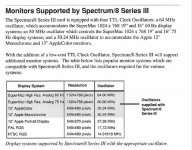
Since larger Virtual Desktops are calculated and stored in the video memory of the Spectrum/8 Series lll, a large Virtual Desktop will mean that you will be able to display fewer colors (or shades of gray). The chart below compares the various Virtual Desktop sizes, and the maximum number of colors (or shades of gray)  available for each size...
In other words:

Whether the card can spit all or some of those pixels outta its backside remains to be seen, but I'll bet it's a damn sight better than 21" resolution.
Like I painfully pointed out, if the virtual desktop is stored in the card's memory, which it apparently is, its maximum size at 8-bit on the 3MB card would be 2048x1536. It theoretically could be freaking enormous at 1 bit (IE, if it's limited to 1536 the resulting width would be 16536 pixels), but I doubt it is since your screenshot of the controls shows the maximum size the same as it is on the 1MB card. If it's limited to 4096x1536 then the max depth would be 4 bit. Why not plug in the card and see?

In any case, there is *ZERO* reason to think this has anything to do with how much it can "push out the backside". We know how much it can push out the backside: it has DACs limited to 66mhz, which is 1024x768 at 60hz. Color depth doesn't matter, that's the pixel clocks your DACs handle. My theoretical idea of using the available memory bandwidth to push out a freakishly high mono (or lower color depth) would rely on replacing those DACs with shift registers that would clock out multiple pixels on a single tick of the existing memory system. (IE, essentially double-clocking it.) The existing hardware simply doesn't have the headroom you're imagining it does.

Here is a modeline calculator for you to play with. Go ahead and stick different resolutions and refresh rates, and keep in mind that anything that results in "pclk" higher than 66mhz is out of reach. That is a *serious* limitation. You can't even get to 1600x1200 @60hz interlaced with that hardware, assuming you could find a monitor that would accept it.

 
Last edited by a moderator:
The existing hardware simply doesn't have the headroom you're imagining it does.
Let me expand on this a little more. Hardware virtual desktops like this were supported on a lot of SVGA cards back in the day too; I ran Linux on a 486 laptop with a puny 640x480 display back in the stone age and Xfree86 supported a hardware virtual desktop mode that let me pretend I had 800x600 to work with. (In the early 'aughts I also used to do a 1600x1200 virtual desktop on my Pentium III Dell laptop that only had a 1024x768 LCD; I had a CRT monitor on my desk at work and I could semi-reliably switch between virtual on the panel and physical on the CRT if I crossed my fingers and prayed while hitting the hotkey.) How they work is you have the contents of a large framebuffer stored in VRAM (and again, this can be an arbitrarily sized framebuffer up to the capacity of the RAM on the card). Meanwhile the "CRTC" section of the video card (IE, the address generation circuitry that counts sequentially through RAM addresses and latches the DAC to actually output pixels) is set up so the "Viewport" it's displaying is offset from the horizontal and vertical origin of said virtual framebuffer. (IE, instead of counting from address zero in the FB on line one, jumping to zero+line length on line two, etc, it counts zero+Voffset+Hoffset+(physical line length*physical line number) for every line) So while the computer that's updating the display sees the whole enchilada the video hardware only worries its pretty little head about the pixels that are actually needed for the physical video mode. Scrolling around this virtual desktop has essentially zero bus or CPU overhead because all that's necessary to scroll the desktop is a quick update of the register that stores the viewport offsets.

In other words, the only additional capability necessary for a card to support virtual resolutions of arbitrary size is the addition of a viewport register. That's it. The fact that this card supports these huge virtual resolutions (at correspondingly lower color depths) says *absolutely nothing* about how capable is it of driving real monitors. Zero.

 
You can do the math yourself (I've already done it above) as to how many pixels would actually fit on it, that number is 2048@1532@8bit.
Oopsie, got that wrong in my last, I said 16bit. G, it makes sense to me that a single RAMDAC at that frequency would be limited to 1024x768, but would three of them working together have that same limitation or are you already taking that into consideration?

@Unknown_K thanks for the manual link, three things about it.

One:

Spectrum8-III-00.JPG

That last is a list of popular cookie cookie recipe resolutions/oscillators. I didn't see a limitation to 1024x768 anywhere in the manual.

Two:

Spectrum8-III-01.JPG

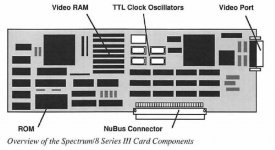
My card has a radically different architecture than any pics I've seen of the series and the one in this diagram. My card has three ASICS next to three RAMDACs. Looks like there's but one RAMDAC on that card as was the case in the 24/III IIRC. Got cards with specs on the later RAMDAC parts? Maybe it only takes one to do better?

Three:

View attachment 16458

The other screens in the SuperVideo drivers are shown in that manual, but the timings spreadsheet for calculating the required oscillator for any given resolution's timings is nowhere to be seen.

Can't play with the card until I get more crystals and I won't know what values I'll need for higher resolutions until somebody helps me massage the VESA spreadsheet's calculations to fit the input box on the lower right. Not saying the card's a silver bullet, but I am saying that it appears to be a lot more flexible in terms of supported resolutions than the later versions given that magical crystal divining window.

Or not.

edit: I've been trying to get this posted while you made two posts, G. Sounds like it's my wishful thinking that the three RAMDACs working in unison might do better at getting more than 1024x768 at lower bit depths out the back end.  :mellow:

 
Last edited by a moderator:
Oopsie, got that wrong in my last, I said 16bit. G, it makes sense to me that a single RAMDAC at that frequency would be limited to 1024x768, but would three of them working together have that same limitation or are you already taking that into consideration?
I have already taken that into consideration. The RAMDACs are 8 bit (max) devices. When running in an indexed mode (8 bit or less) it uses one of them so it can use the palette register, while when running in 24 bit mode it dumbs them down into simple 8-bit DACs and uses one for each color. The same 66mhz (or 80, if that's an option on your card) pixel clock limit applies either way. And that limits you to 1024x768-ish resolutions. Period. (Or, as I suppose, you could potentially try doing weird oddball interlaced slow-scan modes on long persistence monitors, but that's not going to change your horizons that much.)


My card has a radically different architecture than any pics I've seen of the series the one in this diagram with its three ASICS next to three RAMDACs. Looks like there's but one ion that card as was the case in the 24/III IIRC
The manual UnknownK pointed out is for the 8 bit one. 8 bit==indexed modes only==only needs one RAMDAC.

My guess is that the reason your card has three of everything is that from a technical standpoint it's basically three of the 8-bit cards glued together. I'm curious if it actually supports greater bit depths at given resolutions than the 8-bit one for the virtual desktops because I think it's very possible the RAMDAC that handles the indexed color modes can only directly access one of the three MB of RAM. (That would have been the quickest/dirtiest way to do it.)
 

Not saying the card's a silver bullet, but I am saying that it appears to be a lot more flexible in terms of supported resolutions than the later versions given that magical crystal divining window.
No, it's actually sort of garbage compared to later cards that use programmable PLLs to generate pixel clocks instead of having to switch between a bank of fixed crystals. It is sort of cool it lets you swap them, though.

 
Last edited by a moderator:
Well I guess that's that then. As always, thanks for your patience and guidance in yet another learning experience.

Now about that Panasonic Card  .  .  . :lol:

 
Back
Top