• Hello MLAers! We've re-enabled auto-approval for accounts. If you are still waiting on account approval, please check this thread for more information.

Baby's first PCB

Do you know when this was introduced?
We don't have much version history for the ROMs/Toolbox and its a little hard to track down actual timeframes since the System file will replace the ROM code in most cases. The first machine I noticed it in was the Quadra 700/900 (1991) but that doesn't mean it wasn't in earlier ROMs. At a guess I'd say it's likely a System 7 addition.
 
So, I watched Action Retro's video where he installs a Performer in a Plus.
It doesn't play nice with his BlueSCSI. Has anyone else experienced problems when using the Performer in a Plus?
 
Last edited:
Yes. It never worked.

THREAD HERE
Sorry to hear the accelerator board never worked for you. That must be frustrating after all this time. For me, it's worked flawlessly in my Macintosh Plus. I even made a reshaped PCB that fit perfectly inside a Macintosh 512K, and that setup also worked as it should. The BlueSCSI works fairly well too.
 
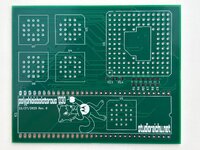
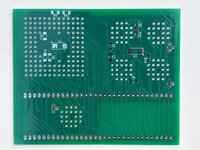
PCBs have arrived. I made a few small changes since the last time I showed the design.
JLCPCB made five of these for $2.07 and shipped to USA for $9.19
IMG_0895.jpeg
IMG_0896.jpeg
 
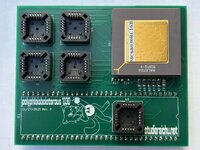
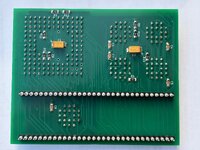
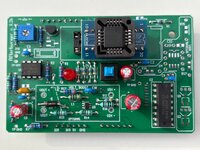
Upgrade almost fully assembled...
ASSY-NOGAL-1.JPG
ASSY-NOGAL-2.JPG
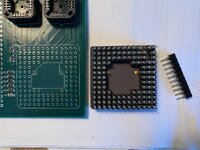
I didn't buy a PGA-128 socket for the 68030, instead I used several machined pin headers.
ASSY-CPUHEADERS.JPG
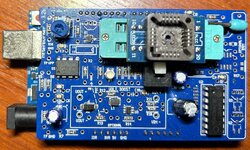
Just waiting on GALs because I also built a GAL programmer for Arduino, but it doesn't identify any GALs inserted and I don't know why.
AFTERBURNER1.JPG
 
Upgrade almost fully assembled...
View attachment 93396
View attachment 93397
I didn't buy a PGA-128 socket for the 68030, instead I used several machined pin headers.
View attachment 93398
Just waiting on GALs because I also built a GAL programmer for Arduino, but it doesn't identify any GALs inserted and I don't know why.
View attachment 93399
afterburner.jpgWe both have the same PCB revision! This is what I’ve been using to program the GAL and ATF chips for the Performer. Were you able to complete the calibration procedure?
 
View attachment 93403We both have the same PCB revision! This is what I’ve been using to program the GAL and ATF chips for the Performer. Were you able to complete the calibration procedure?
Yes. I fixed the Afterburner, it was a problem with the on/off switch. I bought the wrong type of switch from DigiKey so I substituted another harvested from an old fax modem but it didn't function exactly as expected. The switch was connecting VPP to the wrong pad so I soldered a bodge wire and it works now. I've just burned all five GALs. They're ATF16V8Bs, have you tested them?
 
Yes. I fixed the Afterburner, it was a problem with the on/off switch. I bought the wrong type of switch from DigiKey so I substituted another harvested from an old fax modem but it didn't function exactly as expected. The switch was connecting VPP to the wrong pad so I soldered a bodge wire and it works now. I've just burned all five GALs. They're ATF16V8Bs, have you tested them?
Yes, I've used 15 ns chips with no issues
 
My GALs are also 15ns. I just tested the upgrade card in my Macintosh Plus and it does work.
The only problem is that it's very hard to mount on top of the 68000, I can't even push it in all the way. There's a lot of resistance.
I soldered a machined pin socket on top of the 68000, and machined pin headers on the Polyphloisboisterous '030.
 
My GALs are also 15ns. I just tested the upgrade card in my Macintosh Plus and it does work.
The only problem is that it's very hard to mount on top of the 68000, I can't even push it in all the way. There's a lot of resistance.
I soldered a machined pin socket on top of the 68000, and machined pin headers on the Polyphloisboisterous '030.
Yeah, the LB doesn't slide in the usual way! Try fitting one side in first, then use a screwdriver to slightly pry the other rail out until that side seats properly. It’s a bit of a tight squeeze, but it should snap in.

This vid shows how to do it at 23:00


Oh! You mean your board can´t actually be seated as low as you expected! My mistake, I got a bit confused there.

I would desolder the machined pin headers from the board, plug them into the socket first, seat the board on top, and then solder the headers in place. This should allow you to achieve a much more precise fit.
 
Last edited:
I think that the round machined pin headers are too large in diameter. I'll try to desolder them and replace them with buss wires.
 
These machined pin headers are the ones I use for my accelerator prototype boards. The larger side is soldered to the board. It fits nicely into the 64-pin socket on top of the CPU!
mpinh.jpeg
 
We know GAL 7 is a clock doubler, but can it be modified to be a clock quadrupler?
A stock Plus runs at 8MHz, so times four that's 32MHz
Even if so, Performer's timings likely won't support CPU at 32Mhz. @Bolle tested for me when we were cloning my Performer/Plus. I had the same crazy notion, but for the SE. It has the Slot Manager required 16Mhz reference clock on its PDS. Plan was to run that thru the stock GAL7 to get up to 32Mhz.

No go for that, but maybe your approach might work out? Directly coupling a 4x multiplier version of GAL7 to the 68000's 8Mhz clock might just fix the timing issues? Bolle, whatcha think? WAG here is the extra phase lock loop cycle(?) will bork timings as well?

What I'd truly like to see is an SE version of Performer that extends to the back of the case as Radius implemented it on Accelerators and the simple Magic Bus Card. Performer/SE with TPD compatibility would make a formidable combination! Major hurdle there is the connector. Might have to be harvested from a Magic Bus Card? Ridiculous thing that.

Love your work!
 
Last edited:
DSACK timings that work for an 030 at 16mhz will cause spurious acknowledges at 32mhz. There are other potential issues, but that would be the biggest one. While solvable it wouldn't be worth the effort. Real world performance is going to be limited badly by the lacklustre memory bandwidth (16 bit at 8mhz). At one point I evaluated 3x and 4x multipliers in a LC accelerator and there just wasn't any worthwhile improvement past 2x when you're stuck with a half width bus.

Cache SRAM or local DRAM would be required to get the next notable improvement to performance.
 
Cache, on board memory and faster clock were features on the higher tier Performer models.

Thanks much for explaining the source of the problem! @Bolle never told me that it was a problem with DSACK.

I'll bounce this pipe dream off you right here: might the Performer be miniaturized into a 16Mhz 68030 Processor Card for the PowerBook 100? Would the same speed 030 swap itself make for enough of a speed bump to matter? pb100'S 8MB of memory at 16MHz might make it interesting? It should at least run 030 code, no? That would open up some software, maybe even OS upgrade doors I'd think?

 
Last edited:
Cache, on board memory and faster clock were features on the higher tier Performer models.

Thanks much for explaining the source of the problem! @Bolle never told me that it was a problem with DSACK.

I'll bounce this pipe dream off you right here: might the Performer be miniaturized into a 16Mhz 68030 Processor Card for the PowerBook 100? Would the same speed 030 swap itself make for enough of a speed bump to matter? pb100'S 8MB of memory at 16MHz might make it interesting? It should at least run 030 code, no? That would open up some software, maybe even OS upgrade doors I'd think?

You don't need to use anything of the performer there: most of what it's doing is dealing with the clock doubling and I think dynamically slowing certain accesses that would otherwise upset the early hardware. In the powerbook, I bet you could just put the 030 more or less directly on the 16mhz bus, you will need some trivial logic to deal with VPA and DTACK into DSACK1 to signal a 16 bit port. Generating an E clock may also be needed, if that's used. Most else follows pretty directly from there. An extension would be needed to do some very basic MMU and cache initialization, similarly to other 030 accelerators for the 68000 machines.
 
Back
Top