• Hello MLAers! We've re-enabled auto-approval for accounts. If you are still waiting on account approval, please check this thread for more information.

IIci and Daystar Turbo 040

Bolle

68020
I picked up this IIci yesterday after seeing it listed on ebay for local pickup.

Drove 300km to actually get it. The listing had one photo with the case opened and something that was not a cache card was sitting in the cache slot - obviously a Turbo 040 right there. }:)
I jumped right on it and got it even though it does not seem to turn on according to the seller. Could only be either cap, the trickle voltage issue with the PSU or both.
 
First things first, the case is in a pretty nice condition. Little yellowing and no scuffs or marks on the outside. All four rubber feets on there as well.
 
IMG_1499.JPG
 
It did not turn on as the seller stated so I took it apart and found the caps to be gone obviously. I measured the PSU and 5V trickle is there, so lets deal with the caps first.
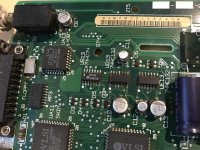
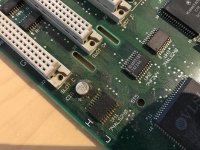
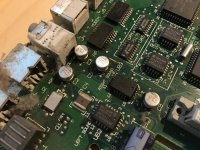
Together with the dust that built up over time things did not look very pretty on the inside:
 
IMG_1481.JPG
IMG_1482.JPG
IMG_1483.JPG
 
Some trace rot was visible right away. Removed all caps and gave the board a soapy bath.
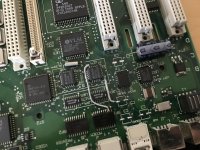
I buzzed all traces that looked sketchy and found two broken ones. One was obvious already from just looking at it. Also heavy rot on the edge and under one of those resistor packs.
 
IMG_1489.JPG
 
Fixed:
 
IMG_1493.JPG
 
 
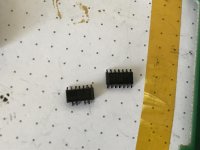
On the other end of the board near the power on circuit there was heavy rotting going on as well. Removed two 74s that did not look very healthy. Indeed they were not as they fell into pieces when removing them:
 
IMG_1494.JPG
 
I ordered two new 74hc132s to replace the broken ones and put on new caps already. Waiting for them to arrive now to actually see if the board works at all.
 
 
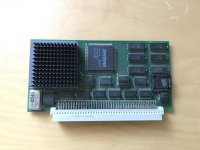
The most interesting thing about the machine was of course the Daystar Turbo 040 that I spotted on the pictures of the listing:
 
IMG_1496.JPG
 
Seems to be a 40MHz model judging by the 20MHz oscillator but only has a 33MHz 040 in it. Didn’t know Daystars accelerators were factory overclocked.
 
As an extra the Mac had a Radius PrecisionColor 24XP in it. Nothing special and probably is going to be replaced by something with at least two DSPs :p
It is going to get Ethernet and an ATTO SEIV along with a fast drive for some ultimate 040-powered System 6 fun.
 
But first I am going to have to wait for the 74s I ordered to get this little thing running at all.


The long term plan may be to put the Daystar into my SE/30 in case some adapter magic happens in the future ;)
 
Sweet find! That heat sink looks as if the proc came off a Radius Rocket. Is that sink common to the Turbos? Replacement of a borked CPU could explain the overclocking.

Heh! That "magic" might be better described as alchemy, which is in the works. It'd be nice if some real magic took place and an adapter appeared out of thin air for you  .  .  .  preferably without the puff of smoke.

 
Last edited by a moderator:
Sweet Find! The extra cards inside are perfect. The feet are just icing on the cake! 

Hopefully the recap will resurrect the old gal. I just got a Iici earlier this week, so I been learning all about the cap/trickle problems. Mine had small amounts of gunk, so i am hoping a quicky recap job is all that is needed.

re:Daystar - That heat sink is standard and the processor speed is normal in final hardware revision. I was thinking about getting a Freescale 40mhz to replace the one I have so that it would run cooler sans heatsink in my SE/30 so that I could recycle the heatsinked 33mhz in my 575. 

 
Fantastic find. Especially the newer ASIC based Turbo 040. All but one of mine are the old many-PLD based models with the cache on a daughter card. And the video card is pretty good. It is Radius's last generation of "consumer" video cards. Unless you're doing graphics work that the Quickdraw acceleration can take a bite of, I don't think a "professional" grade card will be a very noticeable improvement. Nubus and the old 68030 just don't have that much bandwidth compared to what displays can eat up.

 
Bolle,

Sweet gain on the Iici + Turbo.

I have been trying to get my Iici and Turbo 040 33mhz (just like yours) going too. While my mobo had less goo than yours and the usual power supply trickle issue, the IIci is working ok with a new refurb p/s (I blew the last one trying to 'hold down keyboard boot key and flip the power switch' too often!), it probably needs a recap. Alas, no luck so far with the Turbo 040 (despite getting a new 4.11 ROM a colleague on here in the EU provided me) so I will be watching how you go in earnest as I am not sure if it's a power or 040 issue with mine! Let us know how you go...

NB: I see that your Turbo 040 doesn't have a sticker on the ROM so it's not clear what version it is. You'll need a higher ROM (4.01+?) to work with System 7.5+ - so try booting in 7.1 first and use the relevant INITs / Control Panels to see what it is running.

 
I have a ROM programmer myself so I will update to 4.11 if it is not already on there. Might pop the chip from the card into the programmer later on and dump it to check the version and shorten the time until the chips for finishing the repair on the logicboard arrive.

My power supply does work - I just tested it in another machine.

@Trash: of course I have been silently monitoring your threads on recreating one of those adapters for some time now with great interest. I just do not have anything of value to add.

I could bruteforce and burn new GALs/PALs most probably though if I had to and could get my hands on something to play with.

 
Well then, we'll just have to get something delivered into your hands to play with for the project. [:D] ]'>

I haven't mentioned it, but I'm hoping the single 20 pin GAL16V8B on the Macintosh IIx Adapter will be a "Silver Bullet." Since the adapter has access to every signal on the 68030, there probably isn't any need for IIci Slot conversion gymnastics on the card. I'm hoping only the Address Mapping issues are rectified by the GAL in the simplest possible manner. I'm not holding my breath by any means, but the possibility tends toward at least a low to medium level of probability the way I see it.

If you're game, I'm good to go with your plan, PM me.

 
So the chips arrived but still no go. The board won't start either by pressing the power button on the keyboard nor using the button on the back.

I can turn on the powersupply by jumping +5 TRKL to /PFW. The speaker will pop and the power LED on the board turns on but there is no chime or anything.

When buzzing around I noticed that I am only getting around 16 Ohms between ground and +5V. I already checked ALL caps (including the ones I did not touch when recapping) on the front of the board again if there are any shorts.

I also desoldered all ICs that show even the slightest sign of corrosion to check if they shorted out internally but nothing. Resistance between 5V and GND stays at 16Ohms - measured with a digital multimeter btw if that changes anything. Getting a few kOhms between 12V and -12V to ground so I am pretty sure 16Ohm is not ok.

Measured voltages while it is "running" and got 4.91V, 11.9V and -11.89V - those should be ok.

Any further ideas?

 
Things went on, I can now turn on the Mac using the switch on the back or the keyboard switch. There were some more broken traces in the poweron circuit.

After turning on howewer it is still just sitting there... no chime, no video (onboard and nubus) - just a slight popping from the speaker when it powers on.

I saw the poweron circuit also connects to the RBV which also acts as VIA2 on the IIci. Is there anything else that should get some kind of signal from there to succesfully initialize?

No chime at all would usually hint me to lower address lines beeing broken somewhere between the ROMs and CPU but those seem to test fine. Does the chime take place before the MPU maps the ROM and RAM around or after? Looks like I have to go through all address and data lines all over the board... quite some work in front of me then. :-/

 
Bathing it in the kitchen sink using dishwasher detergent and scrubbing the areas using a brush on the board where cap goo did leak.

By the way I did still not yet get the board to boot. Still suspecting some issues with the bus traces to ROM somewhere.

I have gotten two other IIci´s in the meantime one of which had a maxcell bomb go off but I could rescue that one by repairing only two traces that go right under the battery holder. The other one only needed new caps and two new 74H132s in the startup circuit and is working nicely again.

Have been staring at the first board that turns on but does not boot for way too long now and put it into storage as a parts donor in case I ever need something from it.

The Turbo 040 is indeed a 40MHz one and is working great. It came with the 4.01 Firmware. Updated that one to 4.11 and set it up with 7.5.5. Could not yet get any of my two ATTO SE IVs to work at all in the IIci with either the 1.65 or the 2.1rc firmware. Will have to look into that again in the future.

 
Bathing it in the kitchen sink using dishwasher detergent and scrubbing the areas using a brush on the board where cap goo did leak.
I wonder if you might have better luck with isopropyl alcohol. It is apparently safe on logic boards.

If you are in the NY state area Louis Rossman is someone I would trust to fixing the board. https://www.rossmanngroup.com. Perhaps you have the skills required, I don't know but He has a youtube channel and he is very good at fixing boards. https://www.youtube.com/user/rossmanngroup/about

Wishing you much success! It's a nice machine the ci.

 
I run my boards through a bath with 99% isopropanol after washing them in soapy water as well. I am pretty sure I will get back at this board and get it to work some day. I just lost interest for now as I got another working IIci board in the meantime.

Also not even close to NY, so will have to go through it on my own anyways. }:) Not going to give the fun of fixing things up to someone else.

 
Last edited by a moderator:
Back
Top