Wanted: WGS95 PDS, Radius RISC, and MacII Video ROM Images

I was able to recently acquire a Workgroup Server PDS Card for my Quadra 950, but a previous owner of the card stole the 27C1024 ROM chip from the card.
Does anyone have a dump of the ROM from the card? It should be labeled 341-0957.

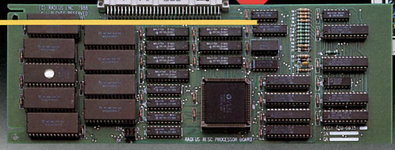
In the same batch of cards there was also a Radius RISC Processor board, again with every socketed chip removed, and a Macintosh II Video Card with every socketed chip removed. If anyone has ROM images for either of those cards it would help too.

Edit: Found a copy of the 342-0008-A ROM from the Macintosh II Video Card, though the card is still missing the PGA chip labeled TFB Controller.
 
Last edited:
The Radius card should be a QuickColor if you can find those ROMs. But without the ARM processor it's not gonna go far.
 
The Radius card should be a QuickColor if you can find those ROMs. But without the ARM processor it's not gonna go far.
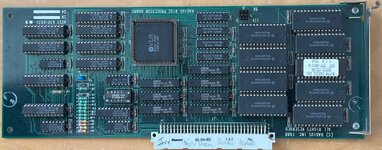
The Radius card is either a QuickColor or QuickCAD, and it is only lacking the GALs and SRAM chips. the ARM is still in it's socket.
Thanks Bolle for the WGS95 ROM, I'll burn it and hopefully bring that card back to life.
I still have no hope of finding a TFB chip for the Mac II Video card.
 
And some more...
Only missing the single GAL22V10 at U27 now which wouldn't budge to my cracking attempts so far.

Radius RISC Processor Board.jpg
 

Attachments

@Snial

Ever seen the card Bolle has posted? 12MHz ARM CPU on a Nubus card. I wonder can you get them to do arbitrary code execution? Be good for a hardware backed Acorn Emulator on classic Macs if you can :)

I believe it is a QuickDraw accelerator? If I remember there are two versions with different ROMs for accelerating different things though... Truth be told I have a terrible memory.
 
Ever seen the card Bolle has posted? 12MHz ARM CPU on a Nubus card. I wonder can you get them to do arbitrary code execution? Be good for a hardware backed Acorn Emulator on classic Macs if you can :)

I believe it is a QuickDraw accelerator? If I remember there are two versions with different ROMs for accelerating different things though... Truth be told I have a terrible memory.
I'm sure my memory is much worse! It's a 12MHz ARM2. It needs a MEMC chip to properly emulate an Archimedes, which it doesn't have. It looks like it's got a 256kBit ROM, which is 32kBytes (seems reasonable) and 256kBytes of video RAM.

Because it's written in 1988, it'll only support 8-bit Color QuickDraw. Maybe an Acorn Archimedes could be emulated directly if the ARM chip had access to the Mac's address space for that Nubus slot? Then the MMU on the Mac (even though it works in a totally different way) could provide a VM environment for the ARM? Though I suspect that's not possible either, because the NuBus slot will be on the wrong side of the MMU.

Let's assume it doesn't and the Mac has a second video card. Then we can use the video RAM as an ARM instruction/data cache and implement a JIT. The instruction set is fairly simple. ALU operations could be cached and executed as is. Branches to cached addresses would function as is. Some PC-relative loads would work. Load/Stores would have to be trapped with a SWI. The address part of a Load/Store is at least 16-bits, so that's a big look-up table.

Let's say most instructions operate at 12MHz, giving 6MIPs and Load/Stores at probably 15% of instructions take 50 cycles to emulate (vs 2 or 3 cycles on a real ARM). Then overall cycle time is (1/12)*.85+(50/12)*.15=0.696 or 1/0.696=1.437 MHz. OK, that's a pretty poor emulation speed compared with an actual Archimedes, but pretty good for emulation!
 
256kBytes of video RAM.
Looks like 64k of SRAM to me - and I don't think it would be used as VRAM because nothing would know to look there for the frame buffer. It would make more sense for the output from this card to be put in the video card's framebuffer, either by DRM / bus mastering, or by the host (hopefully the former).

OK, that's a pretty poor emulation speed compared with an actual Archimedes
Ah well, we'll just have to use it for decoding MP3s and decompressing CompactPro archives instead :)
 
Looks like 64k of SRAM to me - and I don't think it would be used as VRAM because nothing would know to look there for the frame buffer. It would make more sense for the output from this card to be put in the video card's framebuffer, either by DRM / bus mastering, or by the host (hopefully the former).
Oh, right. I assumed it had its own frame
buffer. But a standard 640x480 takes 300kB.
Ah well, we'll just have to use it for decoding MP3s and decompressing CompactPro archives instead :)
A few months back I was playing with MAME’s SparcStation 1 emulator, which runs in realtime. The SS1 (May 1989) had a 20MHz Sparc, with only a multiply step operation (32c (1.6us). A 12MHz ARM2 would perform a multiply in 16c (2.7us), just 40% slower. This means that graphics card would give a Mac II graphics performance roughly in the same ballpark as an SS1.

However the SS1 started out at about £7.4K diskless + mono display+8MB, maybe £8.5K with the Color display. A Mac II was $5.5K, but you’d have to add a colour card, colour display and this accelerator would, I guess easily take it up to about the same price, for half the graphics performance.

The Mac II would still feel much faster, the SS1’s SunView/Solaris 2 OS was sluggish & crude compared to System 6. It was really designed for crunching numbers: CAD or cutting edge R&D.

 
Oh, right. I assumed it had its own frame
buffer. But a standard 640x480 takes 300kB.

A few months back I was playing with MAME’s SparcStation 1 emulator, which runs in realtime. The SS1 (May 1989) had a 20MHz Sparc, with only a multiply step operation (32c (1.6us). A 12MHz ARM2 would perform a multiply in 16c (2.7us), just 40% slower. This means that graphics card would give a Mac II graphics performance roughly in the same ballpark as an SS1.

However the SS1 started out at about £7.4K diskless + mono display+8MB, maybe £8.5K with the Color display. A Mac II was $5.5K, but you’d have to add a colour card, colour display and this accelerator would, I guess easily take it up to about the same price, for half the graphics performance.

The Mac II would still feel much faster, the SS1’s SunView/Solaris 2 OS was sluggish & crude compared to System 6. It was really designed for crunching numbers: CAD or cutting edge R&D.


Looks like it was clocked at 10MHz.
 

Looks like it was clocked at 10MHz.
Weird. I thought that the clock input frequency on an ARM2 was twice the CPU frequency. However, they're right - a 10MHz VL86C010 can execute instructions at up to 10MIPs. The 6MIPs is only an average.

1776870910357.png

Unfortunately, Radius left the window on their EPROM uncovered, so the QuickDraw speed-up was 0%.

1776870986870.png
 
Weird. I thought that the clock input frequency on an ARM2 was twice the CPU frequency. However, they're right - a 10MHz VL86C010 can execute instructions at up to 10MIPs. The 6MIPs is only an average.

View attachment 97975

Unfortunately, Radius left the window on their EPROM uncovered, so the QuickDraw speed-up was 0%.

View attachment 97976
Especially if they used a Xenon flash :LOL:

I've considered erasing ROMs by stick welding next to them, but I found my eraser in the end. Still tempted to give it a go :)
 
Who are these people who strip these cards down for no good reason
:ROFLMAO:

There's always a reason to liberate an ARM CPU ;-) ! Anyway, perhaps there's another way (@Phipli ): Modify the ROM so there's a back door that lets you execute ARM code directly. My guess though is one already exists because it's the kind of thing developers would do.
 
:ROFLMAO:

There's always a reason to liberate an ARM CPU ;-) ! Anyway, perhaps there's another way (@Phipli ): Modify the ROM so there's a back door that lets you execute ARM code directly. My guess though is one already exists because it's the kind of thing developers would do.
Bolle was saying apparently there is very little in the ROM - it seems like code is loaded from the host as is. It already has a front door :) it's just not documented.

Sadly I don't own one to investigate 😞
 
:ROFLMAO:

There's always a reason to liberate an ARM CPU ;-) ! Anyway, perhaps there's another way (@Phipli ): Modify the ROM so there's a back door that lets you execute ARM code directly. My guess though is one already exists because it's the kind of thing developers would do.

It reminds me of the Muffin Top episode in Seinfeld or when Cartman eats the skin off every piece of chicken and Kenny starts crying
 
Back
Top