Recapped IIci intermittent clock counting

KI5NYZ

6502
IIci had very little corrosion and it was isolated to pin 7 of UE13. Cleaned the board and recapped with tantalums from DigiKey. Seller shipped with PRAM battery removed and there is no damage or evidence of the battery having exploded.

The clock was originally working, but now it just stays on the last set time, whether manual or NTP. Snooper says the RTC is working fine, and the set date/time is retained after power cycle or reboot. Using a fresh cr2032 in a MacBatt module.

The mac boots and runs fine. Soft poweron and shutdown/power off works fine. Have disabled all extensions except 'date & time, and alternately with just superclock enabled with no resolution. Google-fu says Y5 or the RTC may be the culprit.

Not able to measure Y5 for a few days. Is there anything else to check for?
 
AFAIK, whichever crystal is the 32,768hz one, in proximity of the RTC, is its clock source. If it's anything like the SE/30 and IIcx (I think the logic is almost identical but the pinout differs?) then the 1hz source, an interrupt, starts from a leg of that 8-pin RTC. It is completely possible to have it retain PRAM/time but not tick, if something is short/broken on those lines.

When the clock won't tick, does your cursor flicker at unexpected times out of sync with normal vertical blanking, even on an idle desktop? (Not counting applications that damage/repaint constantly and always have to do this, e.g. QuickTime MoviePlayer.)
 
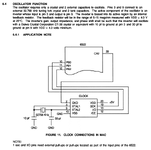
Oscillator
Y5 - C131 & C129 good ground (16MOhm on other side)

Clock Path (as far as I can trace without understanding how the 1Hz comes out of the UE9 RBV)
UK14 p2 -> UD11 p43 good
UD11 p23 -> UE9 p103 good
R40 = 1kOhm
R40 -> +5v good (measured UD11 p23 -> F1)

+V to RTC
UK14 p20 -> D7 p3 good
UK14 p20 -> D8 p3 good
D7 p1 -> +5v good
D8 p1 -> +VBatt good
C137 p1 -> Gnd good
C137 p2 -> UK14 p20 good

Diode measurements
D7 p3 -> F1 (forward):
4.27kOhm
0.457v
D7 p3 -> F1 (reverse)
4.27kOhm (think this diode is bad)
0.9v (think this diode is bad)

D8 p3 - +VBatt (forward):
5.37MOhm
0.533v
D8 p3 -> +Vbatt (reverse):
OL (all the Ohms)
OL (none of the volts)

Please let me know if this is good enough. I think D7 is bad/internally somewhat shorted. Also, is there anything else to check on the 1pps signal past what I have done (with details please)?

EDIT: Can't seem to find a 1n914 SOT23-3 5DX (marking on diode) datasheet to finger out an alternative
 
Last edited:
I took a second look at my IIci, as I've never had to touch the RTC in it yet. It's not only a different pinout from the previous-gen 8-pin one, but a different package entirely. I might have to probe mine now for better reference, since I was looking at a IIcx where the clock circuit had broken, and obviously that won't be as helpful to you.

Have you ever run Apple Personal Diagnostics on this IIci? When the clock isn't ticking properly, I know for sure that the Logic Board Components test in that times out.
 
I ran it previously without regard for if the clock was working or not. Ran it again this morning since adding an Asante, and it locked up (any other work does not lock it up, and only one attempt was made before rebooting and running benchmarks with Snooper and MacBench, which completed successfully).

Will button it back up, this time without the MacBatt since if D7 is indeed shorted I'm putting ~3v from the battery on the +5v rail. Will try APD again then.
 
Not able to measure Y5 for a few days. Is there anything else to check for?
I'm assuming you're also not able to look for the 1Hz tick signal on RTC pin 2, then?

FWIW, measuring directly at a crystal can be hit or miss (although it'll generally work fine it could be that the scope probe will load the oscillator circuit down and skew or stop it). Also, I'm not sure how you cleaned it, but running a board thru the ultrasonic will sometimes kill crystals (I still do it anyway, but it's a thing).

Anyway, if you do have a clock on pin 2 going into the VIA then it's guaranteed that the oscillator is running. Since the machine can set and keep a fixed time, and Snooper says the RTC is working, it means its registers can be written and read. So that part is working fine. It'd be odd if the RTC is broken internally, but also not unheard of.

Have you tested D7 out of circuit to be sure? It being leaky would mean the battery would be attempting to feed the rest of the machine's 5V rail a couple mA at a time, but a Vf of 0.9V is within normal. Your 4.27kOhm could be coming from elsewhere.

Regardless, here's the correct datasheet: https://www.vishay.com/docs/86398/mmbd914.pdf - as for a replacement, I keep BAT54 of several sorts on hand, the base part with no suffix is a drop-in.
 
Thanks, I had assumed I could not measure the crystal directly since I lack high impedance probes, but will try tomorrow anyway. It booted and is working properly (less the clock running), without the battery installed. Can also remove D7 tomorrow and measure out of circuit. Thanks for the datasheet; if it measures bad OOS DigiKey has several thousand BAT54s that will work for $0.05 apiece. If I end up ordering them, will replace both.

Don't have a ultrasonic cleaner fortunately/unfortunately. Just use IPA, soft brushes, and ESD-safe foam swabs.

Do you happen to have the datasheet for Y5?
 
Nope, as Apple didn't publish Manufacturer Part Numbers for the components, and it's not self-evident on the crystal. The ERS for the RTC does provide us with a clue of what it may be, though:

1771728605297.png
 
Removed both D7-8 and measured. Both are good, reinstalled, and working.
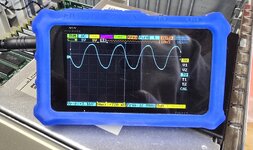
Measured Y5 and it is spot on per the picture.
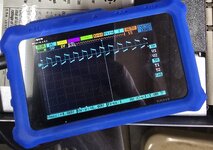
Measured UK14 pin 2 and 1Hz is present (think my crappy scope is loading the circuit and distorting.

MacBatt/CR2032 was at 2.9V, which is where the previous one was before replacing as a troubleshooting step. Replaced with a fresh one; both the previous and current fresh batteries measured 3.1V before installation. The clock is working again.

Confirmed Y5 is still oscillating, albeit minimal P-P when powered off.

Interestingly, when the MacBatt is removed, it takes about 5 seconds for Y5 to start oscillating and producing a signal. When cold booted with the MacBatt in place Y5 produces a signal instantly.

Done for the weekend with the troubleshooting. Will work on it next weekend and see if there is a +5v standby voltage present when plugged in, with MacBatt removed that will help prevent discharging the MacBatt. Up until now I was unplugging the computer after working on it each day.

Will also check is +5v is present immediately at poweron, or if there is a delay along with the Y5 oscillation delay.

Have been testing with both a bone-stock GE and TT Pacific Pico-upgraded Astec with 150W RGEEK PicoPSU.
 
Last edited:
In the posted image, it appears that you measured UK14 pin 2 1Hz with the meter in AC mode. Switch to DC voltage measurement and measure again. This is actually a digital signal. Make sure the Mac's power is on. Then measure that same signal at UD11 pin 43. Make sure you are gently touching the top of the pin as it enters the chip. You don't want to measure at the pad or foot, and you don't want to put any pressure, in case there is corrosion under the foot such that measuring pushes down enough to make a connection.

Also with Mac power on, measure the voltage at UK14 pin 20. Expect > 4.5VDC.

The clock is working again.

I admit I am skeptical of the MacBatt/CR2032 replacement, because of the low voltage. The Mac IIci came with a 3.6V lithium, not a 3V.

However, this should not impact timekeeping when the Mac is powered on, since UK14 should be getting +5V - diode drop.
 
Nope. Sorry. This is an oscilloscope. Don't know what I was thinking. Ignore this part.
Thanks, will make the checks again within the week. Will also get a normal battery for replacement. Will also try to zoom in on Y5 while the computer is off, but running off battery to see if the frequency is still in spec, as well as see if the 2.9v battery even runs the crystal in the first place.

Still have the battery that rested at 2.9v, and will compare with a new one at 3.1v to see if there is a difference in how fast Y5 starts producing a signal.
 
Back
Top