• Hello MLAers! We've re-enabled auto-approval for accounts. If you are still waiting on account approval, please check this thread for more information.

Geethree G4+ “Stealth Serial Port” PCI slot bracket

gsteemso

6502
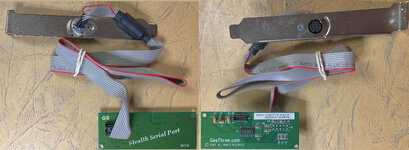
I have a GeeThree brand G4+ Stealth Serial Port adapter I would like to install in my MDD G4. However, I originally bought it for the G4 tower I had before that one, so it has the flavour of mounting plate that’s designed to sit behind the cutout for a modem jack, not the flavour of mounting plate that replaces a PCI-slot cover. The modem jack on a MDD is buried under the processor module – the PCI slot mounting method is the only option there.

The fact I don’t _have_ a PCI-slot mounting plate is not insurmountable. There’s at least one company not that far away from here whose whole business involves making custom computer card-slot mounting plates. (When last I checked, some years ago, they even still offered the ability to make custom NuBus slot brackets – probably because no one had updated that part of their site in a while, but it was there.)

So, a simple question: How exactly is the mini-DIN socket attached to an original GeeThree PCI-slot plate? If I know what it’s supposed to look like, I can just have one made. (Heck, if it’s simple enough I might be able to kludge it together on my own, I don’t yet know one way or the other.) Does the mounting plate just look like a blank slot cover that has a little hole for the serial plug? Or is there some more elaborate structure behind the visible parts, so the port has something to screw to?

 
While I'm on the subject of Stealth Serial Ports, has anyone ever seen, up close, the G5 version they sold until circa 2011? I’m really curious about how that one works, considering that the modem slot in a G5 is supposedly not connected to a real serial port any more, being rather some sort of USB or I²C thing.
 
They still make custom brackets, although not for NuBus slots any more. :¬)

Assuming it works pretty much like the other kind of bracket, it’d be $24 (plus some finishing work on my part) to have one made, looks like, unless GeeThree’s PCI-mount bracket was more complex than I think.
 
This looks like something you could attach to a PCI bracket (if it's not too wide?):
https://vetco.net/products/pan-md-67000-9s_9_pin_mini-din_female_panel_mount_jack
The 9th pin is for Geoport. 8-pins should be sufficient.

Maybe have a look at JamPort?
http://alexhixon.com/jamport/index.html
http://alexhixon.com/jamport/tech.html
It uses a serial port that attaches to the PCI bracket from the rear? I can only find side and rear views of the JamPort PCI bracket:
http://alexhixon.com/projects/jamport/index.html
http://alexhixon.com/projects/jamport/installation.html
http://alexhixon.com/projects/jamport/development.html
 
I must apologize - I was less clear than I believed myself to be. The Stealth has a long cable with a mini-DIN-8 on the end; this is in turn bolted to a bracket, the shape of which varies according to the intended mounting style. I already have everything except the correct PCI-slot-bracket mounting plate; the details of how the mini-DIN-8 should be attached to it are what I do not have and can only guess at.
 
I must apologize - I was less clear than I believed myself to be. The Stealth has a long cable with a mini-DIN-8 on the end; this is in turn bolted to a bracket, the shape of which varies according to the intended mounting style. I already have everything except the correct PCI-slot-bracket mounting plate; the details of how the mini-DIN-8 should be attached to it are what I do not have and can only guess at.
Can the backside of a PCI bracket be made to have the same shape as the backside of the cutout for a modem jack to receive the bracket of your mini-DIN-8?

If the mini-DIN-8 is bolted to a bracket, un-bolt it from that bracket and bolt it to a PCI bracket?

My idea was, if you could not figure out how to connect the mini-DIN-8 from the Stealth to the PCI bracket (drill some holes? self tapping screws? use machine screws with nuts? Make a plate adapter?) then you could buy a mini-DIN-8 that can be attached to the PCI bracket (requires some rewiring of the cable).

Maybe you can provide some pictures and measurements of the mini-DIN-8, its bracket, and a typical PCI bracket.
 
I hadn't thought of your first suggestion! If it can be made to fit, that would definitely be the easiest way to do it, because it only needs the connector hole and screw holes. (I don’t know if it could work yet, because I’m not where it is right now.)

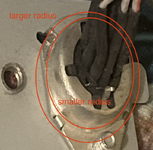
Your second suggestion is more or less what I'd been looking at, but it is not so simple as the first idea because the mini-DIN only has a screw on one side – the other side fits into a curved pocket that looks great but is very difficult to replicate by hand.

I am hoping to avoid the third option, of wiring up a new mini-DIN, because I would have to cut or desolder the wires on the old one; unlike the Jamport, it doesn’t have a handy connector mid-cable.
 
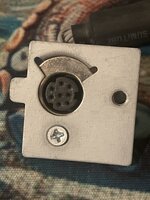
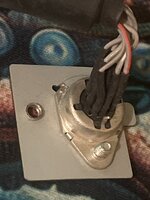
So, I have the thing in front of me now. Unfortunately, both GeeThree’s miniDIN-to-modem-bracket and their modem-bracket-to-case mounting techniques involve sliding one side into a pocket and then attaching the other side with a screw:

image.jpgimage.jpg
So, the only advantage of mounting the mounting plate to a PCI slot cover instead of mounting the miniDIN directly is that the pocket you’d need to create is MUCH simpler to define. Off the top of my head, mounting the miniDIN directly would require making about four radial cuts from the plug opening, then bending the resultant isolated fingers of metal to create prongs that would wedge around the curved bit of frame. Mounting the mounting plate to a slot cover, on the other hand, would merely require screwing a narrow strap of some kind to the inside of the slot cover, off to one side of the plug hole. The output of such a procedure – the mounting plate, stuck to the back of a PCI slot cover – would be about twice the width of the actual slot cover, so I'm only about 90% certain you could attach it before inserting the slot cover back into the machine. Either way it would make the adjacent slot(s) rather tricky to do anything with. On the other hand, trying to make a proper mounting pocket for the narrow circular lip around the edge of the miniDIN sounds incredibly frustrating. I just don’t know. Maybe the option where I kludge up a Jamport-style miniDIN-on-a-stick and resolder my cable to it would be the easiest, after all. Something inside me rebels at the thought of damaging what is by now a 25-year-old bit of pristine aftermarket equipment, though.
 
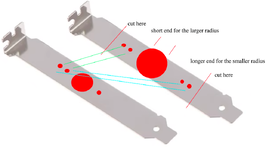
Here’s an idea. I could take a PCI slot cover, put a plug hole in it, and then screw a stiff bit of sheet metal the full width of the slot cover to its back. First, cut the loose end of the stiff bit of sheet metal to have an inwardly rounded edge; then, force it away from the body of the slot cover just far enough to wedge the lip of the miniDIN into. Screw down the other side of the miniDIN and there it is.

I tried to attach a drawing of this but the wretched thing kept erroring out.
 
The PCI slot cover needs 3 or 4 holes.
One big hole for the miniDIN.
One small hole (beveled) for the existing screw.
Two holes for the stiff bit of sheet metal (two holes so it doesn't rotate). Attach with machine screws (and nuts if the PCI plates are not threaded).

Instead of wedging, use a second piece of sheet metal or a washer that is the same thickness of the Mini-DINs holder.

For the stiff bit of sheet metal that is the same width of the slot cover, just sacrifice another PCI backplate. Clamp it, use a metal hole saw or drill that has a diamater similar to that of the mini DIN to drill a hole in the middle of the sacrificial PCI backplate.
One piece will be placed against the PCI bracket and mate with the larger radius of the mini DIN connector. The longer piece will stack on top of that piece and mate with the small radius of the min din connector.
Mini DIN connector.png
Mini DIN PCI backplate.png
 
Last edited:
I like the way you think! This looks eminently do-able – the only potential sticking point is in finding some scrap PCI-slot covers. Considering the number of obsolete commodity peecees that pass through the Seattle Retro-Computing Society’s buy-sell-free-trade table over the course of a few months, it shouldn’t take much looking. :¬)

Failing that, that outfit I mentioned that makes custom ones is still around. I might actually have them do up the main bracket just to get one that looks a little less obviously made from scrap. Their stuff is made of sheet metal with a little actual substance to it – not so flimsy as the el-cheapo, nearly tinfoil-thin ones most computer makers use to just cover the openings. Might hold up a little better to (hopefully) years of stiff plugging/unplugging action.
 
You could design a 3D printed mini DIN holder. Print it out of plastic or metal. Make it as thick as you like so it can't break or sandwich the mini DIN holder between the PCI bracket and a metal plate (if you don't want to expend the effort to make a mating radius in the metal plate).

PCI slot covers are cheap to buy individually or in packs. Some have a folded edge and some are flat.
https://www.moddiy.com/categories/Cases-and-Parts/Case-Parts/PCI-Expansion-Slot-Bracket-Cover
 
I'd forgotten you can 3D print in metal. Does it still cost a lot? (Last I heard about the subject was about 15 years ago, so I'm a little blurry on the details.) If it's gotten halfway affordable by now, might be easiest to just print the whole bracket in one go, miniDIN-plate pocket and all – no need to build up complex layers that way.
 
While I'm on the subject of Stealth Serial Ports, has anyone ever seen, up close, the G5 version they sold until circa 2011? I’m really curious about how that one works, considering that the modem slot in a G5 is supposedly not connected to a real serial port any more, being rather some sort of USB or I²C thing.
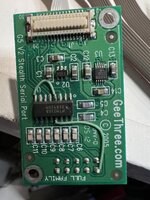
Here are the two variants I've seen:

IMG_2104.jpeg

The long/thin design is for the original G5, and also the Dual 1.8GHz variant of the subsequent June 2004 model.

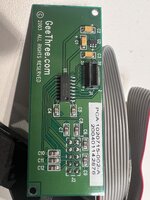
IMG_2105.jpeg

The other one fits the Dual 2.0/2.5GHz June 2004, the Late 2004, and Early 2005 models. The Apple service manual refers to this as "Soft Modem" rather than "Modem", FWIW.


The final Late 2005 model had no provision for an internal modem; a USB version was sold as an option.
 
I wonder if that PCI bracket was cut and stamped
or if it was cut, stamped, and then cut again for the smaller radius.
 
@joevt I think it was cut/stamped in one or at most two operations, no third round of cutting. Anything else would have cost more and it really isn’t that complex of a shape in person.

@jeremywork do you still own those? I'd be quite interested in reverse-engineering them, at least to the surface-level approximation you can get by IDing the chips and whatnot.
 
mini din 8 pin panel mount sockets are still made and sold along with pre made pass though adaptors too. then you'd jsut need to drill a hoe for the din socket and the two mounting screw onto a standard pci slot cover


not sure where your located or what you skill set is but it wouldnt be hard to make a new cable either.
looks like its a standard IDC 10pin header of the pcb.

just a couple links that might help give you some ideas:


@jeremywork, those closeups do indeed help! I can only really say much about the squarer one, but it’s the one I have a machine for so that’s fine. :¬) Sadly, I don’t know any way to actually tell what the two tiny ICs do from the markings, but the 14 capacitors can’t have _enormous_ values just by their size, so could probably be fudged. Looks like the same kind of motherboard connector as on previous generations, too.

@Chopsticks I appreciate those suggestions, just interposing a miniDIN extension cable with an easily mounted end seems so obvious in hindsight. That’s probably what I’ll end up doing – much faster and simpler. I particularly like the already-mounted one and soldering my own pigtail onto it – I’ve done that before so it should go smoothly, and is super straightforward too.
 
yup the pre-made cable should be pretty easy to terminate into a IDC 10 pin female header socket without much trouble


in regards to the two IC's the larger 16 pin one is a Geoport/localport line driver, so basically a RS422 dual line driver


U3 is a +5v charge pump, thats likely boosting a 3v rail from J2


the small 6 pin ic U2 is for the negative voltage rail will either be dropping down a negative voltage rail on the main J2 connector to around -5v or its just inverting a voltage to around -5v

c6-c11 appear to be pull down caps to ground, so likely 0.1uf or something along those line.

if you really want to reverse engineer these i think someone here on the forums did that at some stage..
 
Back
Top