• Hello MLAers! We've re-enabled auto-approval for accounts. If you are still waiting on account approval, please check this thread for more information.

IIsi power supply won't turn off, I'm deep in schematic land

dougg3

68000
I recently got around to trying to fix the power supply from a IIsi I got a while back. I recapped and cleaned everything, of course. I already mentioned in another thread here that I found a shorted diode marked "22UA" that was preventing the power supply from turning on. After replacing it, the power supply is alive!

Except something's still funky with the soft power circuit.
  • If I plug it into AC power after it has been off for a long time, it briefly turns itself on and right back off immediately.
  • If I unplug and replug it at that point, it stays off.
  • Soft power on works fine.
  • If I try to shut it down with either the power button on the back or Special -> Shut Down, I hear the relay click, but then it powers itself right back on and the machine boots back up.
  • The only way I can shut it off after it's powered on is to yank the AC power out.
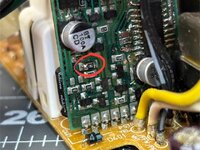
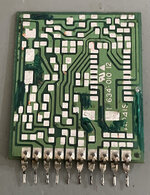
I went slightly crazy with cleaning because I know the little riser board is often a really nasty victim of cap leakage and is responsible for the soft power functionality. It definitely took some damage from the cap leakage. I went as far as to desolder every single component and put everything back on one by one. It took forever! But I'm confident everything is connected now and there isn't any leftover cap goo hiding underneath anything. There are a couple of traces damaged by gunk still, but they have continuity.

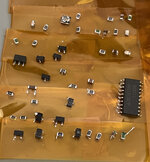
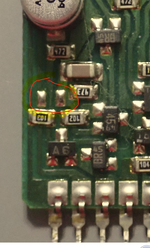
bareboard.jpgcomponents.jpg

Side note: this whole saga led me to discover that Bomarc's (incredibly helpful) schematic has a mistake on the riser board schematic: the chip labeled 44 is not a DTA124. It's bigger than all those other similar pre-biased transistors on the board. After some crazy/lucky searching on the Internet, I found a match. I'm pretty sure it's a M51944BML voltage detector/reset IC. Here's a picture of that (discontinued) part in tape:
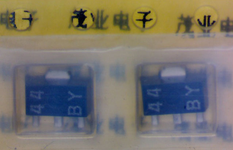
1753028505281.png

Yeah, it looks exactly like the part on this board, marked identically. The digit after the B is probably some kind of date code because it varies in people's pictures I've seen online.

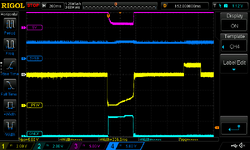
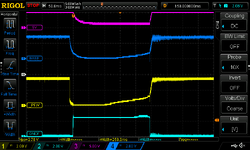
Anyway...I figured out how to probe some pins with my scope, and this is what happens when I try to shut down. The 5V "always on" trickle is good and stays at 5V the whole time, so I'm not plotting it here.
DS1Z_QuickPrint21.png

5V is the main +5V rail. BASE is the base pin of the "45" transistor (DTC124). _PFW is the /PFW pin, and ONOF is the ON/OFF pin of the M51977FP (pin 7).

Here's what I'm seeing in the trace:
  • We start out with the system on.
    • The 5V rail is good.
    • /PFW is pulled to a high-ish voltage through the diode/3.3k resistor to 5V on the IIsi logic board, keeping the power supply turned on.
    • The DTC124 is on, which drives the ON/OFF pin low.
    • The power supply is on and everything looks good.
  • I command a shutdown:
    • /PFW goes low (the Egret drives it low).
    • This causes the base of the DTC124 to go down, which shuts it off.
    • The ON/OFF pin goes up (only to about 2.4V though -- is that normal?)
    • The 5V rail dies, so the M51977 definitely responds to the ON/OFF pin going high to shut it off. The 5V rail gets down to about 1V or so.
  • The Egret is happy that the power supply is off, stops driving /PFW low, and leaves it floating.
    • This causes /PFW to slowly start creeping back up to about 1V (what the 5V rail has on it now), likely because of the diode/3.3k pullup on the logic board.
    • Eventually it creeps up high enough that it seems to re-activate the DTC124, driving the ON/OFF pin low, and everything powers back on again.
      • You can see a brief blip on BASE and /PFW when this happens but I think it's just an artifact of the wires I have coming out of the power supply for measuring these signals safely.
What the heck? Is it normal that 250 ms after telling it to shut off, the 5V rail is still at around 1V? I guess that's not a huge surprise because of all the capacitors on there, but I was curious if it's normal or if there's a problem there. How quickly does the 5V rail die down on a fully working IIsi? How does /PFW work properly on anyone's IIsi if that's the case?

It does seem like the DTC124 will turn itself on if /PFW is around 1V. I even simulated this in an online circuit simulator and sure enough, when /PFW hits 1V, the ON/OFF pin goes low. So the +5V rail still being at 1V after shutdown seems like it's a factor in this behavior.

I tried adding an extra 10K pulldown resistor from the DTC124's base pin to GND, which makes it require more voltage to turn on. This raises the requirement on /PFW to more like 1.2V or so. You can play around with that in the circuit sim by turning the switch on and off to add/remove the pulldown from the circuit. Adding this resistor actually fixes the problem!

But...it seems like a hack, like I haven't actually solved the underlying issue. Otherwise everyone would have this problem on their IIsi.

Does anyone have any thoughts on what might be going on here? I want to test more of the components on the riser board to make sure they're good, but they are tiny, which makes them very difficult to measure out of circuit without accidentally sending them off into another universe. I'm tempted to just leave the 10k pulldown in there and call it a day, but it bothers me that the stock circuit doesn't work.

I've already tried replacing the DTC124, as well as the BAS16 diode before it. No change. (The diode is definitely marked as A6; Bomarc forgot to label it).

Thanks!
 
I can drag my IIsi from the basement and take a look. I assume you don't have a working IIsi where you can swap components to isolate the problem to either the motherboard or power supply?
 
I can drag my IIsi from the basement and take a look. I assume you don't have a working IIsi where you can swap components to isolate the problem to either the motherboard or power supply?

Thanks, David!

Unfortunately, I don't have another IIsi. I do have a IIci, so I've done some swapping back and forth with those power supplies, and that's where it's really a mystery:
  • The IIci power supply works fine with the IIsi motherboard.
  • The IIsi power supply works fine with the IIci motherboard.
In other words, this "won't shut off" symptom only happens when I use the IIsi motherboard with the IIsi power supply. I know that doesn't make any sense, but that's what I see. I know that the IIci motherboard's soft power circuit is quite a bit different from the IIsi because it doesn't have an Egret.

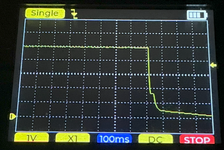
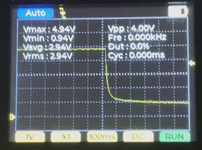
For what it's worth, my IIci's power supply seems to drop down below 1V much faster (albeit with a IIci logic board). The 5V rail appears to drop down from 5V to 0.5V within less than 100 ms.

1753037178096.png

On the other hand, my IIsi supply's 5V rail stays up near 1V for hundreds of milliseconds:

1753038112685.png

From that perspective, the IIsi supply hanging out at 1V for a longer time seems like it might potentially be weird, but I'm not sure if it's normal.
 
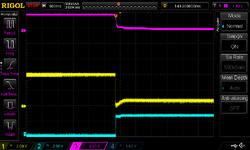
I don't have transistor 45 hooked up. And, obviously my power supply is not restarting, so you only see it turn off (not on again). I tried this with and without the PRAM battery. I am using Floppy Emu and not a hard drive.

IIsi shutdown 50 ms no battery.png

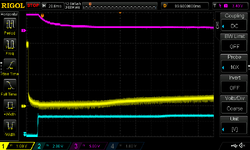
After shutdown, /PFW (yellow) climbs to about half a volt and then begins declining (you can just about make out a decline in the noise in the image below with a 500 ms timescale). About five minutes later and it is down to 0.3 V

IIsi shutdown 500 ms wbattery.png

Here is a shorter time scale with yellow having more vertical resolution to note the rise.

IIsi shutdown 20 ms wbattery.png

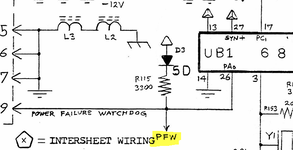
Where does PFW go in the schematic images below?

1753057449608.png

Let me know if you want any other images.

- David
 
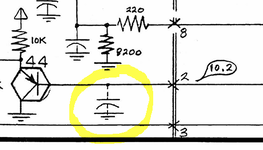
You didn't install this capacitor, did you? There should not be.

1753060624871.png

1753060684069.png

Since you completely rebuilt your riser board, maybe you thought a capacitor should be installed there. If so, it would explain how a charge could accumulate on pin 2.
 
I tried this with and without the PRAM battery. I am using Floppy Emu and not a hard drive.

Wow, you went above and beyond! Thank you so much! (Nice choice of scope, too. ;)) My tests are with an actual hard drive, no PRAM battery. Extra data point: I just realized that if I don't have a hard drive plugged in, my IIsi logic board is also not capable of turning off my IIci's power supply. The hard drive adds enough of a draw that it begins working.


Your curves are very similar to mine. It's comforting to see that your ON/OFF pin goes to the same voltage as mine when off. I was worried about how it wasn't going all the way up to 5V.

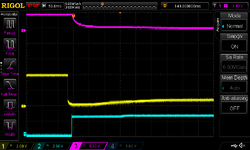
I overlaid the two with different colors and lined up the ground position for channel 3 (+5V). Your 5V (pink) is a little higher than mine (blue) while running, and going ever so slightly lower than mine when it shuts down, but it's fairly similar.

1753058645180.png

Likewise, your /PFW (yellow) is a little higher than mine (blue) when the power supply is running. My /PFW climbs higher than yours when the power supply is off, and eventually it kicks back on and shoots sky high.

1753059275648.png

I assume the rise in /PFW when it's off on both of ours is because the Egret has stopped driving it to ground, and it's getting pulled back up toward what's left of the 5V rail (through the 3300 resistor and diode). Since my 5V "dead" rail is higher than yours, I guess it makes sense that my /PFW also rises a little higher than yours. I think mine is getting bumped up into the range that causes transistor 45 to turn back on.

Where does PFW go in the schematic images below?

I noticed that too and couldn't find anything else on the logic board. I think the only other location it goes to is the PSU part of the schematic.

I find it kind of interesting that I can't find a bleed resistor on the +5V rail anywhere. The power supply seems to have them for the +12V (R212) and -12V (R222, R223, R224) rails, at least that's what I think they are. But the +5V rail doesn't.

So now the big question on my mind is: why is my 5V rail staying higher than yours when it shuts off? To me, that seems like the root problem because it causes /PFW to go too high too. It's like I don't have as much current draw or something.

You didn't install this capacitor, did you? There should not be.

I did not. Nice thinking though! I also noticed it was empty.
 
Wow, you went above and beyond! Thank you so much!

Happy to help.

Here's something to ponder. If I turn the power supply on/button screw on the back of the IIsi to force it to always stay on, then I boot and choose shutdown, here is what I get:

Force power to stay on.png

The timing looks suspiciously like your trace. 250 ms and then it auto powers up again?

There is one noticeable difference, which is /PFW goes to 5 V on mine. (But not initially -- it is slightly above 4 V for a bit).

Maybe your IIsi's problem is not the residual 5V line dragging up /PFW. In fact, do we actually know the voltage required to trigger /PFW? Maybe the EGRET is powering up the board? Otherwise, what circuitry controls the 250 ms delay?

Maybe monitor pin 25 of your EGRET to see if it thinks the power button is being pressed? Or maybe lines 19 and 20 for the ADB power button?

If you're bold, lift leg 26 of the EGRET to take it out of the equation. This will also allow to to inject what startup voltage and shutdown condition you want on /PFW.

- David
 
Here's something to ponder. If I turn the power supply on/button screw on the back of the IIsi to force it to always stay on, then I boot and choose shutdown, here is what I get:

There is one noticeable difference, which is /PFW goes to 5 V on mine. (But not initially -- it is slightly above 4 V for a bit).

I believe when /PFW goes all the way up to 5V, it means Egret is driving it high in an attempt to turn the power supply on. When it goes to that 4V-ish level, it means the power supply is on but Egret has it set as a Hi-Z input and is not driving it at all. So it just gets pulled up to 5V minus a diode drop.

In my case, the power supply turns back on without being asked to (I think because /PFW drifts too far upward and activates the 45 transistor). I eventually see the Egret do the 5V high drive pulse as well, but the power supply is already on at that point, because ON/OFF is low and the +5V rail is good:

DS1Z_QuickPrint15.png
Note that this is an older trace I took, and my 4th channel was graphing the 5V always-on standby rail at this point rather than the base of the transistor.

In your capture, the power supply shuts off. Then, it turns back on right at the moment when /PFW is driven high by the Egret. So your power supply correctly responded to the Egret's request to turn back on.

I will definitely check those pins, but I'm pretty confident the Egret is not involved in the power supply turning back on with the problem I'm seeing. If the Egret was asking it to turn on, the pulse would go all the way up to 5V at the moment that the power supply turns back on like yours does.

Edit: For fun, I replaced D3 on the logic board with a brand new BAS16 (close enough to an MMBD914). Didn't change anything, it's not D3's fault.
 
Last edited:
Now that I've had a night to sleep on it, I agree with your analysis. Your IIsi is not drawing down the 5V rail as quickly as mine. So, yours has some combination of higher capacitance and/or higher resistance.

I measure 5265 uF with the power supply, IIsi motherboard, speaker, power LED, and fan attached. Adding FloppyEmu, keyboard/mouse, internal floppy drive, gives about 5700 uF.
 
I thoroughly enjoyed this series of troubleshooting. As someone who has a pile of Sony IIsi PSUs which exhibit this exact behavior, it hits close to home! I don't have a scope (wish I did), so the only thing I could think to do was clean, clean, and clean the power supply again. My thought was that some electrolytic fluid had wicked somewhere causing these symptoms. This method worked on maybe half of the "bad" PSUs I have.

The Magnatek variant seems to have none of these problems. I've only come across three or four of that make - seems they aren't very common. Of those that I've recapped, only one had catastrophic leakage, but worked perfectly after cleaning and cap replacement.

Regardless, I am excited to try adding a pulldown resistor to the soft power circuit. I don't have anything that's 10k on hand, but I'll be sure to post back once I bodge something in place.
 
I measure 5265 uF with the power supply, IIsi motherboard, speaker, power LED, and fan attached. Adding FloppyEmu, keyboard/mouse, internal floppy drive, gives about 5700 uF.

Thanks for the data points! How are you able to measure that high of capacitance? Do you have a specialized meter? I've noticed my multimeter can't measure larger capacitors too. My multimeter just says OL, and my cheap DSO-TC3 component tester just hangs up forever if I try to measure the capacitance of the 5V rail.

I wonder if the new caps I put in the power supply are "too good"? I used a kit from Console5. Like I wonder if the ESR in the new caps is lower than the original and thus it doesn't lose voltage as quickly as the stock machine or something. Just a random theory to throw out there, I could be totally wrong. It would be interesting to try adding a bleeder resistor on the 5V rail, and/or compare against the specs of the originals. I think I should also do some higher-resolution scope captures so I can see exactly how high the 5V rail and /PFW are rising.

My thought was that some electrolytic fluid had wicked somewhere causing these symptoms. This method worked on maybe half of the "bad" PSUs I have.

Yep, that's what I was thinking too. And this thing was pretty nasty. The screw holding down the main PCB on the secondary side was disgusting and I replaced it. Maybe I've still missed something on the main PSU board, but I cleaned it quite a bit. I wonder how many others are in this same boat where the power off still doesn't work even after extensive cleaning. It kind of looks to me like with the amount of voltage the PSU retains on the 5V rail after powerdown, the original design could have been right on the edge of being problematic. Either way, I can definitely see how conductive electrolyte could mess with that circuit of crowded SMD parts.

I'll be curious to hear if the pulldown on the base resistor works for you too!
 
Last edited:
How are you able to measure that high of capacitance?

Fluke 87V multimeter. It can measure up to 10,000 uF. It's a bit old fashioned, but I'm happy with it.

I wonder if the new caps I put in the power supply are "too good"?

Maybe. However, the IIsi I tested has all aluminum polymer capacitors.

It kind of looks to me like with the amount of voltage the PSU retains on the 5V rail after powerdown, the original design could have been right on the edge of being problematic.

Yes, this is my guess.

Did you test the resistor and capacitor near 45 before you reinstalled them. The values are not listed on the schematic. Their values would affect the time it takes before powering back on.
 
It can measure up to 10,000 uF. It's a bit old fashioned, but I'm happy with it.

Nice!

Maybe. However, the IIsi I tested has all aluminum polymer capacitors.

Good point -- seems like those would have lower ESR than the originals, so that kind of blows my theory in the water. I do wonder what would happen if I put slightly lower uF capacitors on my 5V rail for fun. Or, I wonder if I have a leaky component that's feeding a little bit into the 5V rail.

Did you test the resistor and capacitor near 45 before you reinstalled them. The values are not listed on the schematic. Their values would affect the time it takes before powering back on.

The resistor is the 1K resistor in the bottom left corner of the board, just above the A6 diode which was also unlabeled in the schematic. It tested as 0.987k. The cap is the bigger (1206 I think) SMD ceramic cap a little bit further above it. I didn't test it, but I'm planning on pulling all the caps again and testing them.

I want to create an accurate schematic and replica PCB design for the riser board using KiCad, so I do plan on figuring everything out. I'm pretty sure the "511" diode is also a Zener even though it wasn't marked as such. The only part I'm not sure about at this point is the "B" diode that goes from 12V to the 12V standby rail, over on the right side of the last page. I haven't figured out its purpose in the circuit. Maybe it allows the actual 12V rail to take over for powering the PWM chip when the power supply turns on.
 
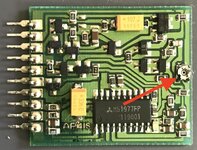
Like @Garrett B I also have a recapped IIsi/Sony PS exhibiting this same behavior. In my case maybe ~20% of the time the Shutdown DOES stick and it doesn't start up again. One thing I wondered (coming from a place of zero real understanding of how this all works) was if what looks like a little potentiometer on the board comes into play? ...which you guys will tell me is actually a solder blob or something, lol.
IIsi ps small board.jpg
 
Last edited:
One thing I wondered (coming from a place of zero real understanding of how this all works) was if what looks like a little potentiometer on the board comes into play? ...which you guys will tell me is actually a solder blob or something, lol.

Haha, not a solder blob! :D Yeah, it's a little variable resistor or pot or something like that. If I'm reading my notes correctly, mine measured as about 2.106 kohms out of circuit, but I'd need to double check that before saying it confidently. Bomarc's schematic says 2K which makes me wonder if I'm wrong. I was trying really hard not to send the part flying and lose it forever when I was measuring it.
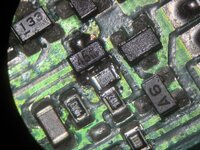
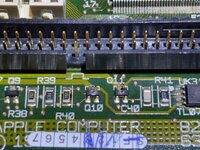
I would be lying if I claimed to be an expert on this, but here's my understanding of that part of the circuit:

Together with that weird looking 6.8k MELF resistor, the pot goes to ground. They combine in series to make a <6.8k + pot> resistor. This also goes through a 150k resistor to the +12V rail and a 10K resistor to the 5V rail. I believe this does a weird voltage divider thing that combines feedback from both the 12V and 5V output rails to create a final voltage to feed into the PWM chip's DET pin (9). The F/B pin (10) is also involved in that part of the circuit with some capacitors and a resistor.

It looks like what it's shooting for is sending 2.5V into the DET pin. The M51977 datasheet is very difficult for me to comprehend, but I think the idea is you feed what should be 2.5V into the DET pin, and it will increase/decrease the PWM duty cycle to try to keep the DET pin at 2.5V. That divider circuit does seem to result in something around 2.5V, so that checks out.

My guess is that if you tweak that pot, it'll adjust the output voltages on all three rails. It's probably a fine tune adjustment.
 
Last edited:
I dug through my bags of parts last night, and found a few 10K 1/8W chip resistors - cool! Before I started any work, I verified my power supply still had problems. Yup - turned on, but then when pressing the rear button to power down it turned right back on. I was eventually able to get it to turn on and off fine after a few minutes, but obviously it isn't 100% functional.

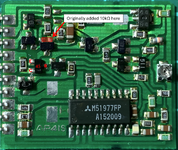
Here's what my riser board looked like after performing the modification to the base and ground pins of the DTC124 transistor. Yes, I know the board is gross, and I'll clean it up more later.

B.jpg

Well, upon powering everything up, I released the magic smoke on the IIsi logic board. Seems that Q10 and Q11 burnt up. These two transistors seem to be part of the audio circuit, specifically for the internal speaker... what the heck? What does that have to do with the PFW or 5VSB line? They're connected to 12V from what I can tell, but I'm having a tough time figuring out what went wrong here. Obviously my mod to the PSU daughtercard screwed something up. Any ideas?!

A.jpg
Screenshot 2025-07-22 100221.png
 
These Bormac schematics are driving me crazy. Based on what's recorded on the Power Supply page, I connected the 10k resistor to the wrong component. Below is what I believe it should be, based on what I can understand from the schematics (although I've never seen a transistor with this pinout). I don't have the unit in front of me, and it's so hard to tell which lines they have labeled as going to the vertical daughtercard vs the harness or other points on the main PCB.

Screenshot 2025-07-22 141055.png
 
Well, upon powering everything up, I released the magic smoke on the IIsi logic board.

Oh no! Sorry to hear that! I'm on a lunch break so I can't look in detail until later tonight, but I can't imagine that resistor would cause this problem. All that pulldown should do is tweak the value of the existing pulldown resistor built into the 45 transistor, effectively requiring /PFW to be slightly higher.

For my resistor, I still have the top of the enclosure off, so I soldered a wire to the end of the larger ceramic capacitor (the end facing the middle of the board), and then used a 10k through hole resistor between that wire and the enclosure. That should have the exact same effect as the resistor you placed though. I'm baffled! It does look like the ground end of your new resistor might be touching that 1K resistor, but it's also GND right there so it shouldn't matter.

These Bormac schematics are driving me crazy. Based on what's recorded on the Power Supply page, I connected the 10k resistor to the wrong component.

No, I think you had it right. The "originally added" position you have marked in your latest picture, and your original picture, is connecting the emitter and base of the 45 transistor together.

The component you're marking in your new picture is the 18V Zener diode. It's really confusing because the pin you have marked as "C" on that Zener diode is actually a no-connect pin on the Zener. The way the board is laid out makes it look like a 3-pin component but they just happened to run a trace through it. The "E" and "B" pins are the only ones actually connected to the Zener.
 
These two transistors seem to be part of the audio circuit, specifically for the internal speaker... what the heck? What does that have to do with the PFW or 5VSB line? They're connected to 12V from what I can tell, but I'm having a tough time figuring out what went wrong here. Obviously my mod to the PSU daughtercard screwed something up. Any ideas?!

Had a chance to look at this further. Agreed that this section of the circuit involves audio. I see a lot of 12V and -12V rail triangles in the schematic at that point. I'm still at a loss here. The "45" transistor is only involved with turning the power supply on or off. When it's on, the power supply is on. When it's off, the power supply is off. Like you said, it only involves /PFW and 5VSB. I don't see how adding a resistor to ground right there would do anything catastrophic like change voltages (which I'm assuming is what happened if something fried). Is there any chance that something was accidentally shorted together (or maybe left open) when re-soldering the riser board back onto the main PSU board?
 
Doug, huge thanks for taking the time to reply. I have some news of success to share! I performed the resistor modification on two other problematic power supplies, and can happily report they're powering on/off as intended. You were right, the original bodge I made was just fine, except on my other two units, I got smart and just piggy-backed the 10k resistor on the ceramic capacitor. I didn't even have to remove the vertical sub board from the main PCB.

A.jpg

Some other interesting pieces of data - the measured resistance across base/emitter of transistor 45 varied a bit between units. One measured 8.4k, one was 6.4k, and my last was 8.2k. All trim pots were set to ~1.2k ohm (unsure whether that contributes or not) and I left them alone.

Again, thank you for taking the time to "deep dive" into these temperamental power supplies! If I had a scope I would have been a little more helpful in contributing to the conversation here. I'm just happy to have three working units. These had been sitting disassembled in a box for years... until now!
 
Back
Top