• Hello MLAers! We've re-enabled auto-approval for accounts. If you are still waiting on account approval, please check this thread for more information.

PowerBook 5300 Power board (UK)

Snial

68000
I'm still planning to fix this PB5300 if I can. I have a spare power board (if that's what they're called?), so I think it's possible to cannibalise them to make a working one ( and I'm going to gloss over the details of that here).
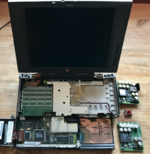
1729357388074.png

What I'd like to find out as a first stage though is whether there's anything more wrong with the PB5300? So, if the board was fixed, would the PB5300 still fail? I'm hoping that either a UK member is happy to send me a known, working Power board from their PB5300 for me to test. I'm happy to pay postage of course! Of course I could send you the PB5300, but I think that'll be more expensive, so this is why I've picked the other option first.

-cheers from Julz
 
These (and their 190 siblings) were notorious for broken power jacks. Sometimes you could just resolder them to the logic board, other times they were broken to the point you had to replace them.
Either way there's not much further testing to be done without a known-good power board.
 
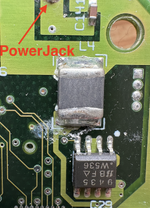
@PotoMac has motivated me to take a closer look at my PB5300. I dismantled it a bit further than I have done in the past. @Franklinstein , the power jack socket looks like it's soldered in OK. The underside is pretty good except for a bit near the power jack!

1750687151512.png

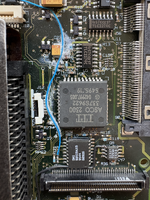
Does L4 or the chip below need replacing? Moving to the top-side. Most of the it is actually OK IMHO, however, there's some pretty serious corrosion between the PCMCIA, Floppy drive/whatever bays:

1750687295569.png

Does anyone know what this does? Reset circuitry? I guess someone has schematics for the PB5300 which would provide the answer.

Meanwhile, at least I have an explanation.

-cheers from Julz
 
@PotoMac has motivated me to take a closer look at my PB5300. I dismantled it a bit further than I have done in the past. @Franklinstein , the power jack socket looks like it's soldered in OK. The underside is pretty good except for a bit near the power jack!

View attachment 88041

Does L4 or the chip below need replacing? Moving to the top-side. Most of the it is actually OK IMHO, however, there's some pretty serious corrosion between the PCMCIA, Floppy drive/whatever bays:

View attachment 88042

Does anyone know what this does? Reset circuitry?

As a first step I'd clean up as much of the white residue with IPA as possible, then you'll have a better idea of the condition. Q2 near the top of the second photo looks burned.

L4 is just an inductor so if it has continuity it should be fine. In general I'd look out for broken traces more than broken components, aside from the obvious.

I guess someone has schematics for the PB5300 which would provide the answer.

The PB5300 series schematics have not come to light. PowerBook schematics are very thin on the ground for some reason.
 
As a first step I'd clean up as much of the white residue with IPA as possible, then you'll have a better idea of the condition. Q2 near the top of the second photo looks burned.
Thanks, I hadn't noticed that one!
L4 <snip> continuity it should be fine. In general <snip> broken traces more than broken components <snip>
Thanks.
The PB5300 series schematics have not come to light. PowerBook schematics are very thin on the ground for some reason.
OK.

-cheers from Julz
 
As a first step I'd clean up as much of the white residue with IPA as possible, then you'll have a better idea of the condition. Q2 near the top of the second photo looks burned.
So, just to recap (sic). If I get 250ml of IPA from trade-chem.co.uk for £5.99 I can use a microfibre cloth (from a spec-saver's glasses case) to clean it?


Is it OK to use cotton-buds instead, or is there too much of a static risk? Or wrap the micro-fibre cloth in the cotton bud; soak in the IPA and then clean it. I understand it evaporates by itself.
 
Is it OK to use cotton-buds instead

I generally use cotton buds. Whether this is a recommendation or not depends on your estimation of my competence ;-).

I understand it evaporates by itself.

It both evaporates more easily than and has lower surface tension than water. And it can take water along on both of these rides, which is why you should generally wash in isopropanol after you wash with water, if you're going to do both, as it'll help chase the water out.
 
Back
Top