• Hello MLAers! We've re-enabled auto-approval for accounts. If you are still waiting on account approval, please check this thread for more information.

Help identify this accelerator board for Mac IIx

Renegade

6502
TL;DR : help me put a name on that thing :)

Hi,

I picked up a Mac IIx around 2000 when I started collecting vintage Macs.
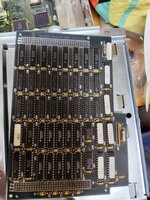
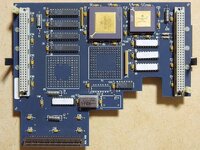
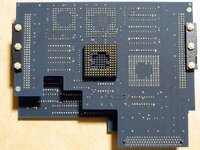
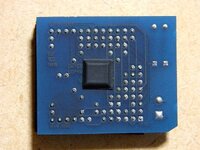
It came with a 50 MHz '030 Daystar accelerator board directly plugged into the CPU socket, with a cache daughterboard on top.

This IIx worked at the time, but I didn't fiddle much with it. It was quickly shelved for a very long time.

The machine nowadays won't start, which isn't surprising as I haven't replaced the capacitors yet.
However, in a burst of curiosity, I'd like to identify this accelerator board.

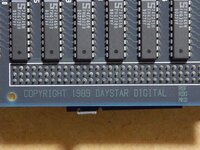
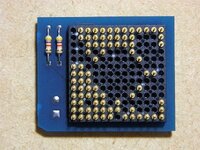
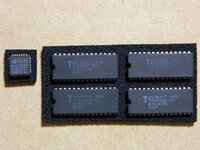
Here are the pictures :
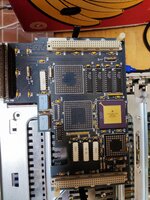
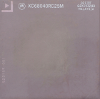
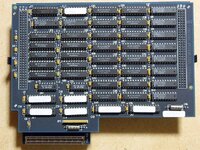
daystar.jpeg daystar_dghtbrd.jpeg

Apart from reading © 1988 (1989 for the cache board) Daystar Digital, there isn't much information written.
 
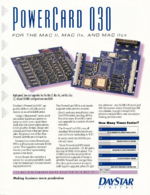
I was hoping the advertisement would explain what all those connectors are used for. Smaller one is maybe for additional cache?
 
Looks like 32K of cache. Probably can't do two cycle operation at 50 mhz due to the latency on the data RAM, but a neat board. Presumably the precursor to the powercache. Dual oscillators is odd, I suppose it's for the FPU so they could run that slower. 50mhz capable chips would have been like hen's teeth back then.

I was hoping the advertisement would explain what all those connectors are used for. Smaller one is maybe for additional cache?

Probably an additional PDS-like connection, but there's not much you can (gracefully) do with that so it presumably went unused. Nubus decode covers the entire slot space, so you'd have to fit your hypothetical device's address space into a hole in IO space and then shoehorn a driver in via an extension, plus no IRQ without hijacking interrupt cycles on the accelerator.

Using it for a hypothetical private fast memory bus (think like a SE accelerator) is about all I could think of being halfway practical.
 
The extra connector is for a backplane bus for Nubus cards. There were only one or two cards that had theoretical support for that bus and the only pictures I have seen of said cards didn’t have the connectors populated…
Now if I could remember what they called that bus.

EDIT: It was called „XCI“

InfoWorld

January 16, 1989

Daystar to Offer 33-MHz SE Accelerator

BY ROBERT SNOWDON JONES

...

Daystar will also introduce three enhancement boards for the Mac II based on its Extended CPU Interface (XCI), which bypasses the 10-MHz limitation on the Mac II's Nubus. The boards plug into the Nubus slot but have a connector that gives them direct access to the CPU. The Video XCI gives higher performance graphics capabilities and is compatible with EGA monitors in addition to the Apple 13-inch monitor and the Sony 19-inch monitor. The Daystar HD XCI uses cache memory to increase performance of hard disk drives.

Andrew Lewis, Daystar's president, said the company will place XCI in the public domain in hopes of spurring more high-speed hardware for the machine. The Mac II's current speed limitations hamper its usage as a CAD or graphics workstation, he said.

XCI is a connector with a few chips, which bypasses the 10-MHz limitation on Apple's Nubus slots. The interface permits a direct 33-MHz path to RAM, video, and disk drives.
 
Ooooo, neat! What a shame no one used it. That would have been cool. I wonder if a SCSI card could have been made with high speed cache, high speed DMA, and drive access.
 
I think it was indeed a SCSI card that was one of the cards to support XCI that actually materialized.
 
Ah, that's one way to skin that cat.

So what they would have been doing is using the nubus space for the DeclROM and IRQ, so the cards can function as first-class citizens in Slot Manager, ie. boot-ready video, storage, etc. Maybe such a card could even function fully over NuBus for compatability's sake, but at minimum it'd be exposing a DeclROM.

The private PDS-like "XCI" bus between the card and the accelerator could be used for data transfer resulting in much greater throughput. Probably they'd use the MMU to remap the address space used by the card on this directly connected bus to the NuBus slot address space so it would be a transparent hand-over from Mac OS's perspective. Alternatively, they could wholesale hijack one or more nubus slot space(s), but that would be a PITA to implement in a plug & play manner, so I doubt they did that.

Either way that'd neatly solve the issues I mentioned with trying to get a PDS-like card on a private bus to playing nicely from Mac OS's perspective. I'm not sure I'd call the approach entirely practical, but daystar wasn't exactly known for shying away from quixotic quests.

I butted up against nubus limitations myself with my NuCF boards. The bandwidth is really mediocre on the early machines.
 
Ah, that's one way to skin that cat.

So what they would have been doing is using the nubus space for the DeclROM and IRQ, so the cards can function as first-class citizens in Slot Manager, ie. boot-ready video, storage, etc. Maybe such a card could even function fully over NuBus for compatability's sake, but at minimum it'd be exposing a DeclROM.

The private PDS-like "XCI" bus between the card and the accelerator could be used for data transfer resulting in much greater throughput. Probably they'd use the MMU to remap the address space used by the card on this directly connected bus to the NuBus slot address space so it would be a transparent hand-over from Mac OS's perspective. Alternatively, they could wholesale hijack one or more nubus slot space(s), but that would be a PITA to implement in a plug & play manner, so I doubt they did that.

Either way that'd neatly solve the issues I mentioned with trying to get a PDS-like card on a private bus to playing nicely from Mac OS's perspective. I'm not sure I'd call the approach entirely practical, but daystar wasn't exactly known for shying away from quixotic quests.

I butted up against nubus limitations myself with my NuCF boards. The bandwidth is really mediocre on the early machines.
Yep, that is exactly what is going on here. Private PDS-like bus.

"Break the NuBus performance barrier. DayStar's XCI backplane connects XCI cards to every DayStar Accelerator. These dual- ported boards operate through NuBus at 10 MHz or up to 50 MHz via the XCI backplane. XCI equipped professionals can incorporate superfast RAM, SCSI and 24 bit Video into NuBus slots. "

More detail here: https://archive.org/details/mac-week-v-3-n-6/page/8/mode/2up

Presumably the control panel which allows you to select NuBus or XCI operation is also responsible for kicking off the MMU tweak to handover during the boot process. This wouldn't affect anything as the logical addresses used by Mac OS could remain the same, and likewise use of the IRQ wouldn't be a problem. Clever.
 
Back
Top