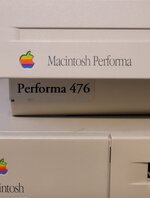
I recently purchased a Performa 467, primarily for the novelty of such an obscure model number. Other than bundled applications, it is identical to the LC III+. Both machines are just LC III computers with a boost from 25 MHz to 33 MHz.
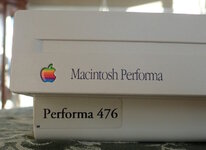
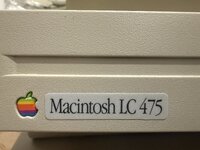
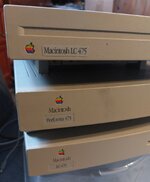
Some weird things were going on at Apple in 1993. Here are all three machines:
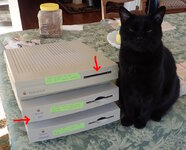
The Macintosh LC III has it's name printed on the case and an auto-inject floppy drive. The Macintosh LC III+ has a sticker and a manual inject floppy, hence the rounded inset for your fingers to push the disk in. The Performa 467 is similar to the LC III+.
Notice that the Macintosh LC III+ does not actually say "+" on the case. In fact, I have three labeled "LC III" computers with a sticker and manual inject floppy, but only two are 33 MHz. So, beware that it may just be an LC III with a manual inject floppy. I think the factory switched the cases over before they ran out of old 25 MHz motherboards.
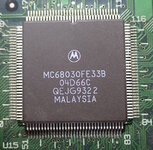
Here is the 68030 CPU with a 33 MHz rating.
Other than the drive, performance is significantly boosted by the speed bump. The columns are: overall, CPU, video, disk, and FPU, relative to the 25 MHz LC III.

I have installed 68882 FPUs into the empty sockets on these computers. By default, they do not include an FPU.
All of the LC III, LC III+, and Performa 460 series computers that I have use the same version of the motherboard, 820-0650-B. They all suffer from capacitor C21 being installed in reverse polarity, along with the incorrect silkscreen.
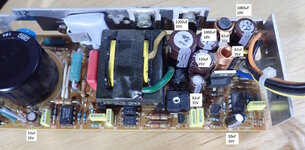
I've seen TDK, Aztec, and Dyna Corp power supplies in these computers. Because Dyna Corp (614-0028) is a little more unusual, here is the recapping layout:
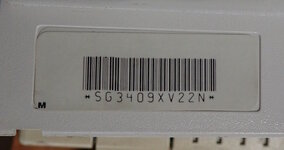
My Performa 467 was manufactured in Singapore during the 40th week of 1993, which is early October. That's consistent with the Wikipedia article timeline.
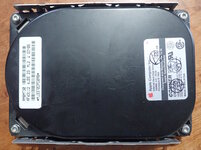
It came without any additional memory or VRAM, but had the original Apple-Conner 160 MB hard drive, which still works.
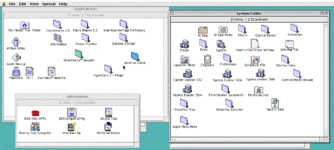
Although I imagine the original owner likely added and removed some of the Performa software bundle, here is a snapshot of what the drive contained when I got it. The "Information" folder with the Apple phone number and other help was novel to me.
- David
Some weird things were going on at Apple in 1993. Here are all three machines:
The Macintosh LC III has it's name printed on the case and an auto-inject floppy drive. The Macintosh LC III+ has a sticker and a manual inject floppy, hence the rounded inset for your fingers to push the disk in. The Performa 467 is similar to the LC III+.
Notice that the Macintosh LC III+ does not actually say "+" on the case. In fact, I have three labeled "LC III" computers with a sticker and manual inject floppy, but only two are 33 MHz. So, beware that it may just be an LC III with a manual inject floppy. I think the factory switched the cases over before they ran out of old 25 MHz motherboards.
Here is the 68030 CPU with a 33 MHz rating.
Other than the drive, performance is significantly boosted by the speed bump. The columns are: overall, CPU, video, disk, and FPU, relative to the 25 MHz LC III.
I have installed 68882 FPUs into the empty sockets on these computers. By default, they do not include an FPU.
All of the LC III, LC III+, and Performa 460 series computers that I have use the same version of the motherboard, 820-0650-B. They all suffer from capacitor C21 being installed in reverse polarity, along with the incorrect silkscreen.
I've seen TDK, Aztec, and Dyna Corp power supplies in these computers. Because Dyna Corp (614-0028) is a little more unusual, here is the recapping layout:
My Performa 467 was manufactured in Singapore during the 40th week of 1993, which is early October. That's consistent with the Wikipedia article timeline.
It came without any additional memory or VRAM, but had the original Apple-Conner 160 MB hard drive, which still works.
Although I imagine the original owner likely added and removed some of the Performa software bundle, here is a snapshot of what the drive contained when I got it. The "Information" folder with the Apple phone number and other help was novel to me.
- David