
Neutral's NeuNet is an alternative cabling system for AppleTalk that was designed in the UK that nobody seems to have now heard of. At first sight, the fact that it uses telephone connectors (although UK ones) invites comparison with PhoneNet, but it's actually designed very differently and to do different jobs. Since I stumbled into a box of it, I thought I would post some pictures and words about it.
The first thing it is designed for is structured cabling. Instead of having a bus wire that loops through boxes on people's desks, NeuNet sockets are faceplates that sit on standard telephone-sized pattress boxes, and each socket plugs into a computer. The bus wiring is within the cable installation: your users can't randomly unplug half your network.
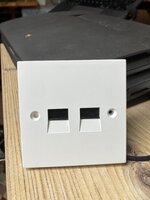
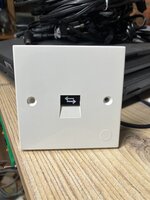
The sockets come in single or double variants, which look like this:

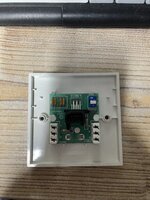
On the back of the socket there is a circuit board that contains circuitry roughly equivalent to the innards of a normal localtalk box.
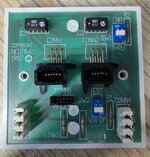
The two components labelled 1601 at the top are the isolation transformers (datasheet; and from this we can see that they must have made these boxes for a good while; the circuit board copyright date is 1987, but the date code on the transformers is 1995!). The END/THRU is used to enable or disable termination, depending on whether this box is on the end of the bus or not. And the TEST/NOR OP ("normal operation") switch enables or disables a test socket which I don't quite understand, although the documentation says that a network tester was available. I do not have one.
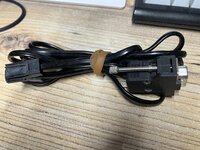
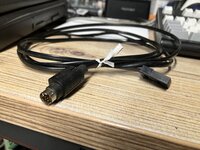
The cables that run from the wall box to the computer look kind of like this, and were obviously available for both 128/512 and Plus-and-above style serial ports:
But what if, in some places, you *want* the flexibility of ordinary LocalTalk cabling? Or you have areas that are already wired up and you need the backwards compatibility? Then you need a NeuNet Bus Socket. These look like this (and, again, come in single or double versions):
The main difference here is the total lack of isolation: the place where the isolation would be (labelled IC1 here) is replaced with straight-through links. This allows a cable to be used to dangle a whole localtalk chain off this socket:

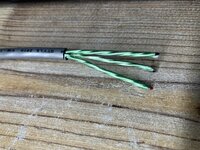
And then your chaos is contained. The cabling downstream of this box may be all over the desks, but the cabling upstream is nicely bundled into a single six core cable in the wall.
Hang on.
Six core?
This takes us to design point number two. This is designed for high speed AppleTalk at 2.5mbits, but in a way that does not require you to upgrade all your computers at once, and which maintains backwards-compatibility with old ones.
How this works is slightly less clear to me, because it requires a NeuNet network card, which I do not have and have never seen. However, there's a whole second pair of bus wires in the cable for high speed, and the documentation says that the NeuNet network card would talk to each computer on the network at the speed that computer can manage. What I assume is going on here is that all computers announce themselves on the slow link, and ones that have this NIC in also announce themselves on the fast link. Then the NIC (or the driver for it) listens for traffic on both the fast and slow interfaces, and sends frames out the fast interface if it's seen the destination on the fast interface, and the slow interface otherwise.
But I may be making this up.
Anyway, I now have a box of NeuNet to go and find somewhere to put. Hope this was vaguely interesting!
(Neutral's website is still up - but it has a copyright date of 2020 and nobody answered my email about this system. If anyone ever does find my email I'll update you all)
The first thing it is designed for is structured cabling. Instead of having a bus wire that loops through boxes on people's desks, NeuNet sockets are faceplates that sit on standard telephone-sized pattress boxes, and each socket plugs into a computer. The bus wiring is within the cable installation: your users can't randomly unplug half your network.
The sockets come in single or double variants, which look like this:
On the back of the socket there is a circuit board that contains circuitry roughly equivalent to the innards of a normal localtalk box.
The two components labelled 1601 at the top are the isolation transformers (datasheet; and from this we can see that they must have made these boxes for a good while; the circuit board copyright date is 1987, but the date code on the transformers is 1995!). The END/THRU is used to enable or disable termination, depending on whether this box is on the end of the bus or not. And the TEST/NOR OP ("normal operation") switch enables or disables a test socket which I don't quite understand, although the documentation says that a network tester was available. I do not have one.
The cables that run from the wall box to the computer look kind of like this, and were obviously available for both 128/512 and Plus-and-above style serial ports:
But what if, in some places, you *want* the flexibility of ordinary LocalTalk cabling? Or you have areas that are already wired up and you need the backwards compatibility? Then you need a NeuNet Bus Socket. These look like this (and, again, come in single or double versions):
The main difference here is the total lack of isolation: the place where the isolation would be (labelled IC1 here) is replaced with straight-through links. This allows a cable to be used to dangle a whole localtalk chain off this socket:
And then your chaos is contained. The cabling downstream of this box may be all over the desks, but the cabling upstream is nicely bundled into a single six core cable in the wall.
Hang on.
Six core?
This takes us to design point number two. This is designed for high speed AppleTalk at 2.5mbits, but in a way that does not require you to upgrade all your computers at once, and which maintains backwards-compatibility with old ones.
How this works is slightly less clear to me, because it requires a NeuNet network card, which I do not have and have never seen. However, there's a whole second pair of bus wires in the cable for high speed, and the documentation says that the NeuNet network card would talk to each computer on the network at the speed that computer can manage. What I assume is going on here is that all computers announce themselves on the slow link, and ones that have this NIC in also announce themselves on the fast link. Then the NIC (or the driver for it) listens for traffic on both the fast and slow interfaces, and sends frames out the fast interface if it's seen the destination on the fast interface, and the slow interface otherwise.
But I may be making this up.
Anyway, I now have a box of NeuNet to go and find somewhere to put. Hope this was vaguely interesting!
(Neutral's website is still up - but it has a copyright date of 2020 and nobody answered my email about this system. If anyone ever does find my email I'll update you all)
Last edited:






 )
)


