Either run a bridge wire from wherever the other end of the trace is to the capacitor leg, or scrape off a bit of the solder mask beside the pad and solder to that instead of the pad. You can get sticky replacement "pads" but you will need to scrape off a bit of solder mask and solder to the trace in either case.
Either run a bridge wire from wherever the other end of the trace is to the capacitor leg, or scrape off a bit of the solder mask beside the pad and solder to that instead of the pad. You can get sticky replacement "pads" but you will need to scrape off a bit of solder mask and solder to the trace in either case.
Yup, the solder mask is part of the PCB manufacturing process that keeps the copper under the mask safe. It looks like a very easy fix, (carefully) scrape a bit of solder mask off and You can probably use something like an component lead to bridge that tiny gap.
Yup, the solder mask is part of the PCB manufacturing process that keeps the copper under the mask safe. It looks like a very easy fix, (carefully) scrape a bit of solder mask off and You can probably use something like an component lead to bridge that tiny gap.
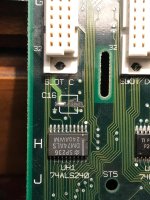
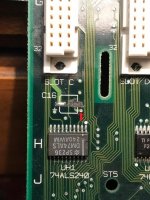
I’m a bit knew to doing this type of repair, are you saying a should scrape off a bit of solder mask directly above or below where the missing pad was? If not could you annotate where you mean?
There is a via (a through-hole) right next to the pad which is where the pad connects to the Ground Plane.
You could either solder a wire into that hole and connect the other end to the capacitor terminal, or scrape the green coating off the trace that you can see between that hole and the capacitor pad. Under the green coating is copper. But don't scrape so hard that you cut through the underlying copper.
To solder a wire in that hole, you really ought to remove the old solder in the hole, which can be very challenging. You would need to add solder flux to the hole first, to help the old solder melt and flow properly and then use some good quality desoldering braid, like Chemtronics. Do not bore the soldering pencil into the hole, if you are having difficulty. The hole has a relatively delicate copper coating (put there by electroplating) and can be damaged by mechanical insult.
@trag@CompgekeAlright, I found a schematic, and I need some confirmation on how I am reading this. When I look at C16 it looks like it is connected to a common ground via the negative side of the capacitor. So if that is correct, I could easily attach a bridge wire to another negative pad like C15 or C14. Am I interpreting the schematic correctly?
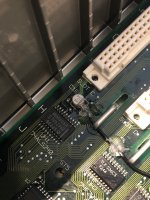
Well, the alternative repair that I came up with was completely successful. On the diagram, I was able to get the negative lead of C16 verified as a common ground. I used a long bridge wire from the negative lead of C16 to the negative lead of C15.
This site uses cookies to help personalise content, tailor your experience and to keep you logged in if you register.
By continuing to use this site, you are consenting to our use of cookies.