
-
 Hello Guest! We're hosting a challenge to welcome vintage Intel macs to the MLA during the month of July! See this thread for more information.
 -
We've made some quality of life improvements to the Trading Post. More info here.
You are using an out of date browser. It may not display this or other websites correctly.
You should upgrade or use an alternative browser.
You should upgrade or use an alternative browser.
Free Macintosh Plus!
- Thread starter PotatoFi
- Start date





No pictures to share on this update, but here's what I've done:
- After letting it sit for 3 weeks, I took it apart, discharged the CRT (no pop), and completely disassembled it
- Cleaned entire case with dishwasher detergent and a toothbrush
- Scrubbed black marks and paint overspray off with a wet rag and baking powder
- Performed full submersion retrobrite under a UV lamp (it didn't do much... I think the cold in my garage inhibits the process), decided that it looks "good enough"
- Ordered new capacitors for the analog board
Last edited by a moderator:

Cold absolutely will work against you. You need UV + at least room temperature 72 F/22 C. Those are essentially the two variables you can control intensity of UV and heat. The stronger the UV, the faster and stronger the reaction, up to a point. Also, more heat the faster the reaction will occur, up to a point.No pictures to share on this update, but here's what I've done:
Tonight I'm going to play with the hairdryer and bending the plastic burn back into shape. I messed with it a bit this afternoon and found that while I could slightly soften the plastic, I couldn't really get much to happen. If you have any tips, let me know.
- After letting it sit for 3 weeks, I took it apart, discharged the CRT (no pop), and completely disassembled it
- Cleaned entire case with dishwasher detergent and a toothbrush
- Scrubbed black marks and paint overspray off with a wet rag and baking powder
- Performed full submersion retrobrite under a UV lamp (it didn't do much... I think the cold in my garage inhibits the process), decided that it looks "good enough"
- Ordered new capacitors for the analog board
Regarding heat to move the plastic, if you can, use a highly controlled heat source where you can set the temperature. There is an extremely fine point between making it soft enough to remold, and just too much, where the texture of the case starts to get lost due to it becoming too amorphous.
Last edited by a moderator:
I have to wait a few days for capacitors to arrive anyway, so I might bring it into the house where it is about 70 F and give them some more time. What's interesting is that it's more white where I scrubbed things off using baking soda, probably due to the slight abrasive nature of the baking soda.Cold absolutely will work against you. You need UV + at least room temperature 72 F/22 C. The more heat you can provide the faster the reaction will occur, up to a point.
I'm curious, what reference do you have for the 72 F/22 C thing? Personal experience is completely valid here.
Last edited by a moderator:
Yep, taking the grime and oxidation off with baking soda gave it easier access to the chromophores in the plastic, so it could attack them more easily to reduce the colorI have to wait a few days for capacitors to arrive anyway, so I might bring it into the house where it is about 72 F and give them some more time. What's interesting is that it's more white where I scrubbed things off using baking soda, probably due to the slight abrasive nature of the baking soda.
Okay, I played with the hairdryer. No effect. Switched to the heat gun, and that got the plastic moldable. Here's what it looked like before:
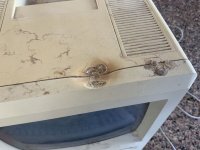
Here's what it looks like now:
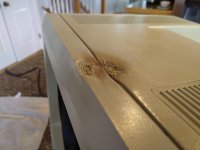
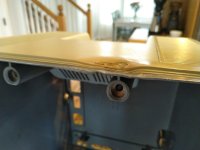
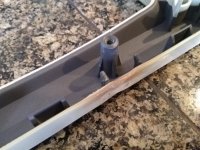
I don't know if I made it better or worse. There is a bit of a burn mark on the front now, despite my best efforts to not get things too hot. The problem is that the sunken/burned parts are in the very corners of the plastic where I can't get heat in there and really push on it.
So I'm kinda wondering if I need to get some bondo, trim away the parts that stick out too much, and fill the parts that are depressed. Of course I'll never be able to match texture but I can at least fill in some stuff.
I'm 100 percent open to suggestions here. I'm especially keen on saving the front panel because it's an M001 panel. What a shame that the top got burned.
Edit: The 8-Bit Guy did an interesting repair on an Apple II with resin... but it was a hole cut in the top. This is on the edge, so I don't think resin will work. I think my best shot is to possibly use body filler and paint a small section of the case. It will never, ever look perfect, but I figure if I can mask it some, that would be good. Looking for opinions about this for sure... I'm just not sure what to do about it.
Here's what it looks like now:
I don't know if I made it better or worse. There is a bit of a burn mark on the front now, despite my best efforts to not get things too hot. The problem is that the sunken/burned parts are in the very corners of the plastic where I can't get heat in there and really push on it.
So I'm kinda wondering if I need to get some bondo, trim away the parts that stick out too much, and fill the parts that are depressed. Of course I'll never be able to match texture but I can at least fill in some stuff.
I'm 100 percent open to suggestions here. I'm especially keen on saving the front panel because it's an M001 panel. What a shame that the top got burned.
Edit: The 8-Bit Guy did an interesting repair on an Apple II with resin... but it was a hole cut in the top. This is on the edge, so I don't think resin will work. I think my best shot is to possibly use body filler and paint a small section of the case. It will never, ever look perfect, but I figure if I can mask it some, that would be good. Looking for opinions about this for sure... I'm just not sure what to do about it.
Last edited by a moderator:


I still wonder what caused a burn\melt like that on it from the start? I can't think of any items that could do that short of a soldering iron or something like that. It seems too big for a cigarette of any kind. Maybe acid? Was it from an area where chemistry was done?
Last edited by a moderator:

Desk lamp too close is my guess.
I'm not sure of the details, but I do know that it spent a good part of it's life in an aircraft hangar. My guess is a hot torch was set on it. It REALLY burned it. Huge bummer that it got both the front and back cases.
I suppose I should consider replacing the case. I must admit that I do like the Platinum cases better than Beige, and my keyboard is Platinum. I don't know what a Macintosh Plus case is worth.
I suppose I should consider replacing the case. I must admit that I do like the Platinum cases better than Beige, and my keyboard is Platinum. I don't know what a Macintosh Plus case is worth.
That would be one desk lamp I would be afraid to get near...Desk lamp too close is my guess.
If you plan to keep it. I'd go for a new case. If you plan to pass it alone, I'd go for a zero sum game with it. Do the best you can, get it working, and just let it go for what its worth.
Last edited by a moderator:
72 F/ 22 C in chemistry is considered part of what is known as STP for chemical reactions. STP stands for Standard Temperature & atmospheric Pressure. Standard temperature is room temperature, which is defined as 72 F / 22 C, according to chemistry standards. Standard pressure is considered 1 atm, which is what the atmospheric pressure is on a neutral day (Sunny, Blue Sky, Fluffy white clouds) at sea level, which by chemistry standards is considered standard earth atmosphere. Practically every chemical reaction is done at STP (unless the reaction calls for a different set of conditions), so the standard rule for a chemical reaction is a "standard" room temperature of 72 F/ 22 C. So I just picked that as it is the so called "golden standard" for chemical reactions. Essentially any chemical reaction that is meant to be done without special conditions should work well under STP, as a standard assumption.I have to wait a few days for capacitors to arrive anyway, so I might bring it into the house where it is about 70 F and give them some more time. What's interesting is that it's more white where I scrubbed things off using baking soda, probably due to the slight abrasive nature of the baking soda.
I'm curious, what reference do you have for the 72 F/22 C thing? Personal experience is completely valid here.
Last edited by a moderator:
Fantastic explanation @Paralel! Thank you!
Okay, I have received my capacitors and have them installed. The very last step is to install the anode cap, but... while the metal parts inside the cap seem to be holding tight, I can't get the suction cup to REALLY suction down. It un-sucks after about 60 seconds. Is this a problem?
I'm seriously ready to flip the power switch on it, other than this problem.
Okay, I have received my capacitors and have them installed. The very last step is to install the anode cap, but... while the metal parts inside the cap seem to be holding tight, I can't get the suction cup to REALLY suction down. It un-sucks after about 60 seconds. Is this a problem?
I'm seriously ready to flip the power switch on it, other than this problem.

No Jinnai, you're correct. Well, really the cap is there because without it the anode wire itself would be arcing everywhere. You NEED the cap to stay "glued" down. That's what the red you usually see in that area is. Glue. You also don't want any nicks damaging the cap. So it sounds like you should reglue the cap somehow. Or, like one of my junk SEs had, duck tape it.
Wish I had access to a better lab, I could tell you. I could solubalize it and do an HPLC-MS. Guarantee it would tell me for sure.It would be great if we could find out what the OEM sticky solution was.
Similar threads

- Replies
- 4
- Views
- 869


- Replies
- 5
- Views
- 470

