• Hello MLAers! We've re-enabled auto-approval for accounts. If you are still waiting on account approval, please check this thread for more information.

IIci @68040: a way to improve performance and frame rate?

Macbuk

6502
Eleven years later i restored my retro-obsession and succesfully restored both my IIci boards (suffering from erratically Power on/no sound syndrome). 

Micromac Carrera 040@33 MHz

equipped one (system 7.1)
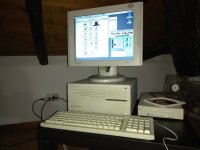
IMG_20190222_194621.jpg

Daystar Turbo 040@33 MHz equipped one with Apple 8.24 card @ 1151x870 (system 7.5)
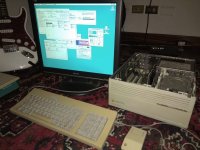
SAVE_20190224_083519.jpeg

I'm quite satisfied with their performance.

However i was wondering if i'm missing some software (quickdraw libraries) or i could trace some of those venerabile accelerators nubus video card to improve the frame rate on 3D games performance (Flight simulator 3, Doom, Pathways into darkness, Wolfenstein 3D).

Which FPS 3D games do you suggest?  Any better optimized game?

I'm asking cause i have read that some nubus accelerated video cards scored less the expected performance when compared to internal video expecially in 68040 enviroments. 

 
Your collection link gives me:


404 NOT_FOUND


Unable to process request
I'm Sorry. Picasaweb hosting service had a permanent shutdown. I will solve asap.

I'm managing to restore the old pre-90 machines i collected over the years (up to 2008). At the time i have recapped/restored only the 2 IIci and a IIfx.

The Se30 i repaired in 2008 thanks to the help of this forum still starts flawlessy.

Now i have a bunch of Macintosh II board (5) and some Classic Mac to test and eventually repair but i'm more interested in collecting "some" nubus cards.

Which accelerated nubus videocard could improve the performance of 3D games in a IIci @ 68040 enviroment? 

 
What resolution do you require at what bit depths for the games you'd like to play?

NuBus cards are limited by the bandwidth of its 10MHz clock. Built-in graphics started with the IIci and running at the 25MHz system clock, you're probably not going to find a NuBus Card that will beat it at low resolutions like 640x480 @ 8-bit for most games when it comes to frame rates. I don't think even its system memory abusing Vampire Video setup could bog it down that far. For higher resolutions/color depth/better frame rates your gaming budget would be better spent on a Quadra 605/LC 475 than a good or great NuBus card. Those kick some serious built-in video butt for very high resolutions at 24bit. That's where graphics budget is best invested or for a less expensive card to run a 1152x870 at 8-bit or 16" 832x642 on the IIci, which tops out at the 640x480 @8-bit sweet spot for most gaming IIRC.

NuBus kicked ISA video card's butt until graphics cards went onto Proprietary Local Buses and then the VLB. The Mac's built-in video IS a local bus in that parlance.

 
Last edited by a moderator:
Few Nubus cards can approach the speed of the Quadra lines onboard framebuffer. The one exception is the ultra rare 8 24 GC from Apple, when used in a IIfx it will benchmark either at or slightly above a Q950’s framebuffer in Snooper. This is probably due to the IRQ management chip in the IIfx giving priority to the 8 24 GC as that card was meant to go into a IIfx.

Otherwise most nubus display cards were designed to push high resolutions at acceptable performance in productivity and engineering apps.

 
What resolution do you require at what bit depths for the games you'd like to play?

[...] you're probably not going to find a NuBus Card that will beat it at low resolutions like 640x480 @ 8-bit for most games when it comes to frame rates. 
Thanks Trash80toHP,  i'm not searching for anything more than 640 x 480 @ 8 bit. I would have liked somewhat higher framerate in Flight simulator 3.0 / Wolfenstein 3d (full screen) / Pathways into darkness . They appear somewhat unsatisfying even in their "sub-windows".

For higher resolutions/color depth/better frame rates your gaming budget would be better spent on a Quadra 605/LC 475 than a good or great NuBus card. Those kick some serious built-in video butt for very high resolutions at 24bit. 
I should already have a quadra 605 deeply stored in my garage (i think with 512 k vram only). 

I'm curious to test if its built in video scores better results than a IIci built in video driven by 68040-33 MHz accelerator.

I had a quadra 650 board into a modded IIcx case but unfortunately i sold It cause i dislike the idea of Frankenstein machines.

Otherwise most nubus display cards were designed to push high resolutions at acceptable performance in productivity and engineering apps.
I will search for a videocard allowing 24 bit at higher resolution than 640x480.

Few Nubus cards can approach the speed of the Quadra lines onboard framebuffer. The one exception is the ultra rare 8 24 GC from Apple, when used in a IIfx it will benchmark either at or slightly above a Q950’s framebuffer in Snooper.
Never seen an 8.24 gc. Neither on ebay! :-(  thanks IIfx

 
Last edited by a moderator:
I should already have a quadra 605 deeply stored in my garage (i think with 512 k vram only). 

I'm curious to test if its built in video scores better results than a IIci built in video driven by 68040-33 MHz accelerator.
Interesting notion, there might be something to it, but most likely you're stuck in that 25MHz system clock bottleneck between 040 at whatever speed and the frame buffer on the logic board. Overclocking the IIci might be your best bet for improving frame rates on that machine if possible, dunno. Quadra 605 can be overclocked IIRC, that'd be my choice for gaming in that era.

 
Do you get much of a FPS boost with the '040 accelerators, or does it remain pretty sluggish?  In the day, any FPS game on any '030 or mildly faster '040 was good for postage stamp size windowing apart from late model '040 machines (950, Q630, 840AV).  Even Marathon, Doom weren't ever that great compared to a PPC with native PPC code, where there is an immense boost.  So apart from finding a PPC card for your IIci to play FPS games, I'd use it for other game genres.

 
Interesting notion [...]

Overclocking the IIci might be your best bet for improving frame rates on that machine if possible, dunno.
Quotation of 68040 accelerators have grown beyond the limit of reasonability. I would avoid to take the risk of bad soldering (even if i'm enough used to and It implies crystal only)

Quadra 605 can be overclocked IIRC, that'd be my choice for gaming in that era.
Would overclocking the lc475 interphere (or avoid) with resolutions higher than 640x480? I remember something similar, but i'm not sure. :-(

 
I had a IIci back in the 90s and it lived through a Turbo040/33 upgrade, Turbo601/66 upgrade, hacking the Turbo601/66 to 96MHz, Moving all disks to JackHammer in striped arrays, adding/replacing a Futura SX/8, Futura II/SX, Radius IV GX 1152.

In my benchmarking, I found that frame rates for games never really improved much, especially between the Turbo040 and Turbo601 and later.   Frame rates were bottlenecked by bandwidth limitations, not by CPU capability.    Pathways Into Darkness was playable with most of the detail settings turned off, IIRC.  This might be the one game that saw some improvements with more CPU.    Marathon was never better than barely playable.   You really needed a minimum of a Q605 for Marathon and a Q630 with the Valkyrie video acceleration option turned on in Marathon was much better.

Basically, you're never going to see good game framerates in a IIci.   It just can't sling the data around fast enough.

Even in a 120MHz NuBus PowerMac, the Radius IV GX and rival Villagetronic card could not produce acceptable framerates in Marathon.    NuBus is just too limited in bandwidth, no matter how much CPU power is on the host side of the bus.

Good framerates on NuBus based machines only happened with there was some form of video connected directly to the Processor bus, such as the built in video on some (all?) of the Quadras or the PDS slot HPV card in the NuBus PowerMacs.

 
Quotation of 68040 accelerators have grown beyond the limit of reasonability. I would avoid to take the risk of bad soldering (even if i'm enough used to and It implies crystal only)

Would overclocking the lc475 interphere (or avoid) with resolutions higher than 640x480? I remember something similar, but i'm not sure. :-(


Overclocking the Q605 can sometimes require that you buy new VRAM modules with faster (lower numbered) speed ratings.    I think going from 80ns to 70 or 60ns?  Or was it going from 100ns to 80ns.  Memory is too dim....

Going to 33MHz almost always works fine with the stock circuit board.  Going to 40MHz often requires replacing the clock buffer chip with a mumble16W70 or mumble16W80.

http://www.applefool.com/clockchipping/

http://colourclassicfaq.com/mobo/chip605.html

 
Do you get much of a FPS boost with the '040 accelerators, or does it remain pretty sluggish?  
The boost Is consistent when compared to 030. Probably overclocking the Micromac Carrera (that carries a 33 MHz chip) to 40 MHz would solve my queries. Buy i've some concern with both Daystar and Micromac 040 cards for the aforementioned reasons.

In the video below a comparison between 040-33 and 030-25 in a 1152x870 8.24 enviroment.


To be honest with internal videocard i obtain very marginal inprovements only. The frame rate is almost the same. 

Am i missing some.software? inside the System i do not find quickdraw libreries. Could they help? 

 
Last edited by a moderator:
[...]Pathways Into Darkness was playable with most of the detail settings turned off, IIRC.  This might be the one game that saw some improvements with more CPU.  

Basically, you're never going to see good game framerates in a IIci.   It just can't sling the data around fast enough.

NuBus is just too limited in bandwidth, no matter how much CPU power is on the host side of the bus.


Thanks. :-(  This should save me from spending money and time. :-) :-)

 
 I wonder if dropping the resolution to 512x384 might help things a bit? That would make playing your games in a near full screen window (maybe full screen?) more satisfying. Dunno if slinging less pixels through the bottleneck at the display might help with the bandwidth limitation or not, but it's worth a try?

 
 I wonder if dropping the resolution to 512x384 might help things a bit? 
Thanks Trash80toHP, i tried: No luck.

You really needed a minimum of a Q605 for Marathon and a Q630 with the Valkyrie video acceleration option turned on in Marathon was much better.

Basically, you're never going to see good game framerates in a IIci.   It just can't sling the data around fast enough 
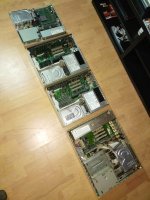
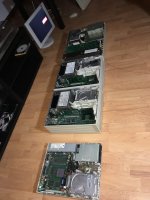
I've been doing some comparison during these days. As you suggested I've found a "still starting" 605 deeply covered of dust.

Up today i've had no interest on pizza box models. Now i have 3 "68030" and 3 "68040" in four machines only, to do some tests  :-)

SAVE_20190303_193442.jpeg

SAVE_20190303_193455.jpeg

As far i can say i noticed the lc475/605 (stock 25 MHz 68lc040) is by no mean better performing than accelerated IIci (33 MHz) in both "Pathways into darkness" and "Flight simulator 3" enviroments.

I'll do some tests with speedometer 4.0 to see if 475 internal video does better than 040 accelerated IIci internal video.

Incidentally I got unexpected (at least for me) results with cvid video playback. :-O

I used Mpegstreamclip to achieve some Cinepak encoded 320x240@30 and 480x360@25 samples.

I tried to download marathon.sit from Macintosh repository. 

However Stuffit 4.02 and 3.07 failed to expand the file. Which version do i Need?

Can you provide a "more friendly" file? 

 
Perhaps try the Marathon downloads from S7T: http://main.system7today.com/gaming_fv.html

As far i can say i noticed the lc475/605 (stock 25 MHz 68lc040) is by no mean better performing than accelerated IIci (33 MHz) in both "Pathways into darkness" and "Flight simulator 3" enviroments.
To me, this would imply that these things are, in fact, CPU bound and are probably not graphics accelerated. 

The way to make these run faster will be to get a faster overall system. For example, a clock chipped 650/800 or 950, or an 840av.

However, given that Flight Simulator 3, 1988 (if I'm reading Wikipedia correctly), is roughly contemporary to the IIci, it was probably never meant to have "fast" graphics. In fact, I would be completely unsurprised if it was really targeting the Plus and SE.

Ultimately, though, for most things QuickDraw-accelerated or anything that can be sped up, what's been posted about Quadra onboard graphics generally outperforming most NuBus cards is correct. The main reason NuBus cards remained popular as add-ons for graphics is if you needed a display larger than 1152x870 (which Apple didn't do onboard until, like, the 7500/8500), high-resolution 24-bit color, if you needed multiple displays, or if you were using an add-in board with additional hardware claiming to speed up specific tasks. (Photoshop acceleration, mainly.)

 
Hey mates, 

I've been benchmarking the PDS Daystar 040 - 33 Mhz.

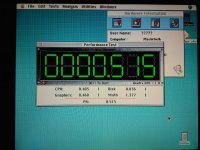
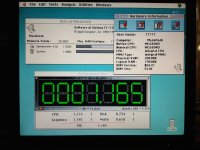
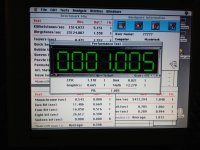
Speedometer 4.0: Some screen.

Stock IIci, cache card, 20 -500

SAVE_20190305_190056.jpeg

IIci, 8.24 card  in 1152*870

Daystar Turbo 040

(No quad control no powermath on )

SAVE_20190305_190119.jpeg

IIci, internal video 640*480

Daystar Turbo 040 - 33 (no quad control/Powermath)

SAVE_20190305_190107.jpeg

Huge score improvement on graphics! 

Quadra 630/650 alike scores. 

Finally...

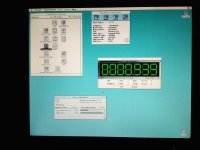
IIci, high resolution card - 8 bit

Daystar 040-33 (Quad control, Powermath option on).

SAVE_20190305_190136.jpeg

Quad control improves CPU and Math scores only. No impact on graphics.

I get very poor hard drive scores , whatever drive i use on both my Macintosh IIci(s). 

:-( :-(  

 
Last edited by a moderator:
Quad control improves CPU and Math scores only. No impact on graphics.
Maybe I missed it, but it doesn't look like you have a benchmark of the IIci with the 8.24 video card installed but without the CPU accelerator?

It makes perfect sense that the internal video would be sped up muchly by the 68040 card compared to the stock CPU given it's just a dumb framebuffer; the CPU is responsible for shoving all the bits around, and even though the "vampire video" of the IIci probably impacts CPU performance somewhat compared to the dedicated VRAM you find on a real Quadra I doubt that would show up much on a video benchmark. (640x480x8 only occupies 320k of RAM, it's really not shoving around *that much*. The difference might start showing up if the IIci supported 1152x870 at the same depth like a Quadra with 1MB can do.) Your 8.24 card is *also* a dumb framebuffer with no hardware acceleration, so the difference between the 1.145 you get with the built-in video verses the 0.665 you get with the video card would simply come down to the difference between RAM performance (68030 native @25mhz) verses Nubus (10mhz+some overhead). I'm going to hazard a guess that if you benchmarked the video card without the accelerator installed you'd find it running at almost exactly the same speed as internal video. I say this because the 0.468 score you got on the internal video in that configuration is lower than what looks to be the Nubus' saturation point. I'd be very surprised if it was anything but vanishingly higher, and not surprised at all if it remained lower.

The "interesting" thing to test here would be a Nubus card that does do video acceleration, like the 8.24GC. (The version with the AMD29000 CPU on it.) For the functions that are offloaded to the parasite CPU you might find the card faster than internal video, but:

  • A: These cards only work on a subset of quickdraw calls; on the ones they don't accelerate they'll be no faster and possibly slower
  • B: Games tend to be problem children with those cards because they often like shoving the pixels around with their own routines anyway instead of making use of the API in a way the card can help with, and
  • C: I vaguely recall reading an Apple KB that claimed that the internal video on a real Quadra was actually faster than the 8.24GC most of the time. (IE, fast direct framebuffer access trumped processes offloading) There are other accelerated cards that might be faster, but probably not by a lot and points A: and B: still apply.
 
Last edited by a moderator:
Back
Top