• Hello MLAers! We've re-enabled auto-approval for accounts. If you are still waiting on account approval, please check this thread for more information.

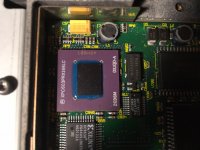
PPC740L G3 CPU Daughterboard For Blackbird Powerbooks

I only ever found the 117, and it was in a parts machine. Its got issues though, it will randomly freeze or bomb until it warms up. Cache issue possibly. 

I ended up finding the apple official one as well. 

 
Last edited by a moderator:
I only ever found the 117, and it was in a parts machine. Its got issues though, it will randomly freeze or bomb until it warms up. Cache issue possibly. 

I ended up finding the apple official one as well. 
The frustrating part is I actually had a 167 years ago, traded it to someone for some work on my Macs that were having serious hardware issues.

Thought I'd never use it for anything...

 
haha. I feel the same now with all my blackbird stuff. Everything I own is parts units because of the brittle plastic. Thats why I wish the CAD/3D printing stuff went somewhere. 

 
It has been done. It'll work with no problems. The 740 and 745 are both limited to 10x multipliers, so max of 333MHz unless you also want to try to overclock the memory bus to 40MHz. I don't know if an OC like that will affect anything else; only the memory and the first bridge chip operate at the full 33MHz while the rest of the system is on a separate buffered '030 bus that runs at 25MHz or less. If you did OC it, I'd probably recommend pulling the modem and its daughter card and devising a more elaborate heatsink or itty bitty fan to go in there to cool things down. Also probably a SSD, maybe drill a few holes in the frame stiffener to aid airflow.

Like the PB 2300, 5300, and 1400/117, none of these had any sort of L2 cache, just the 16k+16k L1 caches that were built-in to the 603e. The 740's 32k+32k L1 caches would likely provide a noticeable boost, in addition to the higher clocks.

That said, I'd be willing to do it (I posted in the Trading Post that I was looking for a damaged upgrade card so as not to ruin a good one), but my current rework tools are limited (just a computer-controlled handheld hot air nozzle) and I haven't yet either found a good rework station for under $7k or the justification to pay full price for one. Supposedly I would also need some sort of oven to bake the new chips before installing them to the PCB (to prevent chip popcorning), and I don't have that either so my success would be a maybe at best. Modern microelectronics is an expensive hobby and I sadly can't justify getting that into it. Maybe if it's still in demand when I retire in 10 years I can do it as a side job but I just don't have the time or space for much more than basic repairs or mods now.

 
The 740 H revision removed the 10x multiplier, the multiplier is now limited to 8x and maximum bus is now limited to 83.3. Apparently stability problems were discovered with the 10x multiplier and the 100 MHz bus on previous revisions. The 745 in this case is not pin compatible with the 603ev because of a one pin difference. I think a CSE input was switched to a BVSelect output. Plus, the core voltage of the 745 is not drop-in compatible with the 603ev since it's 2.0v, whereas the 603ev is 2.6v (of course, that's not insurmountable).

I definitely don't want to try and overclock the memory bus to 40 MHz, the heat issue is likely to be bad enough already.

I definitely plan on a heatsink and a fan of some kind since the heat dissipation, worst-case scenario, doubles from 4 W to 8 W. I doubt the design, without these additions can handle that extra heat dissipation.

Hey, if you're willing to try, I'm game. I can actually get more than a few of the exact kind of processor needed, so it won't matter if one or two gets killed.

A damaged card is a great idea, assuming it can be made operational again. Much better than potentially murdering a good card for an experiment.

I see you're in Tokyo. That works out great, I'm used to sending packages to Japan since my brother lives over there.

One thing I'm interested in, from the pics (which I admit are crap) of the NuPower 167, can you figure out which of the resistor sets is the PLL:CFG? I have looked at it again and again and just can't seem to identify them by sight. The current settings for the PLL:CFG needs to be changed so the card can run at 266 MHz. If one tried to run the 266 MHz G3 with the current PLL:CFG, they will be disappointed to find it only runs at 167 MHz.

 
Last edited by a moderator:
I might be getting my hands back onto the old ACHI rework station I used to use back in the X360 days. Honestly though, I have no use for it as I dont do BGA rework anymore. It was a royal PITA when I did. Every step had to be exactly perfect or things would go wrong in a hurry. 

So if I can get my hands back on it again, It would be available to who needs it. It requires a 220V circuit though. 

The last time I used it was doing repairs on a failed 500Mhz Sonnet L2 card. 

The chip was ceramic so it wont popcorn. the PCB however.... 

 
Last edited by a moderator:
The MPC740ARX266LH arrived today, now I only need to find a victim NuPowr 167 (or 183, although I really wouldn't want to risk a 183 if I can at all avoid it) board.

I'm a patient man, it will happen eventually. The processor was the harder part, to be honest, and I got exceptionally lucky with that one.

 
According to this datasheet, the 745 is "drop-in compatible" with the 740 and 603ev. I'm not an EE, but I take "drop-in compatible" to mean I can take the 745 and install it in place of the 740 or 603ev without changing anything on the original board. It also suggests that any changes to pin assignments are for non-vital functions and thus ignored by the 745 and host system unless the chip is installed in a specific application that exploits these changes.

This datasheet also specifies the minimum operating frequency of the 745 as 200MHz with a maximum of 350MHz, bus frequencies of 33, 50, 66 and 100MHz, and a maximum 10x multiplier. If a 745 was sourced, our theoretical maximum would be 333MHz on a 33MHz bus. A 40MHz bus may be possible but is technically unsupported, and anything over 350MHz is unattainable anyway.

From what I can judge from the pics I would guess that the PLL resistors are those located near the XILINX chip in that picture; they're the only ones with the appearance typical of a bank of selectable components that generally makes up a PLL config.

I'd be willing to take a shot at it if there are no other takers, but no guarantees. I have a dead 5500 board I'll use to try to judge the times and temps to use for removal of the original processor and cleaning of the board, which will hopefully translate to the upgrade card and increase my odds of success.

I'd figure someone had a damaged upgrade card around somewhere. Those flip-chip packages are extremely fragile and people crack the dies all the time through improper handling or installation; this is the major factor that drove Sonnet to factory-install heatsinks to their upgrades and void the warranty if you removed them.

 
I just got out my PPC-upgraded 540c, and miracle of miracles, it's the 167 MHz model! I think....

See for yourself and tell me if it actually is:

IMG_1450.JPG

If I'm reading the writing on the chip correctly, the 3 digits before LC, 166, would represent 166 MHz, yes?

I hesitate to donate it to the cause because it works 100% and I don't want it to be damaged, but I will if there's a greater than 50% chance the swap will work, because the prospect of making it into a 300+ MHz G3 is quite compelling.

c

 
Really?

Well, I don't think it'll matter here, as I have confirmed unequivocally that what I have is indeed the Newer Technology 167 MHz upgrade, which is precisely what Paralel needs! It's not *too* rare, according to a post somewhere on the last page. Right?

Nevertheless, Paralel, it looks like I have the last piece of your puzzle!

c

 
Last edited by a moderator:
Meh, they're uncommon, but they're not quite at the rarity level of the 183MHz or whatever the top-end one is.

On the bright side, even if one of us amateurs botch the processor swap, so long as the card itself is undamaged there's nothing to stop someone from properly performing the upgrade or installing a faster 603ev at a later date; the only guaranteed casualty is the original processor and even then it wouldn't be a problem for someone with a proper BGA reballing kit.

So in combination with Paralel's in-hand 740 this would yield a processor card up to 266MHz, which is about 70% faster in clock speed with a doubling of L1 cache over the original 166MHz 603ev.

 
Shipping is going to be a problem I guess but I can do the swap if needed in case nobody in the US is stepping up to do it.

Have done a lot of CPU swaps already and I am pretty confident that I won’t kill the board or the chip in the process.

 
@Bolle I'd totally be up to sending it to you, but I'll let Paralel make the decisions here, since it's his project (and he has the replacement CPU).

c

 
Sounds good to me. I can send the chip to Bolle no prob.

The only thing that needs to be done besides swapping the processor is to make sure the PLL:CFG 0-3 resistor bank is where we think it is and change it from the current setting to 1-1-0-0, so it will run with the 8x multiplier. Otherwise you'll end up with a G3 that runs at 167 MHz, which is probably still much faster than the 603ev present, but why run at 167 if you can run at 266 MHz?

Also the thermal has to be handled before it is ever installed into a working machine and powered up. The current processor @ 167 MHz is putting out 2.1 W thermal for typical use and 3.2 W worst case scenario. The upgraded processor @ 233 puts out 5.7 W thermal for typical use and 7.9 W worst case scenario. I'm thinking thermal tape and a low (possibly super-low) profile heatsink. Possibly securing the top of the heatsink to the rudamentary heatspreader that the Blackbird has to further enhance the thermal transfer. Hopefully that will be enough, Thoughts?

The processor I have should work great, its not used or reballed, just NOS, been sitting around somewhere with no one to purchase them.

 
Last edited by a moderator:
According to this datasheet, the 745 is "drop-in compatible" with the 740 and 603ev. I'm not an EE, but I take "drop-in compatible" to mean I can take the 745 and install it in place of the 740 or 603ev without changing anything on the original board. It also suggests that any changes to pin assignments are for non-vital functions and thus ignored by the 745 and host system unless the chip is installed in a specific application that exploits these changes.

This datasheet also specifies the minimum operating frequency of the 745 as 200MHz with a maximum of 350MHz, bus frequencies of 33, 50, 66 and 100MHz, and a maximum 10x multiplier. If a 745 was sourced, our theoretical maximum would be 333MHz on a 33MHz bus. A 40MHz bus may be possible but is technically unsupported, and anything over 350MHz is unattainable anyway.

From what I can judge from the pics I would guess that the PLL resistors are those located near the XILINX chip in that picture; they're the only ones with the appearance typical of a bank of selectable components that generally makes up a PLL config.

I'd be willing to take a shot at it if there are no other takers, but no guarantees. I have a dead 5500 board I'll use to try to judge the times and temps to use for removal of the original processor and cleaning of the board, which will hopefully translate to the upgrade card and increase my odds of success.

I'd figure someone had a damaged upgrade card around somewhere. Those flip-chip packages are extremely fragile and people crack the dies all the time through improper handling or installation; this is the major factor that drove Sonnet to factory-install heatsinks to their upgrades and void the warranty if you removed them.



The datasheet you linked says "The PC745 is a drop-in replacement for the PowerPC 740 microprocessor and is also footprint and user software code compatible with the PowerPC603e microprocessor." The way it is phrased means its a drop-in for the 740, but is only footprint and software code compatible with the 603e, not a drop-in replacement for it.

I was correct about there being an issue with B01. It is BVSelect (Board I/O Voltage Selection) an Input, active High, which goes to ground if the I/O bus is 1.8/2.0 V, and 3.3 V if the I/O bus is 3.3 V. On the 603ev B01 is CSE 0, an Output, active High. I'm not exactly sure what a CSE is, but acting as an output on the 603ev and an input on the 740 seems like a problem. Other than that, they are pin-compatible, but Board I/O Voltage Selection is a fairly essential pin.

Their core voltages are also not compatible. The 740 & 603ev run at 2.5 V +/- 5%, the core voltage for the 745 is 2.0 V +/- 5%. It is core voltage compatible with the 740L, which was the second revision of the 740, and has a core voltage of 2.0 +/- 5%.

 
Last edited by a moderator:
Plus, to make the PC745 compatible with the 740, you'd still need to connect B01, with is NC on the 740, so it can act as BVSelect for the 745, so you'd need to use a jumper wire. So, the PC745 is only "drop-in" if you can add a trace to the board design for the 740 its replacing, or place a jumper wire.

 
Last edited by a moderator:
To the membership here as a whole, do the bold sections in this post:


Seem like they could be a problem? I'm not too familiar with some of the abbreviated names for those pins/pads. We need to know if those pads need to be disconnected to act as NC before attempting to graft the G3 to the NuPowr board. We won't really have an option to disconnect those pads after the G3 is in place.

I just want to make sure all our ducks are in a row before we take the plunge.

 
Does anyone know what data bus interface mode (64 or 32 bit) the 603ev operates in when installed in the BlackBird?

Does anyone have a BlackBird running a 603ev upgrade module with the proper info or diag utility that can tell us what mode the data bus is operating in?

If it's 64-bit, we are good to go. If it's 32-bit, we've hit a potential hard stop, because the 740 cannot operate in anything but a 64-bit data bus mode.

It's possible the Pratt chip is still capable of handling a 64-bit data bus interface, but it would be a gamble, as in, we would have no idea until we tried it.

 
Last edited by a moderator:
Back
Top