• Hello MLAers! We've re-enabled auto-approval for accounts. If you are still waiting on account approval, please check this thread for more information.

SE/30 sound issues: Installed 3rd party ROM in SE/30; sound gone, only static

I'm hoping for some SE/30 expertise.  I installed a 32-bit, third-party ROM into my SE/30.  The system powered on and I heard the chime, but it was very staticky.  The system booted just fine, but the speakers continued to put out static, and the real sound faded down to almost nothing.  I quickly powered off the system and replaced the third-party ROM SIMM with the original.  Unfortunately the static continued and got progressively worse. The sound is now gone completely...

Before installing the third-party ROM SIMM, I had recapped the board, and the sound was loud and clear (and static free).

I recapped the board again after the sound died, still no change.  I can no longer hear the startup chime or get any sound whatsoever, and I still hear a lot of static from the speakers.  The system boots and functions perfectly otherwise (no SCSI, LocalTalk or any other issues I've noticed).  I tried installing the board in my other SE/30, and same issues (eliminating the analog board from the problem).

Any ideas?

Thanks in advance!  BTW, great forum!

 
Yes, pics of the caps. Especially if an older board where there are a couple on the far edges. I can not see how a ROM could affect audio in any way since it does not direct the audio directly. So it has to be something else. While I doubt its the speaker itself, it could be. Also check the solder to the speaker connectors. People have a tendency to pull the boards without disconnecting. People like me :)

 
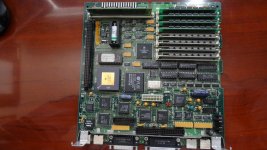
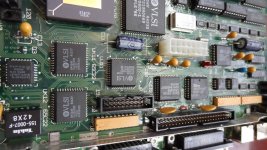
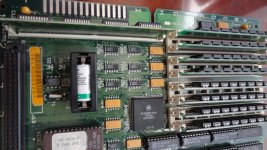
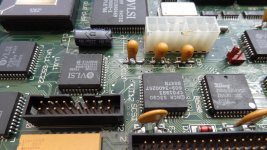
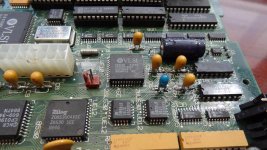
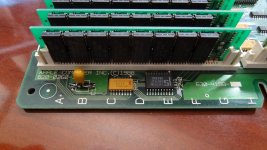
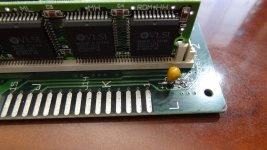
Thank you for your responses!  It also seemed strange to me that the ROM would affect the sound, so I haven't ruled out the possibility that it is a coincidence.  Please see the attached photos.  I can post others if I missed a relevant part of the board.

(Let me just admit up front that my soldering skills are amateurish at best...)

Also, one more thing, the sound works great through the headphone jack--loud and clear.  I have tried the board in a different SE/30 (that has a speaker I know works), so I'm pretty sure there is no issue with the speaker.  I has to be an component on the board.

Thanks again.

DSC04012.JPG

DSC04013.JPG

DSC04014.JPG

DSC04015.JPG

DSC04016.JPG

DSC04017.JPG

DSC04018.JPG

 
broken data line to ASC. Common problem. Sometimes you get a direct break at the ASC, But 99% of the time, the break occurs between the 8530 and 53C80 SCSI/SCC. 

The result is crappy to no sound, and majority of OS freezes/crashes with address error. 

 
Last edited by a moderator:
The sound chip usually gets goo and messes up.  Did you do good cleanup once caps were removed?
I haven't been so bold as to put the board in the dishwasher, as some people have done.  I did try to clean the board with rubbing alcohol and Q-tips.

 
I'm pretty sure the 3rd party ROM SIMM is one of the ones I built, since I just received a similar question from Matt in my email today :) Replying here too, just to add my two cents to the discussion. I very much doubt that the ROM SIMM itself caused any damage to the sound circuit. It's not necessarily a coincidence though--maybe just the act of moving the logic board around to install the new ROM SIMM did something.

You mentioned that sound works great through the headphone jack still. I think that's a huge clue. It probably means the sound chip is fine. I actually had a very similar problem with my IIci (the first machine I ever recapped) earlier this year -- randomly one day I noticed the sound was acting up. It got worse and worse, and eventually stopped working at all. I decided to check the headphone jack one day, and surprisingly it worked 100% fine.

It turns out that the problem was capacitor goo which had leaked underneath the headphone jack. I had carefully removed all the capacitors and cleaned beneath them, but I didn't remove any nearby chips/components to clean underneath them. At least on the IIci, the speaker circuit goes through the headphone jack. When the headphones are removed, it sends the sound to the speaker. When the headphones are plugged in, it sends the sound to the headphones. On my IIci, I removed the headphone jack and immediately realized that the goo had eaten through one of the headphone jack's pins. It fell off as I removed the jack. It was absolutely filthy under all of the ports. Several traces on the serial ports were broken too. I made sure all traces were good/fixed, then I soldered a capacitor leg onto the remains of the broken pin on the audio jack (which was VERY difficult, BTW) and soldered the jack back onto the logic board. Now the sound coming from my speaker is perfect again. The broken pin was one of the pins involved in the circuit on the jack that hooks up the speaker when the headphones are unplugged. Over the past 2-3 years, the goo had slowly eaten away at that pin.

There are certainly a lot of possibilities for what might be wrong. My (potentially crazy) theory is that when removing the logic board to install the custom SIMM, a pin that was almost eaten through finally gave way and became an intermittent connection, and quickly became a fully broken connection after that.

 
broken data line to ASC. Common problem. Sometimes you get a direct break at the ASC, But 99% of the time, the break occurs between the 8530 and 53C80 SCSI/SCC. 

The result is crappy to no sound, and majority of OS freezes/crashes with address error. 
Thanks, techknight!  Pardon my ignorance, though it was easy enough to identify the 8530 and the 53C80, I'm not sure which chip is the ASC.  What is the location of that chip (as printed on the board)?  I can track down some schematics and test continuity between the chips (in fact, if anyone has a link to a good copy of the schematics, that would be fantastic). I haven't experienced any freezes, crashes or address errors.  As I mentioned previously, aside from the sound, everything seems to work perfectly. 

 
I'm pretty sure the 3rd party ROM SIMM is one of the ones I built, since I just received a similar question from Matt in my email today :) Replying here too, just to add my two cents to the discussion. I very much doubt that the ROM SIMM itself caused any damage to the sound circuit. It's not necessarily a coincidence though--maybe just the act of moving the logic board around to install the new ROM SIMM did something.

You mentioned that sound works great through the headphone jack still. I think that's a huge clue. It probably means the sound chip is fine. I actually had a very similar problem with my IIci (the first machine I ever recapped) earlier this year -- randomly one day I noticed the sound was acting up. It got worse and worse, and eventually stopped working at all. I decided to check the headphone jack one day, and surprisingly it worked 100% fine.

It turns out that the problem was capacitor goo which had leaked underneath the headphone jack. I had carefully removed all the capacitors and cleaned beneath them, but I didn't remove any nearby chips/components to clean underneath them. At least on the IIci, the speaker circuit goes through the headphone jack. When the headphones are removed, it sends the sound to the speaker. When the headphones are plugged in, it sends the sound to the headphones. On my IIci, I removed the headphone jack and immediately realized that the goo had eaten through one of the headphone jack's pins. It fell off as I removed the jack. It was absolutely filthy under all of the ports. Several traces on the serial ports were broken too. I made sure all traces were good/fixed, then I soldered a capacitor leg onto the remains of the broken pin on the audio jack (which was VERY difficult, BTW) and soldered the jack back onto the logic board. Now the sound coming from my speaker is perfect again. The broken pin was one of the pins involved in the circuit on the jack that hooks up the speaker when the headphones are unplugged. Over the past 2-3 years, the goo had slowly eaten away at that pin.

There are certainly a lot of possibilities for what might be wrong. My (potentially crazy) theory is that when removing the logic board to install the custom SIMM, a pin that was almost eaten through finally gave way and became an intermittent connection, and quickly became a fully broken connection after that.
Since I'm convinced at this point that your chip has nothing directly to do with the sound issue, I'll try it in my working SE/30...  (crossing my fingers)

 
Thanks, techknight! Pardon my ignorance, though it was easy enough to identify the 8530 and the 53C80, I'm not sure which chip is the ASC. What is the location of that chip (as printed on the board)? I can track down some schematics and test continuity between the chips (in fact, if anyone has a link to a good copy of the schematics, that would be fantastic). I haven't experienced any freezes, crashes or address errors. As I mentioned previously, aside from the sound, everything seems to work perfectly.
The ASC is the Apple Sound Chip. If your headphone jack is working OK, I think it's doubtful that the ASC is the problem, because it's clearly generating sound.
I'll be curious to hear how the SIMM does in the other SE/30. It should be fine...*crosses fingers along with you*

 
Last edited by a moderator:
The ASC is the Apple Sound Chip. If your headphone jack is working OK, I think it's doubtful that the ASC is the problem, because it's clearly generating sound.

I'll be curious to hear how the SIMM does in the other SE/30. It should be fine...*crosses fingers along with you*
Thanks, Doug!  The verdict is...the ROM chip works great in my other SE/30!  Previously I didn't dare try it in another machine for fear of breaking it too.  Now that that's out of the way, I need to find schematics, pull out my multimeter and start testing continuity.

 
the 2MB rom simm seems to work great in all of the SE/30's... its the 8mb rom simm that only works about %60-%70 of the time.

in the se/30.  Why?  i don't know... i think techknight has an idea.

 
Glad it works in your other machine Matt!

uniserver: The problem you're talking about is due to the thickness of the 8 MB ROM SIMM. My supplier made the 8 MB SIMMs much thinner than the 2 MB SIMMs (even though they were both ordered at the same thickness of 1.2 mm), so it has had contact problems in some sockets. The 2 MB SIMMs are thicker and never have the problem. At least some people with SE/30s have trouble with that, but I haven't heard of anybody seeing that problem in newer machines. I've been able to add solder to the contacts to fix the problem for at least one person.

Also, the 8 MB SIMM uses more traces than the 2 MB SIMM which uses more traces than the stock SIMM, so it's potentially possible that a machine could have damage on one of the higher address pins and nobody would know until they tried one of my SIMMs.

On the next batch I have made (whenever I get around to it), I'll try to make sure that the PCBs end up thicker so that particular contact issue doesn't happen. Anyway, that particular issue is totally different from the issue Matt is seeing, which is almost certainly a broken trace/pin somewhere...

 
broken data line to ASC. Common problem. Sometimes you get a direct break at the ASC, But 99% of the time, the break occurs between the 8530 and 53C80 SCSI/SCC. 

The result is crappy to no sound, and majority of OS freezes/crashes with address error. 
Ok, so I found the schematics and did continuity tests.  I tested the address lines between UE10 and UK6 (as well as UJ11, and UI12).  Everything checks out fine.  I also checked for continuity from the Sony sound chips (UB10 and UB11) to UE10.  All is well there too.  Do you have any other suggestions?

 
if the headphone jack works fine, then you need to check the op-amp and transistor pair next to the sony chips. That drives the speaker. 

Also keep in mind the speaker amplifier gets its signal from a reed finger in the headphone jack, so if the jack is corroded slightly, the speaker may or may not work or intermittently. 

 
Last edited by a moderator:
if the headphone jack works fine, then you need to check the op-amp and transistor pair next to the sony chips. That drives the speaker. 

Also keep in mind the speaker amplifier gets its signal from a reed finger in the headphone jack, so if the jack is corroded slightly, the speaker may or may not work or intermittently. 
So I think I've narrowed the problem down to the Q1 NPN transistor.  Comparing this board side by side to one of my working boards, I get no resistance readings between emitter (-) and base (+) nor between collector (-) and base (+) on my broken board.  The same readings on my working board look normal (numbers in the MOhms).  The Q2 PNP transistor tests the same on both boards. 

I'm not familiar with the component specs.  The lettering on it says "1A."  I searched for 1A surface mount NPN transistors, and found some.  Unfortunately they come in 10K, 22K, and 47K varieties (on Amazon).  Do you know the kind of transistor I'll need?  Are there different transistors that might be better?

Thanks!

 
Back
Top