• Hello MLAers! We've re-enabled auto-approval for accounts. If you are still waiting on account approval, please check this thread for more information.

Yet another Macintosh Portable repair thread.

Hi all,

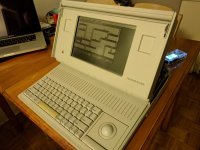
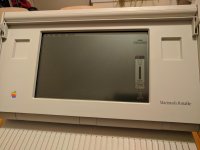
Picked up a Mac Portable 5120 (non-backlit) last week; before powering it up, I removed the logic board, removed the caps from it - all of them, except the tantalum cap on the hybrid board - cleaned the board, replaced the caps, and got a new black 6v 4.5ah brick battery.

Putting it all back together, it won't boot off of the battery alone - the screen flickers, and it either hangs on a flickering mouse-pointer screen, or flips over to the chimes of death.

With the original Macintosh Portable power adapter and new battery connected, it will boot 90% of the time. When it falls, it simply does nothing.

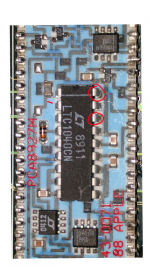
Based on previous threads here, I'm suspecting the hybrid board. I did find one bad trace on there, which I have bridged, but no change.

Wondering if anyone here has any ideas to help narrow down the next vector of attack. I want to test continuity on all of the hybrid board traces, but I lose some of them beneath ICs.


 
Bad hybrid IC. 

Known issue. No real true fix other than using a bit of reflow flux on the hybrid's solder joints on top surface, and use a heatgun to reflow the joints and try to absorb the cap goo into the flux, then clean hybrid. 

That "usually" gets them going. But not always. 

 
This would be a first time for me doing something like what you've described; could I impose upon you to elaborate on the procedure a bit for a relative novice?

 
I'm here to learn. This forum have me the confidence to lean soldering, which I've used to repair a bunch of logic boards and PSUs since I first arrived trying to fix my first compact Mac, an SE/30.

Imagine you have an apprentice with you. Reflow flux? Any one in particular? Solder joints on the top surface? All of them, including the perimeter pins that connect down to the logic board, or just the ones on the ICs and surface-mounted components? Any tips regarding the technique for applying the heat gun?

 
Use kapton tape and aluminum foil to isolate what you're heating, else you ask trouble from other components on the board (or melted plastic connectors)
I'm guessing the hybrid IC is a surface-mount component, with leads only on the top side of the board? I'd start with just that.

If you're not careful around other surface mount components, the heat gun could melt the solder and blow them off the board... I've had it happen.

As far as reflow flux, I've never used it honestly. Not sure what to recommend beyond googleing on that one.

 
Nope, the hybrid IC is a big DIP ceramic package in the corner of the board. 

I posted a picture of it in another thread describing its operation but I cannot recall where though. I have slept since then. 

P.S. I don't work well with apprentices, I had a couple at my current job I have fired already.

It's not you or anyone else, its me...I don't have the patience anymore as I lost it long ago for reasons I will remain nameless. 

 
Last edited by a moderator:
I can take on some mild soldering apprenticeship :)
A good buddy of mine for many years has mentored me in the art, I'm happy to pass on any tips I can.

Granted, most of the advice is in assembly and repair technique, as well as tool recommendation, not quite so much in troubleshooting other than some very obvious things like replace all electrolytic caps all the time. Have a problem? Check for electrolytics. If they exist, replace them  :lol:

 
Techknight; Rajel, thanks for the help so far.

I found in another thread that Techknight mentioned Chipquik SMD291 as a reflow flux.

I'll pop into the Portable again later this week and see what I can do about reflowing joints. I'll take another stab at metering out traces on the hybrid then as well.

 
Still not quite right. 

its DIP mounted to the mainboard, but the IC itself is a ceramic substrate with SMD parts on it. Thats why its called a "Hybrid" 
Aaaaaaaah. That makes sense.

Sega did similar for the RGB video DAC used in several of its arcade boards, and the Game Gear kiosk systems. Potted SMD components on a DIP board.

 
that was a quick trick if the trace goes open on the hybrid module on the main IC, and thats between 16 and 18. 

Also capacitor goo that remains on the hybrid can cause the IC not to oscillate which can show the symptoms you describe, It will also show the battery is charging when its not or vice versa. 

adding a resistor can "kick-start" that IC, but its only a bandaid IF the trace isnt open. ultimately the hybrid needs deep cleaning and the solder joints reflowed with the proper flux. 

 
Thanks. Nobody local to me seems to carry anything but liquid soldering flux or rosin flux; I think I'm going to have to order some of the Chipquik in.

 
So my Chipquik came today, but I don't have a hot air station - I'm going to go in to a local hacklab to see if I can use one of theirs, and get some instruction / supervision.

In the meantime, I figured I might as well repack my original battery. Prior to this, I was hooking up my new black brick to the contacts in the bay via alligator clips.

IMG_20170330_232022.jpg

I popped it in, and the dang thing booted off of it! It booted from floppy, and it booted from FloppyEmu, and had no problem accessing the floppy drive while using the FloppyEmu as a hard drive.

IMG_20170330_214852.jpg

When I first put it in, it reacted properly to the introduction of the power adapter, indicating charging in the battery desk accessory while the adapter was attached. Wasn't doing that at the end, though - with the adapter connected, the battery meter just filled up to the top over about 10 seconds, with no lightning bolt. I guess the hybrid still needs a reflow.

IMG_20170330_221843.jpg

Still, this is the first time that it has booted from the battery. I wonder if it's a crazy fluke, or if my alligator clips just weren't providing enough contact before, somehow.

 
Yeap the hybrid still needs work. 

You may be able to get away with just the resistor mod and be OK. Start with a 10Meg resistor and work your way down until things become stable. 

 
Back
Top