
-
 Hello Guest! We're hosting a challenge to welcome vintage Intel macs to the MLA during the month of July! See this thread for more information.
 -
We've made some quality of life improvements to the Trading Post. More info here.
You are using an out of date browser. It may not display this or other websites correctly.
You should upgrade or use an alternative browser.
You should upgrade or use an alternative browser.
What is the -12V Rail used for?
- Thread starter pizzigri
- Start date



They're used for the serial ports and sound circuit. Sound goes positive and negative and the serial old macs uses (RS422) implements differential pairs.As in the title, what are -12v and -5v rails in classic 68k macs - and also 601 and 603e PowerPC, used for ? Why is it so important? This would help in rebuilding/replacing the PSU in many vinta machines, especially when using modern ATX/SFX psu.

As far as I remember, the LC uses -5V for sound, but I don't remember the -5V rail in 10 pins computers like IIci, IIsi and Q700, these just want -12V as negative current.
As modern power supplies still have the -12V rail, you can restore the -5V rail by doing a thing like this with an LM7905:

 github.com
As modern power supplies still have the -12V rail, you can restore the -5V rail by doing a thing like this with an LM7905:
GitHub - wiretap-retro/ATX--5V-Inline-Adapter: A small inline adapter for an ATX power supply to generate -5VDC for Retro PCs
A small inline adapter for an ATX power supply to generate -5VDC for Retro PCs - wiretap-retro/ATX--5V-Inline-Adapter
github.com

Great info, there the issue of rail power though, especially in the latest sfx psu, the -12v is ratwd at 0.3w, which is… quite anemic, especially if I have to convert it using a 7905…. could that be an issue? Is there a polarity inverter IC I could use? I have seen buck converters rewired to have -12v caveat is they cannot share gnd - which is a problem here
Yep, it could be an issue.especially in the latest sfx psu, the -12v is ratwd at 0.3w
If I recall correctly, while digging AliExpress, I saw few buck modules that convert +12V into -12V and -5V, but I should find it again as I don't remember how it was called.
They're used for the serial ports and sound circuit. Sound goes positive and negative and the serial old macs uses (RS422) implements differential pairs.
This. Some computers do the conversion to a negative voltage on the logic board instead, but you generally need a negative reference somewhere for both of these applications. Most machines that do need a negative voltage rail only need one of the two.
Great info, there the issue of rail power though, especially in the latest sfx psu, the -12v is ratwd at 0.3w, which is… quite anemic
You don't need much power on this at all.
However, the negative lines on modern PSUs are basically vestigial. I have had more luck getting either a 5 -> -5 DC/DC converter or an isolated 5 -> 5 DC/DC converter wired up to produce a negative voltage relative to ground, and hanging it off the 5V line.
edit: no need to use a linear regulator here - this doesn't need to be a precision supply. A switching regulator will work just as well.
If I recall correctly, while digging AliExpress, I saw few buck modules that convert +12V into -12V and -5V, but I should find it again as I don't remember how it was called.
There are loads of DC/DC converters out there that will do this, it's not an exotic requirement.
I know, I wanted to give an exampleThere are loads of DC/DC converters out there that will do this, it's not an exotic requirement.
that is a very interesting solution, do you have an example and a link to this? Especially in regards to sharing the same gnd reference !However, the negative lines on modern PSUs are basically vestigial. I have had more luck getting either a 5 -> -5 DC/DC converter or an isolated 5 -> 5 DC/DC converter wired up to produce a negative voltage relative to ground, and hanging it off the 5V line.
There are loads of DC/DC converters out there that will do this, it's not an exotic requirement.
that is a very interesting solution, do you have an example and a link to this? Especially in regards to sharing the same gnd reference !
Here's something I posted about it a couple of years ago:
2-component LC power supply (amateur hour bodge)
Multiple people have asked me recently about my bodge-up LC II PSU that I use in the rackmount LC II, so I'm going to post about it here. It comes hedged about with a number of warnings, though: this is amateur hour hardware, and may be a bad idea in ways I don't know about. Obviously this...
 68kmla.org
Note that there are far cheaper choices of component - that was just what I had


Somebody (you?) just asked this on my blog. Here's my answer:
I believe the Mac uses very little from -12V, perhaps a few tens of milliamps. I’ve actually been researching this exact question recently, looking at the Mac IIci and IIcx. One thing you may have missed is that the Mac’s internal -5V rail is derived from the -12V supply with a 7905 linear regulator, so you need to sum the Mac’s demand from both -5V and -12V to estimate how much -12V the PSU must provide.
The 7905 -5V regulator itself has a quiescent current of 6 mA.
The two serial ports (printer and serial) use -5V, but for communication and not power. Looking a the circuit for a PhoneNet LocalTalk adapter, the -5V signals are driven through two parallel resistors (10K and 1K), so the current will be about 5.5 mA. I’m not sure about other serial devices but it’s probably similar. Call it 20 mA per serial port if you want to allow for some headroom.
The floppy drives theoretically use -12V, except they actually don’t. None of the standard 1.44MB floppy drives use -12V. If you look at the IIci schematic, you’ll also notice that -12V is only connected to the *external* floppy port, not the internal. I think this was simply a holdover from the Apple II days and an allowance for a possible future external floppy device that needed -12V. But no such future device was ever created. For Apple II drives that do need -12V it’s only used as a reference and the current is about 2.5 mA.
NuBus slots are supplied with -12V but not -5V. But I’ll wager that no NuBus cards actually use -12V for the same reason the Mac itself doesn’t – it’s just not needed for most chips and designs from that era. Maybe if you have a NuBus card that adds extra serial ports, or that does something exotic, then you might see some -12V load. But for typical NuBus cards like ethernet and video and accelerators, no.
Add those all up, and you get a total -12V demand of perhaps 50 mA at most.
I believe the Mac uses very little from -12V, perhaps a few tens of milliamps. I’ve actually been researching this exact question recently, looking at the Mac IIci and IIcx. One thing you may have missed is that the Mac’s internal -5V rail is derived from the -12V supply with a 7905 linear regulator, so you need to sum the Mac’s demand from both -5V and -12V to estimate how much -12V the PSU must provide.
The 7905 -5V regulator itself has a quiescent current of 6 mA.
The two serial ports (printer and serial) use -5V, but for communication and not power. Looking a the circuit for a PhoneNet LocalTalk adapter, the -5V signals are driven through two parallel resistors (10K and 1K), so the current will be about 5.5 mA. I’m not sure about other serial devices but it’s probably similar. Call it 20 mA per serial port if you want to allow for some headroom.
The floppy drives theoretically use -12V, except they actually don’t. None of the standard 1.44MB floppy drives use -12V. If you look at the IIci schematic, you’ll also notice that -12V is only connected to the *external* floppy port, not the internal. I think this was simply a holdover from the Apple II days and an allowance for a possible future external floppy device that needed -12V. But no such future device was ever created. For Apple II drives that do need -12V it’s only used as a reference and the current is about 2.5 mA.
NuBus slots are supplied with -12V but not -5V. But I’ll wager that no NuBus cards actually use -12V for the same reason the Mac itself doesn’t – it’s just not needed for most chips and designs from that era. Maybe if you have a NuBus card that adds extra serial ports, or that does something exotic, then you might see some -12V load. But for typical NuBus cards like ethernet and video and accelerators, no.
Add those all up, and you get a total -12V demand of perhaps 50 mA at most.
They're used for the serial ports and sound circuit.
Serial ports use -5V. Sound does not use any negative voltages that I've seen, at least not on the IIci and IIcx that I've been looking at.

Serial ports use -5V. Sound does not use any negative voltages that I've seen, at least not on the IIci and IIcx that I've been looking at.
Different machines have -12, -5 or neither (this last case the negative voltage is generated on the logic board) from the PSU and in some cases it is then regulated on the board using a 7905.
The original question was about machines in general and there are several different solutions so I didn't go into detail,
Edit
I'm been over hasty. Sorry.
Negative voltages are used in some sound circuits.
Last edited:
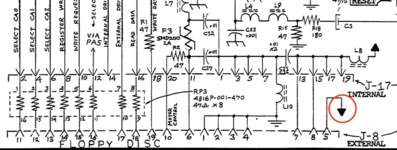
This is from the IIci, but the IIcx is the same. It shows -12V is only connected to the external floppy port. By rights it should also be connected at pin 9 of the internal floppy port but the schematic doesn't show any connection there. I haven't beeped it out to see if this might be a BOMARC error. But the drives themselves don't actually use -12V anyway.
Do you know which 68K Macs used negative voltages in their sound circuits? It would seem to make sense, but so far all the schematics I've looked at (IIci, IIcx, LCII) don't show any negative voltages in the sound circuitry.
The LC 475 and LC 630 have -5v going to the DFAC II chip, if it is missing, sound doesn't work. The 7905 was dead in my lightning struck Performa 630 and sound not working was the symptom I noticed. The -5 also went into the DOS card's sound card, and the serial stuff as discussed (where the surge got in). It had toasted most things on the -5v, except thankfully the DFAC II.View attachment 64614
This is from the IIci, but the IIcx is the same. It shows -12V is only connected to the external floppy port. By rights it should also be connected at pin 9 of the internal floppy port but the schematic doesn't show any connection there. I haven't beeped it out to see if this might be a BOMARC error. But the drives themselves don't actually use -12V anyway.
Do you know which 68K Macs used negative voltages in their sound circuits? It would seem to make sense, but so far all the schematics I've looked at (IIci, IIcx, LCII) don't show any negative voltages in the sound circuitry.
Performa 630 DOS - No Audio
Hello folks! I've been tidying up a Performa 630 DOS Compatible that was found at a dump a good few years ago, it has some corrosion damage due to being left outside (rust on ports, couple of corroded pins on the processor, some relatively minor blemishes here and there, plus it looks like the...
68kmla.org

As @bigmessowires mentioned, we have been discussing this very topic recently in the context of replacement PSUs for IIci/IIcx/IIfx.
There are a very very small number of SFX or Mini ITX PSUs that have more than 0.3A on the -12V rail. The stock PSU labels on the IIci/IIcx/IIfx show a 1A rating, and the Guide to Macintosh Family Hardware also shows 1A for these machines. But from @bigmessowires investigations thus far, seems like 0.3A should suffice.
The other consideration is that it does look like group regulation of the rails is a problem. @zigzagjoe mentioned this in my IIfx thread, and @bigmessowires and I saw this issue in practice as an ATX PSU we have been using has 5V rail voltage issues due to the lack of load on the 12V line. I am looking at whether a power resistor on the 12V line will resolve it but it’s probably better to pick up a PSU that has independent regulation of the rails or uses DC-DC converters. Most of the > $100 SFX PSUs seem to have DC-DC. But then it does start getting expensive. ATX and SFX-L won’t fit inside the IIci PSU enclosure. SFX and Mini ITX should fit.
Also looked at using a buck or boost converter to make a -12V line from the 12V line. Lots of the cheap ones on eBay/Amazon seem to have current limitations of even less than 0.3A. And other solutions that have 1A seemed to require additional heat sinks, etc. But I stopped looking after @bigmessowires determined 0.3A is fine.
There are a very very small number of SFX or Mini ITX PSUs that have more than 0.3A on the -12V rail. The stock PSU labels on the IIci/IIcx/IIfx show a 1A rating, and the Guide to Macintosh Family Hardware also shows 1A for these machines. But from @bigmessowires investigations thus far, seems like 0.3A should suffice.
The other consideration is that it does look like group regulation of the rails is a problem. @zigzagjoe mentioned this in my IIfx thread, and @bigmessowires and I saw this issue in practice as an ATX PSU we have been using has 5V rail voltage issues due to the lack of load on the 12V line. I am looking at whether a power resistor on the 12V line will resolve it but it’s probably better to pick up a PSU that has independent regulation of the rails or uses DC-DC converters. Most of the > $100 SFX PSUs seem to have DC-DC. But then it does start getting expensive. ATX and SFX-L won’t fit inside the IIci PSU enclosure. SFX and Mini ITX should fit.
Also looked at using a buck or boost converter to make a -12V line from the 12V line. Lots of the cheap ones on eBay/Amazon seem to have current limitations of even less than 0.3A. And other solutions that have 1A seemed to require additional heat sinks, etc. But I stopped looking after @bigmessowires determined 0.3A is fine.
Similar threads


- Replies
- 1
- Views
- 105

