Two cards found in a G4 DA

indibil

6502
Hi, lately I've been finding some very strange things, things I've never seen before.

Some friends brought home a G4 DA, and when I opened it up, I found two PCI cards inside that I'd never seen before.

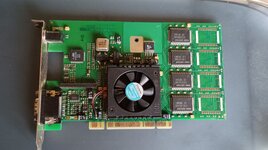
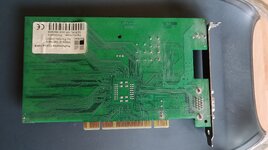
The first is a Formac graphics card, which according to Google seems to be 128-bit and 16MB. I assume it's equivalent to the ATI Rage Pro. For a Power Mac 7600, would this be better or the ATI Rage Pro? I've found drivers.
1776495781447.jpg
1776495781384.jpg

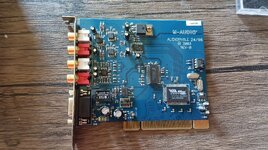
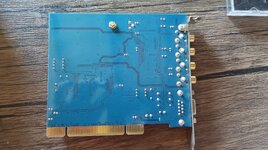
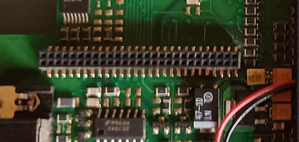
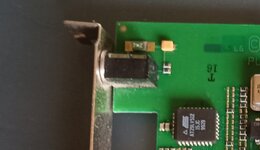
And then I found this card that looks like a sound card, but I haven't found anything about it. Does anyone have it? Are there drivers available?
1776504332706.jpg
1776504332676.jpg

Thanks.
 
The Formac card is a Permedia III-based chipset, it is excellent for 2D but very early 3D - was released late in the cycle as a cheaper dual monitor card for a Mac. Compared to your ATI Rage Pro, it may be faster for 2D with higher resolutions and quality but definitely not 3D, with drivers only for Mac OS 8-9.


The M-Audio card is an entry-level recording sound card, it also came with a break-out box. It fills a slot and probably gives better quality audio out than onboard but no other benefits unless you're into audio production on your Mac. It comes with support for Classic Mac OS and early versions of OS X, it was quite a well supported card.
 
was released late in the cycle as a cheaper dual monitor card for a Mac
I think you're thinking of the Village Tronic MPDD - the desktop doubler.

The Formac Proformance III shown was released as a high end professional card, yes mostly for 2D.

It has some of the best 2D performance of any Mac PCI card, including very fast font acceleration. It reviewed very well at the time for pro use.

The Village Tronic card on the other hand was marketed very much as a budget way of getting a second monitor (but is a great way to add DVI to a System 7 PCI Mac like a 7500).
 
Last edited:
For a Power Mac 7600, would this be better or the ATI Rage Pro?
For 2D, absolutely - for 3D... I'm not certain.

It does support OpenGL and RAGE and I think I remember it being faster than a Rage PRO (Rage II Pro, not edit and Rage 128 Pro), but the advantage of the ATI cards is that family became the defacto standard so compatibility is very good. The Proformance III is more likely to have graphical glitches or compatibility issues.

Give it a go and see.

It is the first card I ever played FA-18 Hornet Korea with hardware/textured accelerated 3D... It was like you were really there! :LOL: Note that there seems to be a bug with Korea that OpenGL doesn't work if you install the update, so stick to the initial release and don't install the 1.1 update.


Magazines reported a beta Glide (voodoo compatibility) driver, but it was never released publicly sadly.

Edit : it looks like 3D performance (using RAVE) was pretty good in many cases at the time of release. I believe "Orion" is a Rage 128 card isn't it??

 
Last edited:
For 2D, absolutely - for 3D... I'm not certain.

It does support OpenGL and RAGE and I think I remember it being faster than a Rage PRO (Rage II Pro, not edit and Rage 128 Pro), but the advantage of the ATI cards is that family became the defacto standard so compatibility is very good. The Proformance III is more likely to have graphical glitches or compatibility issues.

Give it a go and see.

It is the first card I ever played FA-18 Hornet Korea with hardware/textured accelerated 3D... It was like you were really there! :LOL: Note that there seems to be a bug with Korea that OpenGL doesn't work if you install the update, so stick to the initial release and don't install the 1.1 update.


Magazines reported a beta Glide (voodoo compatibility) driver, but it was never released publicly sadly.

Edit : it looks like 3D performance (using RAVE) was pretty good in many cases at the time of release. I believe "Orion" is a Rage 128 card isn't it??


Sorry, assumed the previous link had both, but it was only the updates.

Wow! Thank you so much for all this information! I think the Formac will be a great addition to my collection; I'm going to keep it. I saw in a PDF that there was a card to add a "TFT" port; I suppose it must have been DVI.
 
Last edited:
I saw in a PDF that there was a card to add a "TFT" port; I suppose it must have been DVI.
No, not DVI - an older digital format for early LCDs.

That round socket? That is for 3D glasses :) special ones that use liquid crystal shutters to blank one eye off at a time. The card displays at say, 120hz, but each eye only sees every second frame so you get a 3D vision because every second frame is from a slightly different position. The round socket controls which eye is blanked to sync with the card.
I've never seen a pair of the goggles for sale sadly.
 
No, not DVI - an older digital format for early LCDs.

That round socket? That is for 3D glasses :) special ones that use liquid crystal shutters to blank one eye off at a time. The card displays at say, 120hz, but each eye only sees every second frame so you get a 3D vision because every second frame is from a slightly different position. The round socket controls which eye is blanked to sync with the card.

I've never seen a pair of the goggles for sale sadly.

This connector:

1776616926460.png
 
I saw in a PDF that there was a card to add a "TFT" port; I suppose it must have been DVI.
It was likely OpenLDI/LVDS to support the SGI 1600SW, as Formac resold those. The Permedia 3 chip was the consumer version of the 3DLabs chipset found in e.g. the 3DLabs Oxygen VX1, which also had a version supporting the 1600SW.

Anecdotically, the Permedia 3 accelerated framebuffer driver in Linux (I think the acceleration framework was dropped at some point in 5.x or 6.x, unfortunately), was written for a ProFormance III on a PowerMac 7500. My late batter-bombed PowerMac 7500, to be accurate :-) The ProFormance III was pretty darn good for its time, but software support is king and 3DLads never caught on with gamers :-(
 
Yes, I know. It isn't for DVI. I was also explaining this port to you :

View attachment 97820

Yes, thank you, I understand. Sorry I didn't mention it. I suppose that 3D function can't be experienced without the original glasses.

It was likely OpenLDI/LVDS to support the SGI 1600SW, as Formac resold those. The Permedia 3 chip was the consumer version of the 3DLabs chipset found in e.g. the 3DLabs Oxygen VX1, which also had a version supporting the 1600SW.

Anecdotically, the Permedia 3 accelerated framebuffer driver in Linux (I think the acceleration framework was dropped at some point in 5.x or 6.x, unfortunately), was written for a ProFormance III on a PowerMac 7500. My late batter-bombed PowerMac 7500, to be accurate :-) The ProFormance III was pretty darn good for its time, but software support is king and 3DLads never caught on with gamers :-(

I was completely unfamiliar with those Formacs; I'd never even heard of them. I don't even know how they ended up in a DA.
 
I was completely unfamiliar with those Formacs; I'd never even heard of them. I don't even know how they ended up in a DA.
Formac hardware is common in Europe and rare in the US - if you mostly read / watch US stuff, they will likely pass you by. Same as VillageTronic. They're both German companies.
 
Back
Top