• Hello MLAers! We've re-enabled auto-approval for accounts. If you are still waiting on account approval, please check this thread for more information.

The ongoing saga of Andrew's SE/30

It's been a long time...too long, since I last posted here.  What's happened?

Back in the autumn of 2014, I found a Mac SE/30.  It had visible flaws I wanted to fix, but it booted up, and the price was free!

Or should I say, it once booted up.  A week or two after I got it, I turned it on...and was prompted with a blinking question mark.  A few weeks after that, I turned it on yet again...and saw discordant garbage on the screen.  Frightened, I never turned it on again after that.

Around this time my life descended into a personal crisis, and any potential computer tinkering took a back seat to the effort of retaining my personal sanity.  This was followed by months on end where I was preoccupied by work.  So the Mac sat, on the far end of the kitchen counter, waiting for the right time on a better day.

This week, the right time finally arrived...and I did the teardown I'd been meaning to do for months.
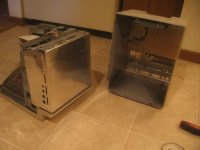
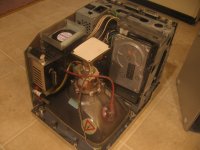
 
Separating the cases was the first, the simplest, and most straightforward part of disassembly:  I'd done this before, and the process was no-doubt eased by a cracked front bezel that wanted to bend.  Of course, that's one of the problems I'm seeking to fix!

IMG_5956sm.jpg

IMG_5960sm.jpg

 
The last time I attempted to disassemble the SE/30, my journey essentially ended here:  I discharged the CRT, then put the computer back together again as I wasn't yet ready to venture on.

This time around, I proceeded to disconnect the CRT from the analog board.  Removing the anode cap was extremely difficult:  The clips were stiff and clung tenaciously, the rubber cap got in the way, my fingers got sore, and I worried that I'd damage the glass trying to get it off.  Eventually I did it, but I'm still not entirely sure how.

Another round of nail-biting happened with the small "video board" attached to the end of the CRT yoke.  Maybe it would have been possible to separate the CRT from the analog board without touching it...but my SE/30 service manual said to pull it off; although a blob of silicone was keeping it tight in place.  I was able to cut through the silicone with a hobby knife and remove the video board from the yoke...but I was petrified that I'd damage the glass.

Finally I undid the yoke cable, video board cable, and logic board cable connectors from their locking clips on the analog board and pulled them out...and my knuckles were straddling the fragile CRT yoke the entire time.  Who says that computers aren't suspenseful to work on? 8-o

To be continued...

 
The last time I attempted to disassemble the SE/30, my journey essentially ended here:  I discharged the CRT, then put the computer back together again as I wasn't yet ready to venture on.
I had the same feelings with my color classic, the first few times, I opened, then closed it. took a few attempts to gain the bravery to venture forth.

 
I had the same feelings with my color classic, the first few times, I opened, then closed it. took a few attempts to gain the bravery to venture forth.
I won't mince it: For someone used to working on modular PCs, a compact Macintosh is a nightmare inside! Cramped quarters, with fragile parts and potential sources of stored electricity seemingly everywhere. At least with a small black and white tube like the one in the SE/30, there are only a few thousand volts to worry about. :)

Part of the reason why I got so waylaid in the first place is that I didn't originally have all the tools I needed. It took several trips to hardware stores around town before I found the prerequisite long-handled T15 screwdriver, and I also bought alligator clips and a few other odds and ends. I think I'm prepared...for now.

 
With all the cables detached and a few screws removed, the logic board came loose. It slid out willingly enough...though it was easy to whack the power supply casing against the CRT if I didn't jimmy it carefully, so it was hardly a tension-free affair.

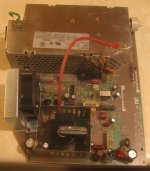
I was expecting to see bulging or leaking capacitors on the board, but to my surprise everything looked clean. In fact, the board itself was so dust-free that it looked as if it had just left the factory! It may well have invisible issues, but for now my fingers are crossed.

What was printed on the board raised my eyebrows, though. This is a Macintosh SE analog board (did SE/30-specific analog boards exist?)...and if "87 35" is a date code, it's older than the computer it's in. I was also a little surprised to see the Apple Computer logo printed in the 1970s Motter Tektura font, which was seriously old hat by 1990.

img_5966sm.jpg

 
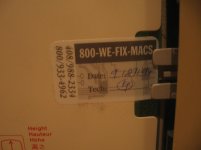
One more observation relating to the analog board and things that aren't totally factory-original: A sticker on the reverse side for "800-WE-FIX-MACS," with a service date in 1994. Apparently they're still in business in Palo Alto, California; which is nowhere near where this Mac ended up!

A similar sticker was emblazoned on the bottom of the floppy drive, this time with a service date in 1993. How many times did this thing need to be serviced?? If computers could talk...

img_5964sm.jpg

 
The hard drive is a Quantum. Which is why it doesnt work anymore. its dead. It is a well known fact that these particular drives have rubber inside that turns into a molten ball of goo and seizes up mechanical parts inside. The drive needs changed out and OS reinstalled. Use a more modern SCA solution, or SCSI2SD. 

Also, you need to remove the logic board, and wash/recap it. The analog board and power supply will need caps eventually, but more importantly the solder joints need tackled on the analog board. 

That should do it. 

 
Last edited by a moderator:
img_5967sm.jpg

Out the logic board comes! The hard drive ribbon cable was made much easier to remove without having the analog board in the way.

But wait: Where's the floppy drive cable? It turns out there isn't one! That explains why the drive didn't work during the computer's brief useful life in my hands...although I can't imagine why it would be missing. Add one to the "parts needed" column...though there's no guarantee that the internal drive even works.

img_5971sm.jpg

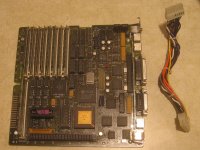
Here is the logic board, in all its planar green glory.

* Near as I can tell, I have four 4MB SIMMs and four 1MB SIMMs, which adds up to 20MB. Almost overkill for a system of this era, but I won't complain!

* Another windfall: The battery was intact, but it hadn't leaked!

The logic board was decidedly less clean than its analog equivalent, though: Most of it was coated with an oil-like residue that shined when I held the board up to the light. No shine was visible in the areas around the silver cylinder-like capacitors, though: These were dull, and gave the appearance of being coated with goo of a different sort. Just as I expected, the capacitors had leaked.

 
The hard drive is a Quantum. Which is why it doesnt work anymore. its dead. It is a well known fact that these particular drives have rubber inside that turns into a molten ball of goo and seizes up mechanical parts inside. The drive needs changed out and OS reinstalled. Use a more modern SCA solution, or SCSI2SD.
It's a damn shame if the hard drive lasted for more than two decades in operational condition, only to die in my hands. But not surprising.

img_5982sm.jpg

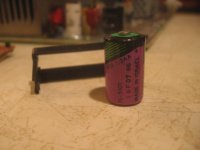
I was quick to remove the purple Tadiran battery. It looked as if it had been replaced at least once in the computer's operational life (date code 07 96) and hadn't leaked, but I still felt as if I diffused a time bomb the instant I took it out.

 
Analog Boards are share between SE and SE/30, and not great differences are found except for the first SEs having another fan (known as "Squirrel cage")

Tadiran Batteries are not known for having the same behavior as Maxell ones, most of the time they are only flat.

 
But you should still get rid of it and buy a new one. Yours is dated 1996... 

They are still available, unlike the ones used in the 128k-Plus which are unobtainable these days (not being manufactured anymore)

 
Thanks for the feedback so far,

Not likely. it was probably used for a few years, And then packed away for years and years until recently.
The SE/30 did boot and the hard drive still worked when I obtained it in 2014...I have pictures here. Trouble is, that only happened once and it never booted again.

 
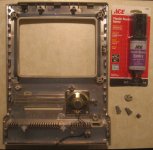
The computer looked as if it had been dropped at one point, and this manifested itself in a number of ways. The front bezel was damaged with two long hairline cracks in front, a chip taken out of the top corner, and four screw struts that had snapped and (in the case of two of them) were rattling loose inside the case.

I bought a tube of epoxy and went to work gluing the screw struts back in place. The hairline cracks were repaired as well; though I was a little messier with the glue than I should have been. Oh well...this SE/30 wouldn't win any beauty awards either way.

IMG_5977sm.jpg

 
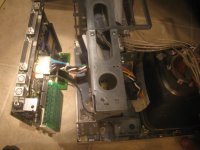
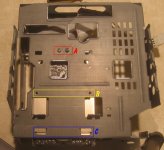
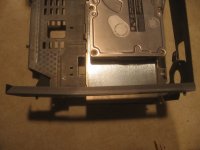
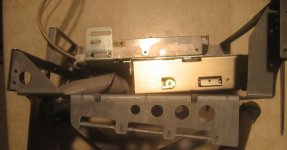
When I got the computer, the metal chassis had become completely unattached from the front bezel. The drive cage was hanging loose, limply, and crookedly from the rear screws (A). The middle screw holes (B} had no fasteners...I'm guessing a delinquent technician left them out during a 1990s service repair...while the front tabs © had become completely dislodged from their slots. I reseated and reattached the drive cage (though there's no guarantee that either drive works).

IMG_5997sm.jpg

 
Now it's time for questions...

IMG_5994sm.jpg

1) Is the top front brace of the chassis supposed to have a slight bend in it, or is this yet another artifact of drop damage?

IMG_5995sm.jpg

2) Is the hard drive supposed to be set so much farther back than the floppy? The illustrations in the service manual show the drives stacked much more in line. (The hard drive is--or was--a 230MB Quantum, and I'm sure it isn't original to the computer.)

3) The hard drive LED and LED cable are missing, and I don't see any place on the bracket to mount it. How was it mounted on SE/30s originally?

 
Concerning front brace, don't remember really, but think should be straight.

Hard drive caddy is ok, some HD were full height, so should be back in order to not touch the screen.

Not all the SE/30 have the LED fitted, if fitted the LED is mounted in the HD caddy.

 
Your floppy drive MUST sit flat as well. Otherwise it won't be aligned with the opening in the bezel properly and you will damage the drive like I did...  :-/

Thanks bibilit for fixing it, BTW! 

It's easy to misalign the FDD on SE-SE/30s. You can't possibly get it wrong on a 128k-Plus.  

 
Back
Top