• Hello MLAers! We've re-enabled auto-approval for accounts. If you are still waiting on account approval, please check this thread for more information.

Tantalum solder/desolder advice needed

Alex

6502
Dear Forum members

I am coming to you with a concern. I've never had to remove a tantalum cap before and am concerned that they may blow up (explode) if I expose them to too much heat, more so when desoldering.

Is this a general concern? I do know that I shouldn't be exposing anything to more than 3 seconds of continuous iron heat but I just want to understand if there are safety concerns that would absolutely require I wear googles. I get kind of spooked by little things that go pup so…

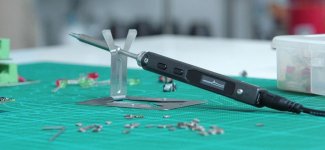
I will be using a TS100 soldering iron which can go up to 400°C.

Would love to get some feedback on any precautions.

—Alex
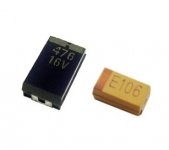
Tantalum cap to solder:desolder.jpeg

TS100.jpg

 
Last edited by a moderator:
The way I've been doing is two irons on both sides of tant caps and lift it together and have succeed to remove it.

Cheers

AP
I thought of that but I kind have to make do with the one I have but what about the direct question of safety?

 
Wear a pair of safety glasses or sunglasses if a mini-explosion really concerns you. Protective eyewear is inherently a good idea, though in this case the risk has to be very, very small. I wear glasses, mind you, so I never think of extra protection in these circumstances.

You’ll have trouble removing the cap with just one iron, unless it’s a “tweezer” style iron. Though flux and solder wick will help, the real danger is that you’ll lift the trace on the other side by trying to lever the side up where you have the heat. So it really would be better to do both sides at once. Alternatively, you MIGHT, if the cap is physically small enough, be able to do both ends at once in a solder “pool” covering both poles of the cap. After removal, you’d then clean the area up and solder in the new cap. I’ve seen that technique used to desolder USB ports and the like, but presumably it could work in this setting too.

Practice boards are a good idea for gaining soldering experience. Any old circuit board will do.

 
I managed to get by with a single iron and desoldering via desoldering braid. Remove the solder on one side of the component, then heat the other and gently pull once the solder is liquid on the remaining side.

Works every time.

 
Wear a pair of safety glasses or sunglasses if a mini-explosion really concerns you. Protective eyewear is inherently a good idea, though in this case the risk has to be very, very small. I wear glasses, mind you, so I never think of extra protection in these circumstances.
I won't quote your entire reply though all of it is excellent. If I do get a new soldering iron (I don't have a station) is there a particular one you recommend. I don't have a huge budget, which I understand is not favorable but maybe you can recommend a desolder iron, tweezer like for the job. I agree, on safety and would certainly want to avoid pulling pads. The pool idea sounds interesting but I am afraid of tantalums exploding, I've seen youtube video where people appear to do it deliberately and it doesn't look like something I would want to experience. Thanks again for an excellent reply.

 
I managed to get by with a single iron and desoldering via desoldering braid. Remove the solder on one side of the component, then heat the other and gently pull once the solder is liquid on the remaining side.

Works every time.
I will try that on an old failed iMac G3 board in a few minutes. Sounds like a plan.

 
It is unlikely that the cap will explode due to the heat used to desolder it, they explode due to electrical shorts developing and large amounts of current flowing through them.  You do need to take caution that the heat you are applying does not cause the pad and trace to lift off the board.  As other have said, there are ways to use a single iron to accomplish it.  If you use solder wick or a simple hand operated vacuum solder sucker and possibly some liquid flux, you should be able to remove the caps safely, it may take a couple of passes on each pad to accomplish it.

 
I got off one tant cap but it took a long time, about 10 min or a little more. I tried to remove a electrolytic one and still haven't managed. It's super hard, for me anyway, to get these off with one soldering iron. I may have to get the tweezer type.

 
Electrolytic caps can be cut off, by wire cutting pliers cutting through the cap, followed by picking off remaining debris/ cleanup. All that is left is then the legs, which can be desoldered easily. There is some danger of lifting a pad with this method, but for the most part it’s simply enough done. You could try that on the scrap board.

Search tweezer soldering iron on eBay and a cheap one should pop up in China.

 
Back
Top