• Hello MLAers! We've re-enabled auto-approval for accounts. If you are still waiting on account approval, please check this thread for more information.

Soft ps mod for hard ps macs & apple II's

barana

Banned
6502
This is a split topic taken from viewtopic.php?f=29&t=17789

I wonder If there is a way that a soft start (power/reset key from keyboard) power supply can be used on an earlier hard ps based mac/A2

What wiring/chip mods would be required?

and as an encore, can it be controlled by the system for shutdown without touching the power/reset key ie full software shutdown

- another addition - an init or something be written for Mac sys 6.x GSOS 6.0.1 so that it sends the appropriate signal to shutdown power.

cmon add your 2c...

 
I dont have a macintosh classic or classic II system. But with the SE and SE/30 its REEEEEEEEEEEL Simple actually. With the SE/30 someone else discovered the PwrOff connection on the secondary VIA is present so soft-shutdown is easy.

I cannot speak for the classic and classic II. But say if it was not present, then shutting down the system automatically powering it off as well would be much more trivial. Not impossible, as adding your own VIA to the expansion connector, or even patch it into the address/data GLU chip is easy enough to add automatic power-off shutdown capability (using bbrauns shutdown INIT tailored to the proper hardware mechanism of course).

If this isnt a concern, another way to go about it is once your at the safe to turn off screen, you could program a PIC or AVR if you press/hold the power button, itll power-down. As well as power up when you press the button.

Its all real easy. If i knew a little bit more about which exact systems your using and if you desire automatic power-off during shutdown will help me derive a schematic. Maybe next weekend ill make my Mac soft-power capable and explain it.

 
Its all real easy. If i knew a little bit more about which exact systems your using and if you desire automatic power-off during shutdown will help me derive a schematic. Maybe next weekend ill make my Mac soft-power capable and explain it


YES YES YES! please!

Well a compact mac ultimately a mac plus would rock! but i think the whole thing may require an adb mac so a classic/se30

(I do wonder how i will get a soft startup ps to fit into a compactmac -would a colour classic ps do?

and an apple IIGS would be the second one I would like to mod - It came with adb and im thinking a compact/si ps maybe (is the IIis ps even softpower enabled)

I do like the pic/avr idea for 8 bit apple iis/other pc's done in straight hardware no os necessary

this is quite exciting!

 
I am going to modify my power supply to run soft/start instead of shoehorning in an ATX. ATX is the easiest for normal modders, but modifying the original supply to work soft-start is cleaner/easier for me. But thats just me.

I thought I had a sony and an Aztec supply, but both my supplies are Aztec. would like to get my hands on a sony as well. The sony will be an easy one to mod to be soft-start.

The aztec isnt as easy, because not only does it have a PWM circuit that runs it, it also has a "tickler" circuit that sends pulses in the MOSFET to build a small voltage on the secondary windings. This in turn power and kick-starts the PWM circuit which eventually takes over. So in the Aztec, i would have to stop the PWM controller, AND tickler to put it in stand-by.

Problem: the tickler and PWM are on 2 different reference planes. weeeeeeeeee... fun.

 
these sony and aztec ps' out of what macs are they from? and will they fit in an se/30?

oh i see, i reread, ur going to mod ur current ps to do the job!

I'm salivating here! hehe

 
Yes. I had thought about just using a simple relay and cutting the mains connection to the Aztec. But I still need a constant 5V for standby current. So, That is why I just rather purposely shut down the power supply into standby, and just draw current from the tickler circuit.

The sony power supplies, they have a whole separate voltage reg for the PWM chip, So i can draw it from there :-)

 
ATX PSU replacements are for hackers who need MORE POWER!!!!!!!! }:)

ATX is also for the unfortunate ones who have a dead Mac PSU on their hands . . .

. . . currently, I fit both categories. :-/

 
Or you can fix the original PSU. But Its not hard to do both cases. ATX and NON-ATX. no problem. Need one of those slimline/HP style ATX supplies to fit inside the SE and SE/30.

But then theres the mac 128/512/plus which has an embedded power supply to the analog board. But then again, theres no power button on the keyboard either :-p

 
@trash80tohpmini

yeah i would like to use also the atx/itx idea for my ppc amiga so it can have soft powerup/down with a usb kb..looking forward to this!

 
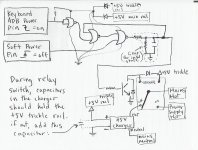
One could utilize the logic of a flip-flop and the power of a relay to soften a power supply. Trickle power could be a simple as cracking open a cell phone charger and shoving that into the mix, or do as the Mac II/x/fx and add an extra PRAM battery or two.

 
Yea, theres 10000 different ways to do it. Ill do it my way, if someone wants to do it their way, by all means. and please share :-)

 
This is sort of what I was talking about in a general sense. The flip flop can be constructed out of a single quad 2-input NOR gate chip. I'm not sure if this is considered a "flip-flop", per se, it's more of a latch I guess. I agree that there are probably 10,000 ways to do this, but for each person there should be one single method that is the best balance of cheap, easy, and reliable. I am definitely interested to see other methods - it makes us all better at this stuff to see different approaches.

This approach also uses some assumptions: It assumes that the ADB keyboard pulls the power pin low and that the soft power pin goes high to turn off the Mac. (The soft power pin could be inverted with the extra NOR gate as necessary) Also, voltage drop from the diodes might need to be considered when selecting a diode, etc. This is a rough idea that would need to be refined for actual use.

Edit: the +5V trickle on the relay should come from the same point after the diodes on top that feed the nor gates. Considering that this trickle line runs the relay coil, that makes the optional capacitor a bit more necessary, especially if there is a delay after turning on the power supply for you to get +5V. Alternatively, you could just leave the +5V trickle on all the time and waste a minute amount of power. It's these sorts things that need testing and refining.

Edit 2: Also to be noted is that many cheap power adapters "claim" to be 5V, but actually are only that voltage under the rated load. This is a low-power application that can't exceed 5.5V (typically), so it would make sense to either find a good power adapter or get a bigger one (i.e. 9V) and bring it down to 5V with a voltage regulator (i.e. 7805).

soft power.jpg

 
I think the ADB keyboard power button is held high. momentary contact switch, pulls low when pressed. I think.... I cant remember. Heck if we wanted to, we could just simply replicate the Mac II circuit and use the PRAM batt for power like in the mac II circuit.

For my own personal use though, I am going to use a microcontroller. More expensive than logic gates, but itll fair me better. This way on systems that you cant tap a shutdown signal from, you could press-hold the power button for say 3 to 5 seconds, and it will shut off.

I guess you could implement this in logic gates as well, using a D-type latch with set/reset pins, such as the 7474. Then some type of RC time constant one-shot that while holding power button, cap discharges and flips the latch.

 
I was under the impression that on keyboards that support the power pin, it is normally floating and closes to ground when the button is pressed - and I saw this on the IIci startup circuit at Gamba's site. This is why I drew in the pull-up resistor on it. I'm betting that with a microcontroller, there is some way to detect/decode the shut down automatically on Macs without an easy pin to tap off from. Maybe even looking at the address bus and seeing if the ROM address of the shutdown sequence is being executed. It would be:

// Init

power pin = 0; // Start with Mac off.

for(; ;) // the "1 infinite loop"

{

while(adb_pin != 0); // Loop until ADB pin = 0.

power_pin = 1; // Turn on Mac.

while(address != 0x1234abcd); // Loop until this address is seen

power_pin = 0; // Turn off Mac.

}

 
I dont program in C so your over my head. I do ASM and BASIC. :-)

Aside from that, I see what your saying. you could hook into ROM without "hooking" into ROM.

You could technically just simply decode an address thats out in a void that other hardware doesnt conflict with. A simple write to that particular address would shut the machine down, using an INIT such as bbraun's could be modified to perform such an action.

 
If I'm reading this correctly:

You could be suggesting the possibility of creating a single state logic analyzer/detector . . .

. . . such might be wedged onto a ROM SIMM V3 PCB to trip board flip-flop signal on a header pin/cable I/O line to the PSU?

The same might be done for a multipurpose MicroController based hack?

Can I use my very rusty Basic for any MicroController project?

What's an ASM? Do I need to learn that if the above is not true?

 
You could be suggesting the possibility of creating a single state logic analyzer/detector . . . . . . such might be wedged onto a ROM SIMM V3 PCB to trip board flip-flop signal on a header pin/cable I/O line to the PSU?
Yep, exactly. This should work in ROM, PDS and cache slots, anything with the addressing lines needed. It could be incorporated into a pass-through connector for any of these slots too.

The same might be done for a multipurpose MicroController based hack?
Yeah I suppose so. You could have a whole list of ROM addresses to look for and have different actions for each one - lights, timers, motors, :) It would take a pretty quick microcontroller to do this, another option is to wire up some combinational logic that looks for a specific address and stores it in a latch. This can be done with a big load of gates. You could use a small FPGA if you want to look for lots of addresses with combinational logic in one chip.

Can I use my very rusty Basic for any MicroController project?
What's an ASM? Do I need to learn that if the above is not true?
I have not programmed a microcontroller in Basic before. ASM is an abbreviation for "assembly language". This is the native language of a processor (or microcontroller), where you actually use the instruction set of a processor instead of writing statements like most other languages. Consequently, programming in ASM leaves the program dependent on the specific type of processor that it was written for. ASM can be extremely efficient and quite cool to play with but it is fairly confusing related to any other option. It is not typically a great place to start without a great deal of assistance. Programming in C or Basic has the advantage of being much easier, and easier to read, even for ASM gurus, and more portable to different processors and different developers even though the end result is often times less efficient. In practice, it is usually the best choice to avoid ASM and select a faster processor. However, if cost is critical (i.e. mass production) or you just want to play with ASM, go for it, it can be quite entertaining.

 
You could technically just simply decode an address thats out in a void that other hardware doesnt conflict with. A simple write to that particular address would shut the machine down, using an INIT such as bbraun's could be modified to perform such an action.
Writing, reading, or executing from a particular address enables that address on the address bus. Specifying what you're doing at that address requires more logic, such as data direction and data lines. CONSEQUENTLY - every bit of ROM is read for the checksum when the Mac is turned on!! D'OH! So you can't just look for a ROM address, more logic is necessary as you have suggested.

If we are allowed to put INITs in the system, may I suggest sending a series of unusual timed pulses, a password if you will, on an available pin? You could detect those specific pulses and shut down the Mac. This would not require tapping the address lines or making near as many connections.

Also useful would be to look at the ROM code for the shutdown sequence and see if there are any clues as to how to detect it in hardware - maybe without any modifications at all.

 
What I thought about doing in this scenario, is use an ATmega128. it has a crapload of I/O pins. Tie these pins to the address and data bus, and clock the micro from the main system clock as well. (everything would be in sync then). the AVR probably doesnt have enough current to arbitrate/talk bi-directionally on the Bus, but it could simply just listen and be fine.

Have it constantly monitor the system bus for a specific write to a specific address void, As i think the bus also has a dedicated Read and Write line from the GLU. boom. power off. of course this take a million wires. ;-)

using a pulse code modulated/serial style pin toggling as you suggest would eliminate ALOT of wires/connections and work just fine. Such as using 2 Data Bits, using one as a serial clock, and the other as serial data. Bit-Bang an AA or a 55 something that simple. Or even 3 data bits and using the 3rd one as an Enable bit.

Also, I could tap into one of the serial ports at the SCC chip? just send a special command serially to the IC and poof machine shuts off. Only downside to this, it requires the serial driver to be open :-(

Eh... Simple thing at least for the SE would be a daughterboard that sits between one of the ROM ICs and the board. Easy way to tap off the data/address bus.

 
Back
Top