• Hello Guest! We're hosting a challenge to welcome vintage Intel macs to the MLA during the month of July! See this thread for more information.

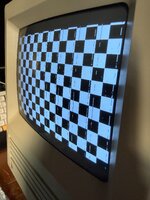
SE Checkerboard pattern with random speckled dashes, no boot chime

I have a Macintosh SE 820-0176-B, 1986, 630-4125 logic board that shows a checkerboard pattern with random noise/static (speckled dashes) displayed on boot, with no audio boot chime — just a single speaker click. I've installed the suspect board into a known-good SE chassis (proven analog board, PSU, and BlueSCSI), so the fault stays with the logic board regardless of chassis. I'm running 4MB of RAM (4 SIMMs), and I've confirmed this isn't a RAM issue — I've swapped in multiple different sets of tested, known-good SIMMs (different brands/batches) and get the identical noisy checkerboard every time, including after moving all 4 SIMMs into different physical slots.

The board is very clean — I've inspected the RAM sockets, solder joints, and surrounding traces closely and everything looks great, no visible cracks or corrosion.

Given the fault is consistent across all SIMM combinations/positions and isn't chassis-related, I suspect it may be in shared RAM-adjacent logic (GLU chip 341-0538-A, ROM chips, or the BBU) rather than the RAM itself. Has anyone run into this specific noisy/speckled checkerboard symptom before, and if so, what ended up being the fix?
 

Attachments

  • IMG_9835.jpeg
    IMG_9835.jpeg
    3.4 MB · Views: 6
From The Dead Mac Scrolls

Symptoms: A Mac SE/30 has no startup bong. The display is filled with a black-and-white checkerboard pattern .
Probable diagnosis: The problem on the SE/30 logic board.
Solution: Check/reseat the ROM SIMM.

OR

Probable diagnosis: The problem is on the logic board.
Solution: Verify that the new ROMs and the new IWM at board locations 06, 07 and 08 are not reversed, backwards or otherwise incorrectly installed.
 
Thank you Fred1212. I verified that ROM HIGH - chip 342-0352-A. ROM LOW - chip 342-0353-A, IWM - chip 34-0043A are in the correct slots and oriented correctly in their sockets on this Macintosh SE 820-0176-B, 1986, 630-4125 logic board. All pins are clean and sockets are clean. The problem still persists.

Let me know if you have any other thoughts.

Thanks, litriSE
 
I have a known good board and swapped out good ROMs and IWM and still the same problem on the troubled board. The swapped good ROMs and IWM still produce checkerboard & noisy lines on the troubled board.
 
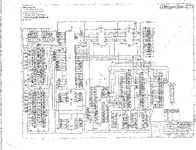
Thanks again Fred1212. Visually, under close inspection the board appears to be sound. I've downloaded the SE schematic. I'll start sounding traces with my meter. Any other thoughts on what it might be, so I can pursue parallel paths?

Thanks again, litriSE
 

Attachments

  • Logic Board 1.gif
    Logic Board 1.gif
    308.4 KB · Views: 4
Update: Macintosh SE checkerboard/noise — continuity testing complete, need advice on scope approach or component swapping


Following up on my earlier post about a Macintosh SE 820-0176-B (1986, 630-4125) logic board showing a checkerboard pattern with random noise/static (speckled dashes) on boot, no chime, just a single speaker click.


Ruled out so far:


  • RAM/SIMMs — multiple tested, known-good SIMM sets (different brands/batches), moved across all four physical slots, identical noisy checkerboard every time.
  • Chassis/analog board/PSU — suspect logic board tested in a known-good SE chassis (proven analog board, PSU, BlueSCSI); fault stays with the logic board.
  • ROM/IWM — verified correct chip placement and orientation (342-0352-A, 342-0353-A, 344-0043A), all pins/sockets clean. Also swapped in known-good ROM HIGH/LOW and IWM chips from my reference board — problem persists unchanged.
  • RAM-size configuration — populated only bank 1 with a soldered 150Ω resistor at R36 to force a clean 2MB config; same noisy checkerboard.
  • Caps — fully recapped the board as a precaution; no change in behavior before/after.
  • Trace/via integrity — completed methodical continuity testing across RA0F–RA9F, RAS1F/RAS2F, CAS0L/CAS1L/CAS0H/CAS1H, and RDO0–RDO15 (LS245 data path) between the 68000/BBU, F257 address muxes, and SIMM sockets, cross-checked against my known-good reference board at the same test points. All continuity confirmed clean and consistent between both boards — no cracked traces or vias found.

Remaining suspects (most soldered direct): GLU (341-0538-A), the two F257 address muxes, the two LS245 data buffers, the BBU (socketed), the 68000 CPU itself, and the VIA.


Since the wiring itself now checks out clean on both boards, I believe the fault has to be a chip producing corrupted output despite sound connections — not a broken trace.


What I'm looking for:


  1. Oscilloscope approach — which signals would you prioritize probing first (RAS/CAS timing, F257 outputs, LS245 outputs, BBU outputs) to isolate a marginal/failing chip without needing to desolder blind?
  2. Component-swap priority — if you were choosing which of the six remaining soldered suspects to desolder and replace first, in what order, and why?

Has anyone dealt with this specific "noisy/speckled checkerboard, survives every RAM/ROM/IWM swap and full continuity check" symptom before? Any insight on narrowing it down further would be hugely appreciated.


Thanks,
litriSE
 
Back
Top