Hi all,
I'm pretty deep into refurbing an SE/30 that entered my orbit in need of both PSU and logic board recaps. It powers on, plays the chime, runs the memory test while the gray background shows, and gets to the point where it thinks about booting, but will just throw a flashing ? disk status.
I have two bluescsis, internal and external, both work to boot an SE. Internal bluescsi only with an HD0 image, it won't boot. Internal drive installed and external bluescsi connected with an HD2 image (in other words, non-conflicting ID), won't boot.
I've toned out every pin to other destinations on the board and they're all connected. I don't have any shorts between lines. I can tell you that the signaling voltage being delivered to the outputs appears to be 2.7V with dips for data transfers; the chip is receiving a stable 5V. Output lines do appear to be cycling some signaling activity, and that corresponds to the flashing of the Activity light on the internal bluescsi... and thanks to the INI file debug option, I know that activity light flashes once every approximately 1,525ms.
The debug log output starts at Initialization Complete, disables the status LED, reports the Pico's operating voltage, then says "DBG BUS RESET" After that, the following:
I note that between 9415ms and 9429ms, it goes through two cycles of the selection:0 command: read6 thing, then the block of activity from SELECTION:0 to IN: 0x00 repeats once every second and a half until I power off the machine.
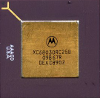
I did have some green corrosion on the SCSI chip's pins that I got removed with some combination of IPA and heating flux on the pins. It's an AM53C80AJC, if that matters. I don't yet have a device I can use to try booting this machine via floppy, and we've been unable to locate any boot floppies in the hoard this machine came from, so I'm at a temporary impasse.
I'm new to this kind of trouble diagnosis so I also don't have a lot of experience with what the log output means. My gut is that the SCSI controller is at fault here, but until the floppy emulator shows up, I thought it might also be worth running the symptoms by the community. Any ideas are appreciated, thanks!
I'm pretty deep into refurbing an SE/30 that entered my orbit in need of both PSU and logic board recaps. It powers on, plays the chime, runs the memory test while the gray background shows, and gets to the point where it thinks about booting, but will just throw a flashing ? disk status.
I have two bluescsis, internal and external, both work to boot an SE. Internal bluescsi only with an HD0 image, it won't boot. Internal drive installed and external bluescsi connected with an HD2 image (in other words, non-conflicting ID), won't boot.
I've toned out every pin to other destinations on the board and they're all connected. I don't have any shorts between lines. I can tell you that the signaling voltage being delivered to the outputs appears to be 2.7V with dips for data transfers; the chip is receiving a stable 5V. Output lines do appear to be cycling some signaling activity, and that corresponds to the flashing of the Activity light on the internal bluescsi... and thanks to the INI file debug option, I know that activity light flashes once every approximately 1,525ms.
The debug log output starts at Initialization Complete, disables the status LED, reports the Pico's operating voltage, then says "DBG BUS RESET" After that, the following:
[7898ms] DBG -- BUS_BUSY
[7898ms] DBG -- BUS_FREE
[8151ms] DBG -- BUS_BUSY
[8151ms] DBG -- BUS_FREE
[8403ms] DBG -- BUS_BUSY
[8404ms] DBG -- BUS_FREE
[8656ms] DBG -- BUS_BUSY
[8656ms] DBG -- BUS_FREE
[8909ms] DBG -- BUS_BUSY
[8909ms] DBG -- BUS_FREE
[9162ms] DBG -- BUS_BUSY
[9162ms] DBG -- BUS_FREE
[9415ms] DBG -- BUS_BUSY
[9415ms] DBG ---- SELECTION: 0
[9416ms] DBG ---- COMMAND: Read6
[9416ms] DBG ------ OUT: 0x08 0x00 0x00 0x00 0x01 0x00
[9416ms] DBG BlueSCSI Toolbox enabled = 1
[9416ms] DBG ------ Read 1x512 starting at 0
[9416ms] DBG ---- DATA_IN
[9420ms] DBG ---- Total IN: 512 OUT: 0 CHECKSUM: 31910
[9420ms] DBG ---- STATUS: 0 GOOD
[9422ms] DBG ---- MESSAGE_IN
[9422ms] DBG ------ IN: 0x00
[9423ms] DBG -- BUS_FREE
[9424ms] DBG -- BUS_BUSY
[9424ms] DBG ---- SELECTION: 0
[9425ms] DBG ---- COMMAND: Read6
[9425ms] DBG ------ OUT: 0x08 0x00 0x00 0x00 0x01 0x00
[9425ms] DBG ------ Read 1x512 starting at 0
[9425ms] DBG ---- DATA_IN
[9426ms] DBG ---- Total IN: 512 OUT: 0 CHECKSUM: 31910
[9426ms] DBG ---- STATUS: 0 GOOD
[9428ms] DBG ---- MESSAGE_IN
[9429ms] DBG ------ IN: 0x00
[9430ms] DBG -- BUS_FREE
[9430ms] DBG -- BUS_BUSY
[9430ms] DBG -- BUS_FREE
[9682ms] DBG -- BUS_BUSY
[9683ms] DBG -- BUS_FREE
[9935ms] DBG -- BUS_BUSY
[9935ms] DBG -- BUS_FREE
[10188ms] DBG -- BUS_BUSY
[10188ms] DBG -- BUS_FREE
[10441ms] DBG -- BUS_BUSY
[10441ms] DBG -- BUS_FREE
[10694ms] DBG -- BUS_BUSY
[10694ms] DBG -- BUS_FREE
[10946ms] DBG -- BUS_BUSY
[10946ms] DBG ---- SELECTION: 0
[10948ms] DBG ---- COMMAND: Read6
[10948ms] DBG ------ OUT: 0x08 0x00 0x00 0x00 0x01 0x00
[10948ms] DBG ------ Read 1x512 starting at 0
[10948ms] DBG ---- DATA_IN
[10952ms] DBG ---- Total IN: 512 OUT: 0 CHECKSUM: 31910
[10952ms] DBG ---- STATUS: 0 GOOD
[10954ms] DBG ---- MESSAGE_IN
[10954ms] DBG ------ IN: 0x00
I note that between 9415ms and 9429ms, it goes through two cycles of the selection:0 command: read6 thing, then the block of activity from SELECTION:0 to IN: 0x00 repeats once every second and a half until I power off the machine.
I did have some green corrosion on the SCSI chip's pins that I got removed with some combination of IPA and heating flux on the pins. It's an AM53C80AJC, if that matters. I don't yet have a device I can use to try booting this machine via floppy, and we've been unable to locate any boot floppies in the hoard this machine came from, so I'm at a temporary impasse.
I'm new to this kind of trouble diagnosis so I also don't have a lot of experience with what the log output means. My gut is that the SCSI controller is at fault here, but until the floppy emulator shows up, I thought it might also be worth running the symptoms by the community. Any ideas are appreciated, thanks!