• Hello MLAers! We've re-enabled auto-approval for accounts. If you are still waiting on account approval, please check this thread for more information.

Removing glue from underneath original aluminium can capacitors

JonP

6502
Having successfully de-capped and cleaned an SE/30 logic board, I notice that the original aluminium capacitors appear to have had some kind of glue under them (see image).  It seems impervious to isopropyl alcohol and I'd prefer not to try and physically remove it in case I damage any tracks etc.  Anyone seen this before and had any joy removing ???

Jon.
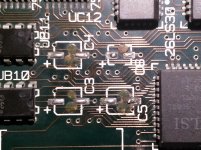


IMG_20180818_234046.jpg

 
I have just been practicing cleaning a junk (damaged past hope) SE/30 board. On mine the gunk under the capacitors looks like a dot of yellow right in the center. I assumed it was capacitor leakage but maybe not?

I had some success scraping away some of the gunk with a toothpick and isopropyl alcohol but some deposits remained stubbornly impervious. Curious to hear what you learn.

 
Is that hot glue? It looks like hot glue.

Only issue is, everywhere I look says the alcohol is good for removing hot glue, so maybe that's out.

I saw someone recommend acetone for hot glue.  I don't know how that interacts with the circuit board, but I suspect it would be fine and it's a good solvent for a lot of different adhesives.

 
BTW how did you remove your capacitors? I’ve been experimenting with different methods. On the test board I used the twist method but only because this board is already too far gone to save. 

Also, for the record, my yellow gunk did not respond to flux remover which I think might be a relative of acetone. Very stubborn stuff.  

 
Last edited by a moderator:
I followed the twist method to remove the actual cans and then the remaining leg pieces desoldered easily.  In fact, it was the axial capacitors that were a pain - it seems that the board holes were rather small for the size of the wire and they were a friction fit!

I'll have a go at warming the glue later, though if the new tants can be fitted with it in place, might well leave it alone as there are an awful lots of fine traces running underneath!

 
Having successfully de-capped and cleaned an SE/30 logic board, I notice that the original aluminium capacitors appear to have had some kind of glue under them (see image).  It seems impervious to isopropyl alcohol and I'd prefer not to try and physically remove it in case I damage any tracks etc.  Anyone seen this before and had any joy removing ???
Interesting problem. Unless the material is some sort of epoxy?

The most important thing here is that the material that is not conductive nor corrosive to the board's own epoxy film. Test for continuity, follow the trace from the pad to its destination and ensure continuity is present otherwise I wouldn't worry about it.

It's possible that someone may have glued down the cap with epoxy or some other material prior to soldering, perhaps to hold them in place. Don't try scraping the material off because you might damage the board's surface, causing traces to become exposed or cut.

So again, as long as the material is non-conductive and not corrosive you should be fine. Just be sure there is continuity from the pad, along the trace and to the destination.

 
Last edited by a moderator:
I notice that the original aluminium capacitors appear to have had some kind of glue under them (see image).
You could try adding a fair amount of flux and running over it with a solder wick and your iron to see if that stuff will come loose or burn off (make sure you are venting the fumes away from you, god knows what that stuff is, don't inhale it.)

Follow that with some isopropyl alcohol cleanup and if you see some progress, repeat the steps. After each cleanup, check to ensure you are not damaging anything. Remember, don't use pressure or force, just let the heat of the iron penetrate over that material, the flux should help to clear that up because flux itself helps in the cleaning process. Sometimes things get charred looking depending on the type of flux but it all disappears with the isopropyl alcohol cleanup.

Remember though, don't apply pressure or use abrasives to remove it, be gentle but the heat might help remove it.

Don't forget to ventilate the fumes away from you. This should always be done anyway.

 
Yes, seen that glue in several boards, but mainly in early SE/30 ones, so original.

As i am using tiny capacitors i don't care much about it, but removing the glue is nearly imposible without damaging anything.

 
Yeah, I don’t usually worry too much about that glue. It’s just not worth the risk of damaging the board trying to remove it.

 
Thanks all for the advice, I've recapped successfully - some glue came off easily, some didn't and was left in place.  Now to work out why it still isn't completing start-up!

BR

Jon.

 
Back
Top