-
 Hello Guest! We're hosting a challenge to welcome vintage Intel macs to the MLA during the month of July! See this thread for more information.
 -
We've made some quality of life improvements to the Trading Post. More info here.
You are using an out of date browser. It may not display this or other websites correctly.
You should upgrade or use an alternative browser.
You should upgrade or use an alternative browser.
Prototype Mac Case, that is the question . . .
- Thread starter Trash80toHP_Mini
- Start date


Uhm, what? Are you saying the diagram is wrong, or the diagram is something that would appear on a prototype, not a production case, what?I realize this started out as a pretty much "Standard ATX case," but there are several things at odds with it being a production machine as pictured in the bezel removal diagram on its @$$end.
Looking at the pictures again I'm more and more certain I've dealt with this exact case before. It had a U-shaped top, and they "cleverly" hid the screws to remove the top behind it. Thus to open it you had to yank the bezel off. I remember people getting really confused because they were used to having the screws to get the top off in the back and the bezel firmly screwed in place from the inside, so by all appearances these cases would appear hermetically sealed if you didn't know the trick. (Not every reseller of these things was nice enough to put the sticker on the back.)
What does that have to do with anything? The tray might be from a 9xxx, but the case has *nothing* to do with the tray. Again, look, it doesn't fit the spacing of the bays properly.I checked out the exploded diagrams of the 8600/9600 cases in the Service Source while I was at work.
Actually, what I suspect happened here was that this case chassis, the design of which which I think dates from around 1998-1999, was updated to "relocate" that front fan to face to the side with that added-on bracket but they never updated the front stamping to get rid of the dome. Side-facing fans started being a "thing" sometime around 2001-2002 because of the sheer amount of heat coming off the 1Ghz+ AMD and Pentium 4 CPUs of that era was significantly more than that coming off 1999-era chips. Plus, you know, someone decided it looked cool. Undoubtedly the case skins were also updated to include some stamped/milled slots that matched up with this. (Or possibly they just cut a hole and screwed a grill over it.)Have they got a fan mounted to the left hand... (snip)...The hole on the case cover matching up with the fan is professionally done, but by no means a standard feature.
This has all the hallmarks of a short production run of an oddly modified stock case.
*Why* would an IBM case have a specific Apple drive tray in it? That isn't a "prototype" part, I was able to search it from the part number stamped on it.1997 - 9600/8600 Released & Apple halts all CHRP licensing.
Heaven knows there weren't any other sources of junk computers in RTP besides SUPER SECRET laboratories.Ten years later I found this oddity in a thrift shop just outside RTP.
No, it's not. It happens to be the right width to wedge in there, but it's not made to fit that case by any stretch of the imagination. Here, I've annotated your picture to show what the problem is:BTW, that Apple drive mounting plate seems to be made to fit this case
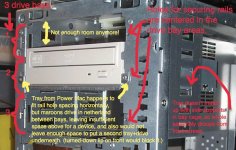
It's simply *not* the right part. The case has 3 drive bays; you screwed rails to the devices, and the rails had screw-ears which let you secure the device to the case. That mismatched tray turns 3 drive bays into *one* as mounted: It pushes the CD-ROM drive halfway into the bay above it, and the lip on the bottom edge of the tray means even if you had another one you wouldn't be able to put another regular-height device below it either. (You could stick one in there if you had the rails, or just chuck one in and let it lie on the bottom of the cage, but then there will be an obvious gap between it and the device above. Oh, yeah, I'm sure that's for "cooling", right?)
Sigh. The floppy goes in the 3 1/2 inch bay. There's a drawing of the bezel on the sticker that shows what it looked like: 3 exposed 5 1/4 inch bays, 2 exposed 3 1/2 inch slots, the bottom 3 1/2 device was obscured.it puts the Optical drive bay and the tape/zip bay just about where they wound up in the 9600/8600. Spacing is wrong for the floppy up top...
Seriously, I *swear* I had this exact case. If you googled *enough* you could find a picture of it, the problem is that no one *cares* about 2000-vintage generic PCs. It's a dime-a-dozen (but well built) OEM PC chassis, *nothing* special about it.
"It came from a thift shop in a town where *maybe* there were prototype boxes floating around 10 years before I got it and, uhm, if I squint my eyes the proportions sort of remind me of the Power Mac 8600 even though it's actually wrong in every conceivable detail. By jove, PROTOTYPE!"Not saying it's an Apple prototype, not even saying it's an IBM CHRP prototype, just saying that when I look at it now, it looks like A prototype box . . .. . . and that's alot of coinkidinks.

Yes, my first thought was "Prototype Mac Case" and that didn't fit the details of the case at all.
Second thought was Big Blue CHRP "Prototype Case" and that still may fit, but it's less likely than . . .
. . . my third WAG which is that it likely came from one of RTPs many development centers, the three Universities from which its name derives or one of the other Universities in the greater Raleigh area or from an industrial or possibly Server environment.
I just took/massaged/compressed the pics to prove you right in most details, especially about that drive tray . . .
. . . except for a couple of interesting details that might show that it's likely a low production, non-standard clone case for development, stock, general availability fits that scenario well.
CHRPness depends upon the date of mfr. which is curiously lacking, There's another number on the sticker covering the back of the case to google: SL-2960 HP is in the Triangle as well, but the case dimensions are completely wrong, but it would have made a great development chassis!
As I said earlier, finding that Apple Logo set me off, but it has been a very interesting line of research!
Pics in a few!
Second thought was Big Blue CHRP "Prototype Case" and that still may fit, but it's less likely than . . .
. . . my third WAG which is that it likely came from one of RTPs many development centers, the three Universities from which its name derives or one of the other Universities in the greater Raleigh area or from an industrial or possibly Server environment.
I just took/massaged/compressed the pics to prove you right in most details, especially about that drive tray . . .
. . . except for a couple of interesting details that might show that it's likely a low production, non-standard clone case for development, stock, general availability fits that scenario well.
CHRPness depends upon the date of mfr. which is curiously lacking, There's another number on the sticker covering the back of the case to google: SL-2960 HP is in the Triangle as well, but the case dimensions are completely wrong, but it would have made a great development chassis!
As I said earlier, finding that Apple Logo set me off, but it has been a very interesting line of research!
Pics in a few!
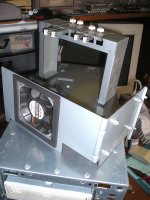

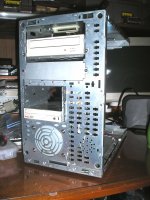
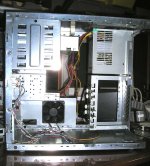
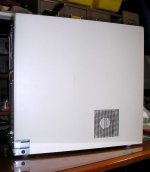
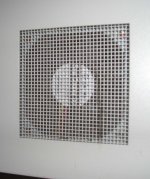

That fugly factory finger hole doesn't look baseline generic clone case to me at all.
That single detail makes repetitive removal of the metal shell quick, easy and painless indeed.
On the double-take, the side fan mod has a factory look as well, but not like something meant for a general production case for a stock clones.
Whatever, I still think it's an interesting, low production development case series, the question to me would be the actual timeline.
edit: see why I agree about the x600 bracket being a kludge, the depth is wrong, but it's something that would be readily available in any of the University Computer Labs around the Triangle.

If that motherboard is what came in it - it SIGNIFICANTLY pre-dates the Apple Intel DTK. That is an Intel D815EEA2 motherboard. It runs a Pentium 3 chip, and is from early 2001. This specific one was meant to be in "all-in-one" PCs with an LCD display (that funny connector next to the CPU between the chipset and the back panel ports is the internal-display port.)
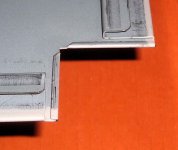
Prior to this last round of pictures I had *no idea* what you were talking about, you hadn't posted any of the outer shroud. (I'd assumed that everything was missing, not just the bezel.) My first thought upon seeing that notch was perhaps there had been a locking device in that corner that someone had hacked out to open the case, but it does look like the edges of it have been turned/finished. That certainly implies this case was being used for *something* odd, but it doesn't negate the near statistical certainty that the case is a completely off-the-shelf item ordered out of an OEM catalog and modified by a the reseller/end user.(The picture of the cut-out corner)
That single detail makes repetitive removal of the metal shell quick, easy and painless indeed.
Looks like a bone-standard-if-somewhat-bland early-ish Pentium 4-era side panel to me. (The case is white and plain, which in my mind that anchors it to the early 2000s; colors like silver and black started being popular enough with OEM/small builder/home-built machines around 2003-2004 to start outnumbering the white/beige boxes, even for systems built for business/industrial use.)On the double-take, the side fan mod has a factory look as well, but not like something meant for a general production case for a stock clones.
Anyway. It's impossible to prove a negative *and* that cut-out corner is "interesting" so the case may well have served time in a lab setting, possibly as home to something interesting. (Or driving something interesting.) But it's just as likely that the case sat for years collecting dust, I dunno, under a cash register or in a stockroom and that cutout was added to route a cable or to clamp the thing into a kiosk. The missing drive rails and bezel suggest it was brutally stripped when it was removed from service; that *is* the sort of thing that happens to machines in commercial/industrial settings, which I guess is a point in favor of it not just being the box from under an accountant's desk. There might be an interesting story behind how the Mac drive tray found its way into it, but I would have some pretty serious doubts about it having anything to do with IBM/CHRP/etc, etc.
Nope, like I said there was NOTHING in the case when I picked it up, sorry for the confusion, this is one of the Win98 ROMburner project boxes,boards/drives, etc. The most telling point about dating would be:
The only two things that SCREAM development box to me are that great finger hole/case removal feature and the continuous height adjustments for PCI Cards of whatever height . . .
. . . like oversize/oddly sized development cards like prototypes for those crazy network sniffing cards in the Lunchbox from Tekekec. RTP is a hotbed of development of all kinds of Tech, second largest in the USA according to some mentions I've seen in CHRP related searches.
I've got the Win98 CD in the HackLab now, so this sucker is going back together very soon now, no matter what the heck this very cool case might be. [} ] ]'>
] ]'>
However, the x600 that was in development in the same general time frame as IBM's ATX form factor Long Trail CHRP board. Apparently it features a side mounted cooling fan as well. Can anyone confirm that it's pointed at the RAM Banks. I'd love to have a pic of the inside of an x600 case showing that fan location. At any rate, side fan cooling predates the P4 by at least five years.If the case has a side fan with duct, its from 2003ish or later. The extra ventilation was needed for Intel's Prescott Pentium 4 Toaster.
The only two things that SCREAM development box to me are that great finger hole/case removal feature and the continuous height adjustments for PCI Cards of whatever height . . .
. . . like oversize/oddly sized development cards like prototypes for those crazy network sniffing cards in the Lunchbox from Tekekec. RTP is a hotbed of development of all kinds of Tech, second largest in the USA according to some mentions I've seen in CHRP related searches.
I've got the Win98 CD in the HackLab now, so this sucker is going back together very soon now, no matter what the heck this very cool case might be. [}
] ]'>
I said it was a hurry-up at lunchtime session and that new pics would be up in the AM today.Prior to this last round of pictures I had *no idea* what you were talking about, you hadn't posted any of the outer shroud. (I'd assumed that everything was missing, not just the bezel.) My first thought upon seeing that notch was perhaps there had been a locking device in that corner that someone had hacked out to open the case, but it does look like the edges of it have been turned/finished. That certainly implies this case was being used for *something* odd, but it doesn't negate the near statistical certainty that the case is a completely off-the-shelf item ordered out of an OEM catalog and modified by a the reseller/end user.

Check the "AT" compatibility listings on the door/tray, that makes me think it's much earlier than Y2K. More likely an early ATX development case, much modded from a future generation of Clone Boxen.Looks like a bone-standard-if-somewhat-bland early-ish Pentium 4-era side panel to me. (The case is white and plain, which in my mind that anchors it to the early 2000s; colors like silver and black started being popular enough with OEM/small builder/home-built machines around 2003-2004 to start outnumbering the white/beige boxes, even for systems built for business/industrial use.)On the double-take, the side fan mod has a factory look as well, but not like something meant for a general production case for a stock clones.
Indeed, but considering the string of coincidences, Long Trail CHRP is by far the most interesting of improbabilities.Anyway. It's impossible to prove a negative *and* that cut-out corner is "interesting" so the case may well have served time in a lab setting, possibly as home to something interesting. (Or driving something interesting.) But it's just as likely that the case sat for years collecting dust, I dunno, under a cash register or in a stockroom and that cutout was added to route a cable or to clamp the thing into a kiosk. The missing drive rails and bezel suggest it was brutally stripped when it was removed from service; that *is* the sort of thing that happens to machines in commercial/industrial settings, which I guess is a point in favor of it not just being the box from under an accountant's desk. There might be an interesting story behind how the Mac drive tray found its way into it, but I would have some pretty serious doubts about it having anything to do with IBM/CHRP/etc, etc.
toodles, late back to wlrk again! :O


I already said in my opinion the case chassis itself dated to somewhere around 1999 and was updated to add the side fan sometime later than that. That may actually be a late date, I'm basing that on the fact that the system I had which I *swear* was exactly that case was built sometime in late 1999-2000. So far as I know the tooling for parts of that case could date back to the original release of the ATX specs by Intel in 1995.Check the "AT" compatibility listings on the door/tray, that makes me think it's much earlier than Y2K. More likely an early ATX development case, much modded from a future generation of Clone Boxen.
In any case, it wasn't particularly uncommon to see cases of around that vintage that offered the possibility of mounting either AT or ATX-style motherboards. (And conversely I've seen motherboards that could be mounted in either style of case; the motherboard would be roughly square and the ATX mounting was generally a nasty kludge job with cables running to a backplate. Of course, by this point AT motherboards were *all* nasty kludge jobs with wires running from all over the motherboard to ports mounted on slot covers.) You'd have to swap out the back panel to accommodate an AT board but the tray part of the assembly could have been used in multiple case configurations.
If it *really* was something modified prior to Y2K for something that needed a special fan layout I'd actually say a far more likely possibility than anything CHRP would be an Alpha motherboard. Alpha was HOT in the late 90's, both literally and figuratively, and ATX incarnations weren't rare.Indeed, but considering the string of coincidences, Long Trail CHRP is by far the most interesting of improbabilities.
That bizarre adjustable dingus to hold the cards in place (in addition to the slot cover screws) is by far the most interesting part of the case; again, I swear I had almost exactly that case but it didn't have that part. That actually makes me wonder if this might have been mounted in a truck/van, or some other location where vibration might be a problem. (Inside a rolling kiosk? On a factory floor or inside a piece of manufacturing equipment? Etc, etc.)
Looking further, I'm not completely clear on what component has the Apple logo...
If it's just the drive tray that you have the optical drive mounted on, then it's a simple mix-up: someone tossed an Apple drive tray in it when it didn't belong. Looking further, those 5.25" drive bays are obviously meant for a standard "attach the metal rail on each side of the optical drive" type mounting - I've seen those a thousand times in many random chassis manufacturers over the years. With the side fan, this looks like your average early-2000s Pentium 4-era chassis.
And it almost assuredly had a cheap plastic front panel that is long since lost. (Hell, I have two old ATX chassis myself whose front panels are broken enough that they don't stay put any more.) Without those front panels, they all look remarkably similar to yours.
I think your Apple tray was a complete red herring. You just have a low-end ATX chassis from the early 2000s.
If it's just the drive tray that you have the optical drive mounted on, then it's a simple mix-up: someone tossed an Apple drive tray in it when it didn't belong. Looking further, those 5.25" drive bays are obviously meant for a standard "attach the metal rail on each side of the optical drive" type mounting - I've seen those a thousand times in many random chassis manufacturers over the years. With the side fan, this looks like your average early-2000s Pentium 4-era chassis.
And it almost assuredly had a cheap plastic front panel that is long since lost. (Hell, I have two old ATX chassis myself whose front panels are broken enough that they don't stay put any more.) Without those front panels, they all look remarkably similar to yours.
I think your Apple tray was a complete red herring. You just have a low-end ATX chassis from the early 2000s.
Found it! Side mounted fan in Apple's Workgroup Server 9650 in the same case as the X600s with which it was introduced in February 1997.
So the side fan is totally consistent with the time frame I outlined earlier. IBM's Long Trail CHRP Board was developed in parallel to the x600 series, rendering the side fan's presence a moot point in terms of dating the case in question as far as I'm concerned.
g makes an interesting point about it possibly being for industrial use, but I'd think that there would be filters on the fans. There are however, a dozen holes distrbuted about the front and sides which might be consistent with early shock mounting methods (drives in Luggable computers, etc.) but I think that's much less likely than this being a very nice case intended for developers in the fresh new world of the ATX standard. That would be motherboard developers as well as developers of PCI cards and ISA cards supported in the early Intel design standards for ATX.
This case being from a Bog standard, cheap Clone is clearly contraindicated IMO.
I do believe that this case is part of a short production run of cases intended for the development environment. As such, more than a few of these cases probably made their way into the many Tech houses here in RTP and I was lucky enough to snag one several years later in a local Thrift.
In my wildest dreams this may have housed one of the prototypes for Big Blue's Long Trail CHRP demonstration board during its development right here in RTP. Though it could well have been developed in a facility elsewhere, the Glendale Labs where my Pops was a boffin at one point comes to mind, but IBM's entire PC Division was right here in NC during that time frame..
Stranger things happen with regularity here in the Bermuda Triangle of N.C. :lol:
Last pic set unless I get requests for any details:
Here's a pair of shots of your expansion card dingus, g.
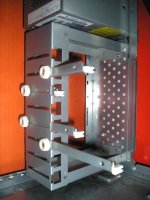
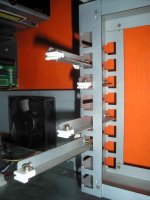
Fugly fan in the side implementation:
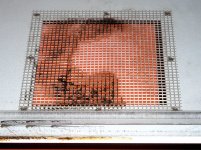
Nicely stamped, notched and seamed "finger hole" for easy, repetitive access to case innards, clearly not an attractive, consumer oriented design feature.
Drive bay makeover for Dimetrodon, the Intel MoBo, Win98 Rom HackStation candidate. Note the 2.5" SCA MiniDrive with cable adapter mounted in a 3.5" adapter and mounted in the 3.5" Drive "Magazine Clip." Let's see if '98 handles the UltraSCSI card and drive with any more aplomb than the ubuntu NetBook Remix did.
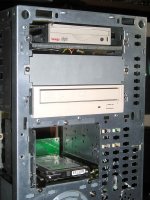
Last, but not least, the FDD/Zip does indeed fit mit dat meshuggah x600 Drive Tray installation.
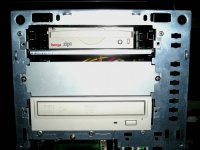
This has been fun, but I'm going back to fitting this out as an ancient Win98 computer rather than admiring it as an empty curiosity.
But I really am glad it caught my eye, it's a great toy . . .
. . . and even better as an exercise in fantasy/imagination and curiosity! [] ]'>
So the side fan is totally consistent with the time frame I outlined earlier. IBM's Long Trail CHRP Board was developed in parallel to the x600 series, rendering the side fan's presence a moot point in terms of dating the case in question as far as I'm concerned.
g makes an interesting point about it possibly being for industrial use, but I'd think that there would be filters on the fans. There are however, a dozen holes distrbuted about the front and sides which might be consistent with early shock mounting methods (drives in Luggable computers, etc.) but I think that's much less likely than this being a very nice case intended for developers in the fresh new world of the ATX standard. That would be motherboard developers as well as developers of PCI cards and ISA cards supported in the early Intel design standards for ATX.
This case being from a Bog standard, cheap Clone is clearly contraindicated IMO.
I do believe that this case is part of a short production run of cases intended for the development environment. As such, more than a few of these cases probably made their way into the many Tech houses here in RTP and I was lucky enough to snag one several years later in a local Thrift.
In my wildest dreams this may have housed one of the prototypes for Big Blue's Long Trail CHRP demonstration board during its development right here in RTP. Though it could well have been developed in a facility elsewhere, the Glendale Labs where my Pops was a boffin at one point comes to mind, but IBM's entire PC Division was right here in NC during that time frame..
Stranger things happen with regularity here in the Bermuda Triangle of N.C. :lol:
Last pic set unless I get requests for any details:
Here's a pair of shots of your expansion card dingus, g.
Fugly fan in the side implementation:
Nicely stamped, notched and seamed "finger hole" for easy, repetitive access to case innards, clearly not an attractive, consumer oriented design feature.
Drive bay makeover for Dimetrodon, the Intel MoBo, Win98 Rom HackStation candidate. Note the 2.5" SCA MiniDrive with cable adapter mounted in a 3.5" adapter and mounted in the 3.5" Drive "Magazine Clip." Let's see if '98 handles the UltraSCSI card and drive with any more aplomb than the ubuntu NetBook Remix did.
Last, but not least, the FDD/Zip does indeed fit mit dat meshuggah x600 Drive Tray installation.
This has been fun, but I'm going back to fitting this out as an ancient Win98 computer rather than admiring it as an empty curiosity.
But I really am glad it caught my eye, it's a great toy . . .
. . . and even better as an exercise in fantasy/imagination and curiosity! [
] ]'>
BTW, if anyone has a half dozen of what might be suitable metal drive rails available, PLEASE let me know, I'd love to have a set. 
"I saw an airplane with a propeller at the local field today:"Found it! Side mounted fan in Apple's Workgroup Server 9650 in the same case as the X600s with which it was introduced in February 1997.
So the side fan is totally consistent with the time frame I outlined earlier. IBM's Long Trail CHRP Board was developed in parallel to the x600 series, rendering the side fan's presence a moot point in terms of dating the case in question as far as I'm concerned.

"Even though it differs in a few minor points it's *CLEARLY* a prototype Luftwaffe combat aircraft, I mean, look how closely its configuration matches that of the Messerschmitt Bf109, which are known to have existed ON THE SAME PLANET!"

"See how the propeller is on the *FRONT*? This is a World War II vintage aircraft, any other details are totally a moot point in terms of dating the machine in question as far as I'm concerned."
Uhm, developers nail motherboards to whatever's handy, they don't get special things.I think that's much less likely than this being a very nice case intended for developers in the fresh new world of the ATX standard. That would be motherboard developers as well as developers of PCI cards and ISA cards supported in the early Intel design standards for ATX.
I'm sure it's nice sheet metal but it's nothing special. The cases they sell to "white box" makers are often more sturdy than the exquisitely-engineered-but-flimsy-in-pieces plastic-and-tinfoil boxes that brand-name systems come in. If your basis for comparison is Apple's cases from the 90's then, well, it's a bad reference point. They're "highly engineered" but the materials were *crap* compared to a cheap clone thrown together out of generic Taiwanese parts.This case being from a Bog standard, cheap Clone is clearly contraindicated IMO.
You know, if that makes you feel warm and fuzzy, sure, that's what happened. Your only pieces of evidence are a red herring drive bracket and a general sense that at least some of the case's tooling dates to an era when AT motherboards were still floating around. (I bought my last BRAND NEW AT motherboard in late 2000, a 500Mhz K6-2 to upgrade someone's 386-40* on the cheap, and you could still readily buy cases that could take them.) That's *it*. You have no dates, no labels, no engravings, nothing, but sure, believe that it's a prototype if it makes your day somehow. I like believing that All Dogs go to Heaven with less evidence than that.I do believe that this case is part of a short production run of cases intended for the development environment. As such, more than a few of these cases probably made their way into the many Tech houses here in RTP and I was lucky enough to snag one several years later in a local Thrift.
In my wildest dreams this may have housed one of the prototypes for Big Blue's Long Trail CHRP demonstration board during its development right here in RTP. Though it could well have been developed in a facility elsewhere, the Glendale Labs where my Pops was a boffin at one point comes to mind, but IBM's entire PC Division was right here in NC during that time frame..
(* As an aside, that 386 had a *really* nice case. Thick metal, the chassis alone probably weighed 20 pounds, easy to access drive bays, TOTALLY a prototype. No, wait, it spent its whole life working in a law office. It did have an awesome label on it that said it was made in Taiwan by a factory with the address "something-something Science-Based Industrial Park Road blaw-blaw-blaw.")
Or maybe there was just a trim piece of some sort that snapped into that area, long lost now. There's a nice big round hole in the chassis it could have snapped into. Or, again, some sort of anti-theft bracket, perhaps. It being a "finger hole" sounds pretty ridiculously sketchy to me. But again, it can be whatever you like.Nicely stamped, notched and seamed "finger hole" for easy, repetitive access to case innards, clearly not an attractive, consumer oriented design feature.
I ran across this great website the other day. It was made by this guy who works a landscaper in Utah, who one day was out collecting rocks to throw in gardens when he was suddenly struck by how a nearby boulder *totally* looked like a dragon skull. So now he's dedicated his life to the study of the giant dragons that lived in Utah that crystallized and turned into rocks half a billion years ago but left amazing mathematical clues that only he understands that proves that they're *not* just rocks, no matter what those nasty paleontologists who keep making fun of him say. Everybody needs a hobby.. . . and even better as an exercise in fantasy/imagination and curiosity! [
Great one! :lol: But the only point I was and have been making in reference to the X600 is that it nails introduction of the side mounted cooling fan to the timeline seven(?) years prior to the P4 thermal eruption event."I saw an airplane with a propeller at the local field today:"Found it! Side mounted fan in Apple's Workgroup Server 9650 in the same case as the X600s with which it was introduced in February 1997.
So the side fan is totally consistent with the time frame I outlined earlier. IBM's Long Trail CHRP Board was developed in parallel to the x600 series, rendering the side fan's presence a moot point in terms of dating the case in question as far as I'm concerned.
Granted, but developers of motherboards for a brand spanking new form factor reference design don't.Uhm, developers nail motherboards to whatever's handy, they don't get special things.I think that's much less likely than this being a very nice case intended for developers in the fresh new world of the ATX standard. That would be motherboard developers as well as developers of PCI cards and ISA cards supported in the early Intel design standards for ATX.
Having done a lot of custom sheet metal work of all sizes for many uses and having dissected a considerable number of computer cases to collect the more interesting bits of sheet metal work over the years, I beg to differ.I'm sure it's nice sheet metal but it's nothing special . . .This case being from a Bog standard, cheap Clone is clearly contraindicated IMO.
I'll ask middle little bro about the likely intentions of the designer of the sheet metal, construction techniques employed and probable production date of this case. He does exactly this kind of packaging design work for blade servers, switching and test equipment, etc. at Tekelec. Which is a major reason I couldn't resist bidding on the Chameleon Open LunchBox BEAST from Tekelec. [
] ]'>Actually, that's one of the clearest of indicators that this isn't a production case from a clone. Note the fact that there is no FCC classification for A or B use or residue from the removal of such anywhere on the case whatsoever. See the comparison picset below.You know, if that makes you feel warm and fuzzy, sure, that's what happened. Your only pieces of evidence are a red herring drive bracket and a general sense that at least some of the case's tooling dates to an era when AT motherboards were still floating around.I do believe that this case is part of a short production run of cases intended for the development environment. As such, more than a few of these cases probably made their way into the many Tech houses here in RTP and I was lucky enough to snag one several years later in a local Thrift.
In my wildest dreams this may have housed one of the prototypes for Big Blue's Long Trail CHRP demonstration board during its development right here in RTP. Though it could well have been developed in a facility elsewhere, the Glendale Labs where my Pops was a boffin at one point comes to mind, but IBM's entire PC Division was right here in NC during that time frame..
You have no dates, no labels, no engravings, nothing, but sure, believe that it's a prototype if it makes your day somehow . . .That table of compatibility specs was a curiosity I thought helped date this case to the development period of ATX equipment. I appreciate all the info about compatibilities of cases, and I'd love to hear about any other cases with such info stamped onto the MoBo tray for reference long after the documentation on the case had been tossed. Curious to see, that's all.
Sounds just like my Radius 81/110 which also has a cool card retention design. This is a VERY light weight, highly refined piece of sheet metal work with an ugly, utilitarian cover that came with a generic front bezel as documented in the removal diagram on the backplane, that being being one of the very few stickers on the case.(* As an aside, that 386 had a *really* nice case. Thick metal, the chassis alone probably weighed 20 pounds, easy to access drive bays, TOTALLY a prototype . . .
As I said, there are four of those holes on each side and the front of the case, it's not related to the finger hole at all.Or maybe there was just a trim piece of some sort that snapped into that area, long lost now. There's a nice big round hole in the chassis it could have snapped into. Or, again, some sort of anti-theft bracket, perhaps. It being a "finger hole" sounds pretty ridiculously sketchy to me. But again, it can be whatever you like.Nicely stamped, notched and seamed "finger hole" for easy, repetitive access to case innards, clearly not an attractive, consumer oriented design feature.
Yep, I have several that I cycle through with regularity, cyclical mania and depression being a contributing factor that adds a bit of zest to my participation in each. [I ran across this great website the other day. It was made by this guy who works a landscaper in Utah, who one day was out collecting rocks to throw in gardens when he was suddenly struck by how a nearby boulder *totally* looked like a dragon skull. So now he's dedicated his life to the study of the giant dragons that lived in Utah that crystallized and turned into rocks half a billion years ago but left amazing mathematical clues that only he understands that proves that they're *not* just rocks, no matter what those nasty paleontologists who keep making fun of him say. Everybody needs a hobby.. . . and even better as an exercise in fantasy/imagination and curiosity! [
 ] ]'> I need to document the interesting case features at the back of the case on top and bottom. They look lke a clever implementation of a quick-change racking clip system for the chassis in its Bare@$$ nekkid' configuration. Again one of several curiosities about this beast.
Also take note of the sixty one bow-tie LED/Switch locations scattered punched all about about the front of the case and the four neat neatly spaced rectangular punches as well. Yet another curiosity the leads me to believe that this was a General Purpose/Specialty case and not a mass produced item.
I'll try to post the comparison pics of a pre-P4 bog standard Clone case I made up to point out the differences at lunch time. I'll document the "racking clip" features tonight as well.
Once again, my first thought was "PROTOTYPE!" when I found that Apple Logo simply because the case bore absolutely no resemblance to any Mac case I'd ever seen, especially the drive mounting plate I'd never before seen IRL or in documentation for the systems I've never owned that employed it.
late again! toodles!
I don't think I have have *ever* seen a white-box clone with FCC classification stickers certifying the assembled unit. Not ever, ever, ever. In one of your pictures the power supply *does* appear to have an FCC sticker on it, however. If the case and power supply were sold as a unit then only the power supply needs the sticker. (And to cut off the possible objection, that still applies if that's not the original supply, of course.)Actually, that's one of the clearest of indicators that this isn't a production case from a clone. Note the fact that there is no FCC classification for A or B use or residue from the removal of such anywhere on the case whatsoever. See the comparison picset below.
That case that I really wish I still had to take a picture of looked *exactly* like that from the front, to the point that I would bet money it was stamped from the same tooling. Ever think that maybe the company that designed it might have perforated the front panel like that because it would let them move around the locations of things like the power button and LEDs and sell a line of seemingly distinct cases that just had a different plastic bezel? IE, if Joe Blow Cloner Incorporated agrees to order (some many hundreds/thousands) of the things it qualifies them to get their choice of bezel with a milled logo and the switches wherever they want? That actually argues strongly *against* it being some sort of prototype for a specific form factor, a prototype wouldn't have all these neat universal features that let the OEM's customers pick and choose and mix and match bits and pieces to get exactly what they need.Also take note of the sixty one bow-tie LED/Switch locations scattered punched all about about the front of the case and the four neat neatly spaced rectangular punches as well. Yet another curiosity the leads me to believe that this was a General Purpose/Specialty case and not a mass produced item.
Your comparison is meaningless, it's a sample of *one*. I've owned generic tower cases that you could probably climb up on top of and jump on without hurting, while I've had others that you could literally crumple up in your hands. (I'm using the word "literally" correctly according to the dictionary meaning in that sentence, no exaggeration.) The cost difference between the two when new would be about $60.I'll try to post the comparison pics of a pre-P4 bog standard Clone case I made up to point out the differences at lunch time. I'll document the "racking clip" features tonight as well.
I could pick up a diamond and a piece of pencil lead and froth for hours how they're not ultimately the same thing because one is so much sparklier than the other but from a chemistry standpoint I'd still be wrong.
Anyway, again, if it makes you feel good believe whatever you want. Clearly you're not to be convinced here.
Hell, I had one that was literally bullet proof. We used it as a stand to put things on that we shot, and everything from .22 to 9mm would - at best - pass through one side then rattle around inside. .45 would pass all the way through more often than not, and rifle rounds would pass completely through as well. But for small-caliber pistol rounds, this chassis (a full-tower server chassis,) would have been a perfectly decent thing to duck behind if a firefight broke out. That chassis was our "shooting target stand" for a couple years before it finally sustained enough structural damage to no longer be useful.Your comparison is meaningless, it's a sample of *one*. I've owned generic tower cases that you could probably climb up on top of and jump on without hurting...
And yes, I had used it as a step-stool before. It was sturdier than many real step-stools I have used before. It had zero problems holding my 200-lb. self, including jumping on it.


With all that metal, I was thinking 4400 at first, perhaps another similar type model that was a tower (not a desktop).
In that case, every singly bvanilla clone sold was in clear violation of FCC regulations. I'd be very surprised if "any" of the case imports advertized on the pages of Computer Shopper back in the day failed to have an FCC Class B certification label per import regulations or at least my limited understanding of them. Every computer sold in the US of A for home use has to meet and display Class A FCC approval.I don't think I have have *ever* seen a white-box clone with FCC classification stickers certifying the assembled unit. Not ever, ever, ever.Actually, that's one of the clearest of indicators that this isn't a production case from a clone. Note the fact that there is no FCC classification for A or B use or residue from the removal of such anywhere on the case whatsoever. See the comparison picset below.
Your Accountants Mid-Tower at work would have been Class B and he may have used it against regulations in his home office, we all did that back in the day.
For industrial environments, development enclosures, servers for use in industrial environments and MilSpec hardware requires no such certifications . . .
. . . still don't think that means a whole heck of a lot other than being a notable exception. :-/
Tooling for the can is cheap in comparison to hard tooling for the plastic bezel. I don't recall offhand ever seeing a generic case where the front panel wasn't integrated in to the Bezel plastics.That case that I really wish I still had to take a picture of looked *exactly* like that from the front, to the point that I would bet money it was stamped from the same tooling. Ever think that maybe the company that designed it might have perforated the front panel like that because it would let them move around the locations of things like the power button and LEDs and sell a line of seemingly distinct cases that just had a different plastic bezel?Also take note of the sixty one bow-tie LED/Switch locations scattered punched all about about the front of the case and the four neat neatly spaced rectangular punches as well. Yet another curiosity the leads me to believe that this was a General Purpose/Specialty case and not a mass produced item.
We'll see after work. Late again, ta!Your comparison is meaningless, it's a sample of *one*.I'll try to post the comparison pics of a pre-P4 bog standard Clone case I made up to point out the differences at lunch time. I'll document the "racking clip" features tonight as well.

Quick shop, and we have what Trash wants to do: