Many years ago, I got into restoring broken / unresponsive G5 PMs when they were still making reasonable £s 2nd hand. Many had failed with similar symptoms to the above, so it wasn't a bad earner getting them going again and moving on for a small profit.
What I discovered (as did the PM G5 community IIRC) was that many of these "failed" G5s were suffering the same issue as early XBoxes - in the latter case, it was known as the RROD (Red Ring Of Death). In the XBox case, the issue was often micro fractures in the solder between the large CPU and GPU chips and motherboard.
Manufacturing using tin-based solder (to move away from lead) was still relatively new, and the speculation was the multiple - often extreme - heat cycles was causing the solder "joints" in the large BGA chips to 'fracture' - effectively causing an open connection when cold. (the same sort of issue we often see in lead-based solder on 128/512/Plus analog boards) For the XBox,
one of the solutions was to introduce a "clamp" to physically press down on the large BGA video chip - in a brute force kinda way. Of course, the proper solution would be to reflow the chip, but back then that was prohibitively expensive - hence the cheaper, brute-force approach.
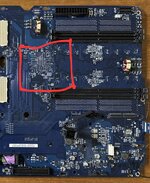
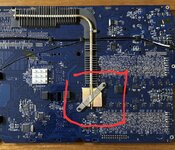
Why am I going on about this?... Well, the way I ended up 'fixing' a number of 'dead' G5s at the time was using a similar technique... not on a CPU or GPU chip, but on what I believe was the PM G5 equivalent of an Intel 'northbridge' (?) chip. Whatever the chip's purpose, it's the one located between the memory chip banks on the underside of the logic board. As you can see from these photos.
View attachment 87264
View attachment 87265
Apple knew it got hot (see the extensive heat sink arrangement) but those plastic "spring clamps" were clearly not providing enough pressure to overcome the solder fracture issue that developed over the long term. My solution, replace them with either slightly shorter ones with stronger springs (when I could find them) or replace the plastic clamps with an fashioned nut / bolt to gently increase the pressure from the heatsink on the chip. Yes, it was a crude approach - but you'd be surprised how many PM G5s this brought back to life...
Of course, this may not help in this case, and YMMV... But I thought I'd share just in case... Good luck!


 Hello Guest! We're hosting a challenge to welcome vintage Intel macs to the MLA during the month of July! See this thread for more information.