

• Hello MLAers! We've re-enabled auto-approval for accounts. If you are still waiting on account approval, please check this thread for more information.

New theory on the cause of the infamous Tunnel Vision problem - Testers needed!

Usually the polarizer I got didn't have the retarding film, so naturally black/blue on whitish yellow LCDs would acquire a greenish-yellow (think chartreuse) tinge, always with black pixels. Odd color, but much better contrast.

Ahh… I’ve found the same, experimentally. Removing the ruined polariser from, say, a Powerbook 150 passive-matrix screen seems to expose an additional grey layer that is also ruined and has to be scraped away. I was thinking that was the film-compensating layer (of FSTN) but I had seen the name ‘retarder’ somewhere else - I’m glad you mentioned it.

The result of not having the correct polariser is a display with yellow background and dark purple pixels, in my experience.

Could you please help me to find a source for the best type of polariser film to use on these mono LCDs from the early 90s? :) I’m having to do it by trial-and-error and I haven’t found anything great yet.

Cheers!
 

Attachments

  • 59386729-4685-4CD3-869E-ED902965B82F.jpeg
    59386729-4685-4CD3-869E-ED902965B82F.jpeg
    1.7 MB · Views: 36
Last edited:
Did you swap the rear one also? I forget if that helps the yellow and purple - it does happen sometimes. My first 150 attempt looked yellow/orangeish. I've not yet nailed down all the bits of science that go into this. Unfortunately there's a lot of variables to fixing LCDs.
 
Did you swap the rear one also? I forget if that helps the yellow and purple - it does happen sometimes. My first 150 attempt looked yellow/orangeish. I've not yet nailed down all the bits of science that go into this. Unfortunately there's a lot of variables to fixing LCDs.
Thanks - I don’t think I did the rear film on that one, but I replaced both on a different LCD recently also with yellowish results. I think I just need to find a better source of film.

Meanwhile, we’re off-topic for this thread - sorry about that - I just got excited thinking perhaps someone had found the secret source of DSTN polariser film with retarder :)
 
I've gotten a few inquiries about how my "100 degree celsius bake to fix tunnel vision" on my PB 180 has held up after a year. It's been about 18 months now and no ill effects or return of the issue. I just had it on for about 4 hours with the screen looking normal. I don't use my PB180 on a regular basis and it was stored on the shelf for the summer. Though no tunnel vision effects appear when the monitor is on, you can still see the remnants of what happened before the fix when the LCD is off. The old tunnel vision area appears subtly lighter, when viewing it at a certain angle in certain lighting, though not when looking at it straight on (basically at its worst state...i.e. mine never went completely dark, just a little over an inch on the sides and an inch and a half on the corners). It's not visible when the LCD is on, i.e. it looks normal.
 
The panel retaining a bias. LCDs are driven with AC waveforms that get switched around to try and work around this persistence thing (just read any old panel datasheet and there'll usually be a pin doing that.
Mono polarizers look different because of a retardation film, this is just a filter layer.

I have a vinegar'd 180 panel - the one I intend on using for testing my ideas on vignetting (that's currently 8000mi from me) that would like a word about that.

The charge retention is why the moisture invasion from a bad seal for the Hosiden active matrix mono LCD's makes more sense than the competing theory for tunnel vision. The other theory has no mechanism to explain how the charge retention occurs. For the moisture invasion theory it is easily explained that the moisture can create a parasitic capacitance which temporarily provides enough energy for image retention. Eventually the parasitic capacitance loses its stored charge and that is when the retained image is lost. That's why it isn't a true "burn in", it's a pseudo "burn-in" because the retained image will dissipate if disconnected from any power source for several days. I have been able to demonstrate this when a Hosiden LCD from a Powerbook 540 was completely stripped all the way to the down to all its various individual pieces of polarizers and diffusers along with the glass sandwich that contains the liquid crystals and TFT. I was able to show the retained image in the tunnel vision region by replacing the polarizer on the glass sandwich, showing that the retained image is inside the glass sandwich when it is attached to nothing, indicating that it is within the liquid crystal layer itself. The only way that would be possible is if the source of the power for the liquid crystals was within the glass sandwich. Parasitic capacitance in the liquid crystal layer makes the most sense for how this is possible. The best answer for parasitic capacitance in the liquid crystal layer is moisture intrusion.

Anyone can test this for themselves. Take a Hosiden active matrix mono LCD that hasn't been baked and has a retained image after being powered down, strip it down completely to all the individual components of the screen. Put the polarizer back over the glass sandwich that isn't attached to anything and you will see the retained image. Give it a few days at the most, and you will see when placing the polarizer over the glass sandwich now that the retained image is lost, because the parasitic capacitance has dissipated. The competing non-moisture intrusion theory for tunnel vision can't explain this behavior with their model of how tunnel vision occurs.

As far as baking a screen in a vacuum, as far as I know, no one has been able to do this due to a lack of proper equipment.
 
It is also now worth noting that Color LCDs made by Hosiden can also be affected by tunnel vision. @techknight ran into this in multiple panels from the IBM ThinkPad 750C, which uses an active matrix color display from Hosiden.
 
It is also now worth noting that Color LCDs made by Hosiden can also be affected by tunnel vision. @techknight ran into this in multiple panels from the IBM ThinkPad 750C, which uses an active matrix color display from Hosiden.

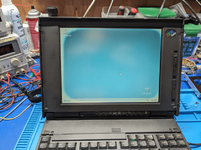
I guess this proves that Hosiden's methodology of creating LCD's at that time was just crap.
 
Hosiden goes on the same sh*t list as Reflektor Saratov for me, now. Soviet Reflektor LCDs are apparently sealed together with shellac, which doesn't bode well for their durability.
 
The moisture theory has problems. Uniformity of the tunnel vision, i.e. if moisture gets in, why does it appear as a lens both from top, sides, and bottom...and what about gravity's effect and how water tends to seep in more randomly, even in small amounts of moisture. Also, the fact that it dissipate at a consistent rate, i.e. turn the display off for a few hours and all is good again until the same amount of time passes and it starts to tunnel again. And, once baked, why doesn't it return in a relatively quick time, i.e. if baking mainly removes moisture, why doesn't it come back?

I actually was curious and wanted to run some tests so I bought a cheap second display, baked it to try and fix it...this one didn't quite come back 100% as the picture was more degraded (it doesn't seems as sharp anymore). I stuck it in a large box and ran a humidifier with the removed panel for a week (unpowered) and tunneling didn't return. It's not conclusive since I'm not sure how quickly, in the moisture theory, it is postulated the moisture would get in-between the panels? Does there have to be special circumstances, like pressure and heat differences? I suppose I could just sit in in water for a while, but I fear that would just kill it and make it useless. Anyone done something similar? Are we to think the baking removed both the moisture and re-sealed it? The observed tunneling effect more aligns with heating/warping and cooling/unwarping than moisture, which would persist at a longer rate in the display, disrupting particles.

There are a bunch of great videos on liquid crystal displays and their properties. Just watched another one recently from professor Loch at Hull University, who demonstrates the material, and right in his video, as he's trying to show how the polarizer works, and the small clear plates containing the liquid crystals are not perfectly level on both sides, you see the tunnel effect happening on the edges (and I previously articulated why panel warping would do that). That said, I can't conclusively say either way, but again, my experiment and my observed behavior of sample liquid crystal displays really seem to be an argument against the moisture theory. If anyone could remove the moisture via baking and then have it return via some form of extreme moisture exposure, that would be a step in the right direction. I couldn't get it to do that but others are free to give it a try. Only way to end this argument is to have several people try and prove it's moisture by having it return after removing it (and quickly, so that it's not a seal re-releasing over time causing warping again, but actual immediate post-moisture exposure showing cause and effect)
 
Last edited:
It is also now worth noting that Color LCDs made by Hosiden can also be affected by tunnel vision. @techknight ran into this in multiple panels from the IBM ThinkPad 750C, which uses an active matrix color display from Hosiden.
Oh that's too bad. I have a ThinkPad 365XD and so far it's held out great. Don't know who made its display as I haven't taken it apart as of yet. It's a lovely machine from 1995/96 running Windows 98 presently.
 
There's a lovely page here on thinkwiki that lists what LCDs old ThinkPads used. You can see there all of them that are known to use Hosiden panels, and the 365XD isn't listed. It's listed under two panels made by Hitachi. It's always possible of course that they shipped with LCDs from other vendors.
The bigger problem on your 365XD is that the hinge mounts are going to explode at some point, but that's usually a far more fixable issue :)

Also worth noting that I don't think it's time to panic if you have a color Hosiden display. techknight's two cases are so far the only two cases reported - and that hosiden panel was used in a LOT of ThinkPads, including the legendary 701c, and no one else has documented having that issue yet (poor techknight).
 
I stuck it in a large box and ran a humidifier with the removed panel for a week (unpowered) and tunneling didn't return.
Am curious about this statement... did you mean "de"humidifier? Also, you say "tunnelling didn't return" - does that mean you 'fixed' it?
 
Am curious about this statement... did you mean "de"humidifier? Also, you say "tunnelling didn't return" - does that mean you 'fixed' it?
No, I tried to see if I could have tunneling return after baking it, so I wanted to add more moisture to the air than was normal (thus a humidifier). We had just gotten a new washer and dryer so I used one of those very large boxes, though I cut out a side for air and placed it close to a wall to control air flow. I didn't want it dripping with water, so it took a bit of fiddling to be able to have it run for a while without supervision.
 
There's a lovely page here on thinkwiki that lists what LCDs old ThinkPads used. You can see there all of them that are known to use Hosiden panels, and the 365XD isn't listed. It's listed under two panels made by Hitachi. It's always possible of course that they shipped with LCDs from other vendors.
The bigger problem on your 365XD is that the hinge mounts are going to explode at some point, but that's usually a far more fixable issue :)

Also worth noting that I don't think it's time to panic if you have a color Hosiden display. techknight's two cases are so far the only two cases reported - and that hosiden panel was used in a LOT of ThinkPads, including the legendary 701c, and no one else has documented having that issue yet (poor techknight).
Oh, good to know. Yes, the hinge exploded on mine on one side. It got stuck on a wooden platform (I think I had it sitting on a piece of plywood) when I tried to open it up. So important to always lift the laptop if you open up the panel. I did 3D print a fix for the missing tab and it seems to work. But, that panel is very flimsy.
 
Has anyone tried to contact Hosiden to see if they have any ideas? Maybe they could put us in touch with someone who worked there back in the 90s. Surely people who did this work for a living would enjoy waxing poetic and speculating on what could be going wrong.
 
Has anyone tried to contact Hosiden to see if they have any ideas? Maybe they could put us in touch with someone who worked there back in the 90s. Surely people who did this work for a living would enjoy waxing poetic and speculating on what could be going wrong.
Hosiden is a very large company. They also have exited the LCD business over two decades ago.
 
We often hit a wall when trying to communicate with japanese companies because we would need someone fluent in japanese
it's the same story for getting schematics out of toshiba

I wonder if there is something like vcf in asia , that could maybe help.
 
Back
Top