Yes, I'm running with the non HDMI version in my machines, I can live without audio since I have more usage for the other resolutionswow this is insane =)
does these support 1280x1024 also or only hdmi spec?
Yes, I'm running with the non HDMI version in my machines, I can live without audio since I have more usage for the other resolutionswow this is insane =)
does these support 1280x1024 also or only hdmi spec?
Yes, it’s a real HDMI and it does 1280x1024 in 32 bit color. With The duo dock I had some issues, let me pull mine out and test again, in 700/650 it works without any issues (other than the bugs mention by Melkhior)Will be really nice!! is this 1280x1024 supported? What kind of output connector is it real HDMI?
I want to run in my duo Dock or 650/700![]()
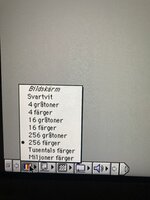
All of @Melkhior's FPGA platforms supports 1/2/4/16/32 bits-per-pixel. I traded @Jockelill for a QuadraFPGA (040 PDS version) which works quite nicely on the fast 040 bus. 33mhz is the max system clock supported currently, it will not work at 40.@Jockelill Any idea if it'll eventually support 8- & 4-bit color and B&W?
@Jockelill Any idea if it'll eventually support 8- & 4-bit color and B&W?


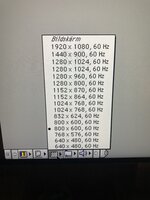
This is awesome @Jockelill, following to see how it goes.View attachment 80973View attachment 80974
This is basically all that is supported. The first occurrence of each resolution will give you a window boxed (it’s running 1080p then), the second is “true” resolution.
Two known bugs:
* Sometimes the lower resolutions are not perfectly centered. If you change to another resolution this usually fixes the problem.
*Sometimes the screen goes black when you change to 640x480. Restart is only solution. I’m guessing this issue is only related to my monitor.
You're basically describing QuickDraw accelerationI wonder if it is possible to do host-side framebuffer memory instead of needing to map the whole framebuffer memory over nubus, then transfer damaged regions to nubus as needed. Could possibly reduce requirements for the nubus side of things in that manner
Not quite that easy. Lack of IO and RAM to use as a frame buffer is a major stumbling block, further complicated by nubus being fast enough to be annoying. Definitely won't be bit banging it easily.Those are awesome, but eyewateringly expensive with the FPGA board.
I've wondered for a bit how bad a dumb framebuffer dumping to HDMI with a bare metal Pi would be as a low-cost solution?
Basically take RGBtoHDMI and modify to bang NuBus with a level shifter just enough to map framebuffer memory for the HDMI side to consume. You could build a board + pi for $40, theoretically.
Maybe it's stupid. Obviously no acceleration with a really basic solution, too.
No way to get notified of screen updates in anything resembling a graceful manner. The mac vnc server ends up hashing each line, and the scsi video cards just always blast the entire frame buffer over scsi. It's terrible at 640x480 and only gets exponentially worse at higher bitdepths/resolutions.I wonder if it is possible to do host-side framebuffer memory instead of needing to map the whole framebuffer memory over nubus, then transfer damaged regions to nubus as needed. Could possibly reduce requirements for the nubus side of things in that manner
I would have thought that at first but the PiStorm manages to bang the 68k bus at a pretty high freq. For memory constraints are you thinking about a pico? I’m thinking more along the lines of a zero 2.Not quite that easy. Lack of IO and RAM to use as a frame buffer is a major stumbling block, further complicated by nubus being fast enough to be annoying. Definitely won't be bit banging it easily.
I would have thought that at first but the PiStorm manages to bang the 68k bus at a pretty high freq. For memory constraints are you thinking about a pico? I’m thinking more along the lines of a zero 2.
It’s so confusing…I constantly search the wrong one.Ah. I was thinking RGB2HDMI which uses a Pico. Pistorm uses a large CPLD/small FPGA to handle all the timing-sensitive bits, an approach like that would be needed here. Not my cup of tea but it is a potentially workable approach.