More tales from Bandley 3

Work-from-home has it's benefits, however mixing it up in the office is important, particularly when developing something new.
The spring of 1983 was stressful period for the Mac group, as the decision to build the factory in Fremont rather than Texas put a huge additional load on us.
Finding a building, purchasing the equipment and staffing all became -our- responsibility rather than that of the manufacturing division. So, lots of meetings.
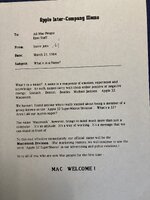
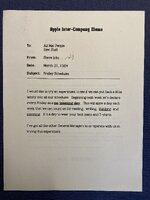
One day in March this showed up in all our in baskets-
IMG_0724.jpeg

Remember kids- no e-mail or text in those days, just phone and Xeroxed memos to pass info around. (yes, this is my original memo but since they were all copies the initials are not "real")
Not only were they no meeting days, but they quickly became let's hang out in the B3 inner lobby and have a beer or two afternoons. This invited some cross-pollinating among the staff which was actually quite productive.
Soon though it was decided we should have a bit of entertainment as well. Steve was hooked on the Windham Hill record label at the time, and one Friday he had scheduled Liz Story, one of their pianists, to come play for us. Oops, we needed a piano for the lobby.
IIRC, 2 days and over $30k later a shiny new Bosendorfer grand appeared, was tuned and ready. Wonder where it is now?
On another afternoon we were treated to a Q&A session on design by Maya Lin, the architect of the Vietnam Veterans Memorial. There were more that I don't recall now -it was a very busy time.
The comment in his memo that mentions jeans and t-shirts is a bit gratuitous, as that was pretty much all anyone ever wore to work.
 
Last time I was on the Infinite Loop campus, the Bosendorfer grand piano was tucked away in a room called the Piano Bar, directly across from Town Hall where media events used to take place.
 
I kinda rushed a bunch of pics as a lot of this stuff -might- be going to R&R auctions later this spring. Or not, though they gave me a crazy estimate for an SJ business card...
I'm getting older and my kids don't care.
 
Once Steve had won the battle over locating the Mac factory locally rather than in Dallas we found a suitable building in Fremont, CA.
120k sq ft. and brand new, so no interior obstacles to work around. As usual we needed to celebrate somehow.
He chartered a bus and we all took the 20 minute ride (much less traffic then) over for a look. On arriving we found lunch waiting for us -fully catered, white tablecloths, the whole bit. Some of the team had brought roller skates and had a blast skating all over that pristine concrete floor.
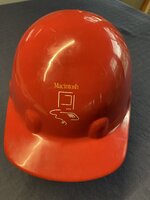
We were then each presented with an official Mac hardhat to kick off the construction.
I believe this may be one of the rarest early Mac collectables as there were only 80 ordered (I signed the purchase order). These are genuine Fibremetal brand, not some toy -typical of Jobs.
 

Attachments

  • IMG_0738.jpeg
    IMG_0738.jpeg
    1.4 MB · Views: 31
And then there were the last minute RFI issues. Originally all was supposed to be well, but the far-field tests indicated that the case seams leaked a bit more than was allowed -I remember the term "slot antenna" being used.
The solution was to spray a coballoy (paint) coating inside the case -some were actually done using an arc-spray (metalizing) process. Both added some thickness and that caused interference at the seam, which caused difficulty on assembly. The solution was to put each Mac face down and push the back onto the bezel with a large arbor press -a stunningly manual step in an otherwise automated factory.
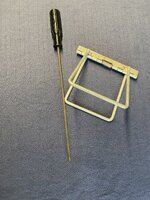
If you have ever tried to open a Mac for the first time you probably did some damage with your screwdriver or whatever. There was a cool tool developed for use here, made from a chunk of piano hinge with the edges milled down to fit. Once the case had been opened and re-closed a couple of times things got easier. I made and sold a bunch of these case crackers to Radius as well.
The extended Torx driver was a last minute thing too.
 

Attachments

  • Mac tools.jpeg
    Mac tools.jpeg
    4.3 MB · Views: 22
These are genuine Fibremetal brand, not some toy -typical of Jobs.
That hat is tremendously cool! And so different to the Apple of the following decade. When eWorld launched, employees were given souvenir "hard hats" made of flimsy yellow plastic. That plastic eventually became so brittle, the hat would shatter into pieces if you dropped it on the floor. It was sort of a metaphor for all the computers made during the Spindler years.
 
Thanks for sharing your recollections, perhaps a blog or book might come of these if you have the time and energy to write more?

And please scan documents you have and add them to archive.org. RR auction stuff is bought by people who tend to not want to share what they’ve ‘invested’ in. I’m not saying to not sell the stuff, but at least some archival beforehand would greatly benefit the wider group interested in this stuff.
 
The backstories are so helpful. Those of us that were not around tend to invent our best theories for parts, bodges, and designs, but are delighted to learn the actual first-hand account.
 
And then there were the last minute RFI issues. Originally all was supposed to be well, but the far-field tests indicated that the case seams leaked a bit more than was allowed -I remember the term "slot antenna" being used.
The solution was to spray a coballoy (paint) coating inside the case -some were actually done using an arc-spray (metalizing) process. Both added some thickness and that caused interference at the seam, which caused difficulty on assembly. The solution was to put each Mac face down and push the back onto the bezel with a large arbor press -a stunningly manual step in an otherwise automated factory.
If you have ever tried to open a Mac for the first time you probably did some damage with your screwdriver or whatever. There was a cool tool developed for use here, made from a chunk of piano hinge with the edges milled down to fit. Once the case had been opened and re-closed a couple of times things got easier. I made and sold a bunch of these case crackers to Radius as well.
The extended Torx driver was a last minute thing too.
This is of course, all very insightful. Manufacturing is an art-form too, especially when you're doing something new. Are these stories on Folklore.org yet?
 
This is of course, all very insightful. Manufacturing is an art-form too, especially when you're doing something new. Are these stories on Folklore.org yet?

They would be a fantastic addition, but on the about page it states that since its move to the Computer History Museum, Folklore.org is read only and all interactive elements have been removed, including the ability to add new articles, which is very sad.

 
Just watched it and...ummm. Lots of grey hair there and (IMHO) some errors and at least one serious omission.
I can't comment on the very early ( 77-80) stuff as I started in mid '81-right after the IPO and was employee 2708 -originally on the Apple ][ and drafted into the Mac group in late '82. Before that I had spent 4 years at Amdahl working on the 470/v7.
However-
The Lisa project was in Bandley 4. That was the one with the blacked out windows and no outsiders policy. In my memory Taco Towers was always Creative Services.
The Red Coach Inn was not at Valco (the mall) but in a smaller shopping center at Wolfe/Stevens Creek -directly across Wolfe from the large HP complex which was eventually ripped out to become the Apple Spaceship.
The pirate flag thing came out of a 3 day off-site meeting we had in Carmel during early '83.
Steve had a whiteboard set up with 3 points in all caps. "The journey is the reward" "Real artists ship" and... "Being a pirate is more fun than being in the Navy". So the flag was put up after our return from Carmel.
We were just about to move into the newly renovated B3 after actually developing the Mac in -Texaco Towers, a rather cheesy 2 story office condo building on Stevens Creek.
It was next to a Texaco service station on the NE corner of Hiway 9, and across from the huge Cali Brothers Feed Store on Stevens Creek.
We had no lobby or conference room there, so any meeting with suppliers or other outsiders took place at the Bob's Big Boy restaurant directly across Hiway 9 (now called DeAnza Blvd). All this was very close, walking distance actually, to the rest of the Apple buildings but we really did live in a world of our own.
Texaco Towers was integral to the project and should be mentioned.
Possibly more trivia than you all need, but I have gotten a surprising number of messages asking for additional stories.
 
Back
Top