• Hello MLAers! We've re-enabled auto-approval for accounts. If you are still waiting on account approval, please check this thread for more information.

Mini vMac on 68k PowerBook?

While playing on my PB170 I was lamenting the fact that most of the B&W games before 1990 won’t work on it and most newer games dropped B&W support. Then I thought wouldn’t it be nice if you could emulate an SE, Plus, 512 or 128 on these monochrome PowerBooks? Looking at Mini vMac’s site there actually IS a 680x0 port of the emulator available! So maybe this is a real possibility. Has anyone gotten the 68k port to work though? I’ve tried it on my 170 and 180c but on both it makes noise but just displays a solid black screen. Can’t tell if it is actually booting or not. Maybe a wimpy 68030 can’t actually handle this?

 
No, this is specifically the "Macintosh OS 9 and earlier" 680x0 platform official port by Gryphel.  It launches and has all the proper trappings (menu, title-bar, etc.)of a functional Mac program so I'm sure it isn't for an Amiga.

 
Remember reading about someone actually running Mini vMac in a Mini vMac... Can't find the page now, maybe it was on Gryphel site.

Should run on a 68k, but on a 180 would be very slow. Maybe the black screen is just that, it take a lot of time booting...

Fastest 68k i have is a Duo 270c, will try later.

 
I just tried running Mini vMac within Mini vMac (Mac Plus on Mac II) and I get the black screen too.

Left it about 10 minutes doing its own thing (Speed: All Out) but it stayed black.

 
Just tried Mini vMac in both Basilisk II as well as on my SE/30. Black screen, I wonder if maybe it is a bug in the program. Somtimes clicking or pressing control would cause the emulated display to refresh, and show the floppy question mark screen. Of course it was static though, completely unusable.

 
Last edited by a moderator:
Yeah, I just tried it on Basilisk too.  My only real hardware 68040 is inconveniently far away (and running A/UX) at the moment but I would like to know if there is a flaw in this particular build of mini vMac or if it will run on SOME high end 68k Mac hardware.  It seems like it might be running but there is something screwy going on with the video output.  I might get ambitious in the next few days and try to compile it on the 170 with my copy of CodeWarrior.

 
No, it's not really a bug in the program - I don't think it is, anyway, having tested this before.

I'm reasonably certain it's just really, really, *really* slow. I feel as if I tested it before and I got it to display a single frame, but if I'm making claims like that I'd better have some proof. :p

Maybe when I get my CC working (dead hard drive) I'll give it a whirl. 

 
Last edited by a moderator:
I hear the startup chime from the Mac Plus ROM just fine, and as I said, I can get the display to refresh sometimes, by interacting with the program. I don't think it is running "really, really really slow".
 

Yeah, I just tried it on Basilisk too. My only real hardware 68040 is inconveniently far away (and running A/UX) at the moment but I would like to know if there is a flaw in this particular build of mini vMac or if it will run on SOME high end 68k Mac hardware. It seems like it might be running but there is something screwy going on with the video output. I might get ambitious in the next few days and try to compile it on the 170 with my copy of CodeWarrior.
You can try to run it on A/UX. Also, it is compiled using MPW. I used both mini vMac 3.3.3, and the latest 3.4.1. Both have the issue.

 
Last edited by a moderator:
Awesome.  I remembered seeing the emulator inside an emulator thing that galgot mentioned earlier on the web somewhere once.  Pretty sure it was the original vMac on Basilisk II.that you just demonstrated.  How was the emulator's responsiveness?  Seeing your demo I managed to get vMac-0.1.9b to work on my 170.  It runs ultra slow though.  I was reading about shapeshifter which I think is the emulator zuctronic was thinking of for the Amiga and it runs at near full speed on the equivalent CPU.  In other words a 68030 Amiga runs almost as fast as a similarly equipped 68030 Macintosh.  This isn't so much of a emulator as a virtual machine.  The instructions don't have to be translated since the CPU's are identical.  Curious how it handles I/O though.  There must be some translation/emulation there somewhere.

 
There's a screenshot at the bottom of this page :

http://www.gryphel.com/c/minivmac/screens/more.html

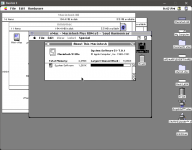
Showing a System 1.1 guest Mini vMac running on a System 7.5.5 host. The host HD icon is the standard Mini vMac HD icon. I doubt it's a fake.

But it's not the page I remember . there was a phrase like "... and yes, You can run Mini vMac on a Mini vMac..." or something of this kind... and saying that it was slow indeed .

The guys at emaculation.com (gosh, that domain name always scared me...) should know better.

 
Last edited by a moderator:
The emulators responsiveness was very good, with no lag or delays at all (in fact it's even accelerated from the original Mac Plus its trying to emulate); but remember Basilisk II on my modern PC runs probably at least a hundred times faster than a real 68K mac.

 
I sent a message to Paul and it turns out mini vMac 3.4 has had 68k support broken all along but no one had reported it.  He said he will see about getting it fixed in 3.5 at some point.  Anyone have an older binary like v3.3.3?  Couldn't track one down yet.

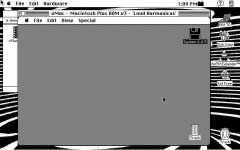
Here's the older vMac 0.1.9 running on my PowerBook170! :)

vMac on PB170.jpg

 
Last edited by a moderator:
I sent a message to Paul and it turns out mini vMac 3.4 has had 68k support broken all along but no one had reported it.  He said he will see about getting it fixed in 3.5 at some point.  Anyone have an older binary like v3.3.3?  Couldn't track one down yet.

Here's the older vMac 0.1.9 running on my PowerBook170! :)
That's cool !

How fast is it ? Usable ?

 
That is what I figured :( . Oh well. I wonder if Mini vMac will be any faster? (Once Paul fixes the bug of course).

 
Back
Top