
-
 Hello Guest! We're hosting a challenge to welcome vintage Intel macs to the MLA during the month of July! See this thread for more information.
 -
We've made some quality of life improvements to the Trading Post. More info here.
You are using an out of date browser. It may not display this or other websites correctly.
You should upgrade or use an alternative browser.
You should upgrade or use an alternative browser.
Macintosh 128 Proto (as far as i can tell)
- Thread starter Macdrone
- Start date



Also Steve jobs wanted to bypass sony for the drives since twiggys just were turnng out to be junk (why the eprom is replacable on my boards),so he went to someone else to build a similar drive. That fell through and his team kept the Sony deal for the 3.5 drive alive which saved the Mac.


Okay, here's what I think it is:
A late prototype Macintosh. This was probably used by a Mac Team member who kept using it for a few years after the release of the Mac. As it was a daily use machine, it was upgraded as they went.
What's original? The case, frame, floppy drive bracket, floppy drive, logic board, ROM chips (342-0220 and 342-0221, right?)
What's new? The DRAM chips, the mini-mux board (the little "extra" board on the logic board at E3).
The mini-mux and 256kbit DRAM chips were a popular upgrade back in the day. If you wanted it to be "original", you would remove the mux board, repair the cut trace on the bottom of the logic board under the mux board area, and replace the 16 DRAM chips with 64kbit chips.
I'm a little surprised that the ROM chips are still the original 128k/512k versions. Many people upgraded these to the Mac Plus ROMs which added 800k drive support giving you a Mac 512ke.
A late prototype Macintosh. This was probably used by a Mac Team member who kept using it for a few years after the release of the Mac. As it was a daily use machine, it was upgraded as they went.
What's original? The case, frame, floppy drive bracket, floppy drive, logic board, ROM chips (342-0220 and 342-0221, right?)
What's new? The DRAM chips, the mini-mux board (the little "extra" board on the logic board at E3).
The mini-mux and 256kbit DRAM chips were a popular upgrade back in the day. If you wanted it to be "original", you would remove the mux board, repair the cut trace on the bottom of the logic board under the mux board area, and replace the 16 DRAM chips with 64kbit chips.
I'm a little surprised that the ROM chips are still the original 128k/512k versions. Many people upgraded these to the Mac Plus ROMs which added 800k drive support giving you a Mac 512ke.

Every Mac 128, 512, 512ke, Plus, SE, SE/30, Classic, and Classic II had the front brace-gap wide enough for the Twiggy drive. That's how people could easily hack slot load CD drives in them so frequently.
In your picture there is a metal cover on the back of the FDD with one screw that the ribbon sneaks up under. That is not regular production. I think you need to tear down further and see if you have a weird early Sony drive in there too.
In your picture there is a metal cover on the back of the FDD with one screw that the ribbon sneaks up under. That is not regular production. I think you need to tear down further and see if you have a weird early Sony drive in there too.

I don't have and have never seen a Classic II, but every Compact from 128k-Classic has provision for a full height 5.25" Drive built into the chassis.
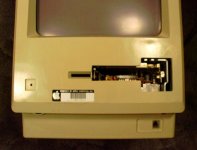
If you think the 3.5" drive looks funny in the 5.25" TwiggyHole in the chassis from the back, get a load of it from the front!
I need to pop my upgraded 128k open to see if has that fancy FDD bracket or the slab-sided simplification installed in later compacts.
ClearTwiggyProtoHoaxMacHacks™
If you think the 3.5" drive looks funny in the 5.25" TwiggyHole in the chassis from the back, get a load of it from the front!
I need to pop my upgraded 128k open to see if has that fancy FDD bracket or the slab-sided simplification installed in later compacts.
ClearTwiggyProtoHoaxMacHacks™
:lol: You beat me to the post, Al!
But yours is an upgraded 128k board. The little mux chip is the giveaway. The 128k board was designed to be easy to upgrade to 512k by adding that board when the 256kbit DRAM chips got cheaper. In fact, yours looks like the production 128k board. Mine had been upgraded in a similar manner by Videx but they skipped the board and soldered the mux chip directly to the board with wire wrap wire.According to the folklore site the proto late model was 512 not 128 so it's not upgraded.
The real 512k board was a slightly different design supporting 128k or 512k of RAM without the patched-on board.
Thanks for those shots, mcd. I never realized that the Pre-Plus compacts had their A/B interconnect headers positioned so that they wouldn't be blocked by the MIA TwiggyBox. With the placement of that connector on the Plus, it's a real PITA to cycle that connection when playing around with makeshift replacements for the Twiggy Drive's enclosure.

I don't have any before pictures but I have the TMS mux chip still.
The 128k/512k ROMs are 342-0220 (HI) and 342-0221 (LO). They may have a revision suffix on the end (A, B, etc)
The 512ke/Plus ROMs are 342-0341 (HI) and 342-0342 (LO). Once again, there may be a revision suffix on the end. These ROMs added SCSI and 800k floppy support.
EDIT: it would be cool if you could trace this back to someone at Apple. Steve Capps is a customer of mine but I'd be way to chicken to ask. Isn't Andy Hertzfeld supposed to be approachable? Maybe he could at least confirm the lineage of the case.
The 128k/512k ROMs are 342-0220 (HI) and 342-0221 (LO). They may have a revision suffix on the end (A, B, etc)
The 512ke/Plus ROMs are 342-0341 (HI) and 342-0342 (LO). Once again, there may be a revision suffix on the end. These ROMs added SCSI and 800k floppy support.
EDIT: it would be cool if you could trace this back to someone at Apple. Steve Capps is a customer of mine but I'd be way to chicken to ask. Isn't Andy Hertzfeld supposed to be approachable? Maybe he could at least confirm the lineage of the case.

Nope, I wish it were. The only prototypes in my collection are the PEx MoBo and Paladin KBD/Trackball. I do collect every ProtoMac/Peripheral pic I can find, wherever I find it, in the hopes of doing a ProtoHoaxMacHack or three. I'll do so even if I need to "save page as" and and then strip the images out of a long series of folders to get around some idiotic copy protection scheme for eBay pics. Those I don't usually post here though. [] ]'>
That one is definitely a TwiggyMac prototype case they had laying around the joint. I wonder if it dated from before SJ was let in on the secret development effort? It wouldn't surprise me at all if the Sony drive in this prototype only spits the floppy in and out for engineering tests. Sony modified the MicroFloppy drive they were developing for the Mac to achieve 400k storage capacity, so they undoubtedly did physical testing while the multi-speed controllers were still in development. From what I recall in the ten years ago discussions about this prototype, it might have been used to make the measurements needed to develop the Micro-Floppy bezel tooling. The complex drive cages might have been manufactured by Sony and then retooled for a less expensive part at a later date. Has anyone seen any makers mark on the complex cages?
My much upgraded 128k has the same, bent only, slab-sided floppy cage as do my two Mac Pluses. This engineering test prototype has what appears to be the same complex, stamped metal floppy cage as Macdrone's Prototype. Also note the untextured finish of both prototype cases. Any Mac case that's untextured is, without question, a prototype case, whether it be from the soft tooling produced first go-round prototyping process or the last go-round of hard tooling development tests.
] ]'>That one is definitely a TwiggyMac prototype case they had laying around the joint. I wonder if it dated from before SJ was let in on the secret development effort? It wouldn't surprise me at all if the Sony drive in this prototype only spits the floppy in and out for engineering tests. Sony modified the MicroFloppy drive they were developing for the Mac to achieve 400k storage capacity, so they undoubtedly did physical testing while the multi-speed controllers were still in development. From what I recall in the ten years ago discussions about this prototype, it might have been used to make the measurements needed to develop the Micro-Floppy bezel tooling. The complex drive cages might have been manufactured by Sony and then retooled for a less expensive part at a later date. Has anyone seen any makers mark on the complex cages?
My much upgraded 128k has the same, bent only, slab-sided floppy cage as do my two Mac Pluses. This engineering test prototype has what appears to be the same complex, stamped metal floppy cage as Macdrone's Prototype. Also note the untextured finish of both prototype cases. Any Mac case that's untextured is, without question, a prototype case, whether it be from the soft tooling produced first go-round prototyping process or the last go-round of hard tooling development tests.
Similar threads

- Replies
- 9
- Views
- 4K


- Replies
- 274
- Views
- 46K


- Replies
- 43
- Views
- 11K

