• Hello MLAers! We've re-enabled auto-approval for accounts. If you are still waiting on account approval, please check this thread for more information.

Mac SE/30 - horizontal wavy lines?

Hi All,

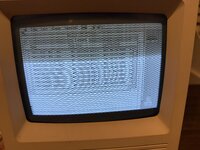
I have recently picked up a Mac SE/30 that boots fine but has a horrible wavy horizontal picture distortion as per attached pic.

The unit has been recapped and I tested the board in a known good machine with the same result which makes me thing it's a motherboard issue.

I did give it a good clean in IPA but same result.

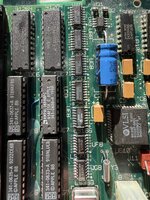
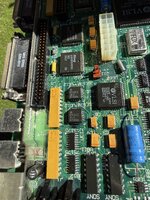
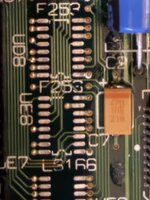
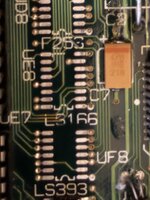
I've also attached a p[hoto of the U8 area which apparently is notorious for causing failures as I can't see any issues.

Any help/advice appreciated.

Thanks

Sonny
 

Attachments

  • IMG_2687.jpeg
    IMG_2687.jpeg
    2.4 MB · Views: 65
  • IMG_2691.jpeg
    IMG_2691.jpeg
    2.6 MB · Views: 62
I can see green grunge and dirt. Ultrasonic clean an see what happens. If no go you will need to lift a few chips and see what it's like under them
 
I've also attached a p[hoto of the U8 area which apparently is notorious for causing failures as I can't see any issues.

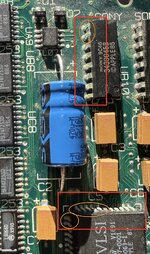
The solder joints on these chips look damaged, certainly due to electrolyte from the old cap at C7:

IMG_5808.jpeg

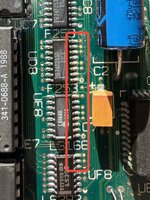
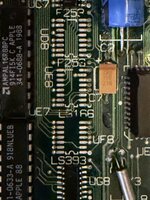
The picture you’re seeing looks like part of the VRAM is not getting written to (default state showing through), likely an addressing error. So start with repairing the joints on the F253 chip at UD8.
 
I can see green grunge and dirt.
Me too - the following chips and nearby traces have more corrosion than they should after recapping. A thorough cleaning is in order and far less invasive than removing the chips - I would clean it first (you can always lift the chips following the cleaning, if you have ongoing issues).

SE30 vid issues 01.jpg

Ultrasonic is best (if you have it) but chemical cleansing, done properly, is also effective.
 
Agree with the above.

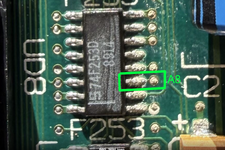
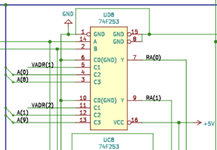
Once you have cleaned, have a look at (if I'm counting properly), A8. This is an educated guess based on: you have what looks like four lines of good data followed by four lines of default VRAM content, repeat. The framebuffer is 512 pixels wide, at 1bpp, which is 64 bytes per line. That's 256 bytes per "good" bit and per "bad" bit, which would suggest bit 8 is misbehaving.

Might be wrong, though.
 
Agree with the above.

Once you have cleaned, have a look at (if I'm counting properly), A8. This is an educated guess based on: you have what looks like four lines of good data followed by four lines of default VRAM content, repeat. The framebuffer is 512 pixels wide, at 1bpp, which is 64 bytes per line. That's 256 bytes per "good" bit and per "bad" bit, which would suggest bit 8 is misbehaving.

Might be wrong, though.

A8 is pin 3 of UD8, so I think you're right on the money there.

Screenshot 2025-08-30 at 18.31.56.png
 

Attachments

  • Screenshot 2025-08-30 at 18.34.13.png
    Screenshot 2025-08-30 at 18.34.13.png
    214.8 KB · Views: 23
I was too afraid to try it for a long time, but vinegar works really well for this kind of corrosion. Just the regular grocery store 5%, scrub with a toothbrush, rinse thoroughly with distilled water, then isopropanol to drive the water out of all the little crevices. I've gotten great results with this method on a couple boards. Did not damage anything.
 
Hello All,

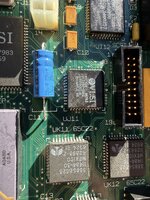
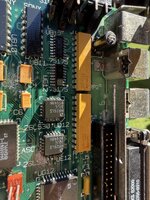
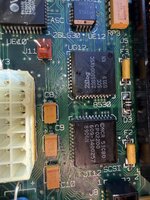
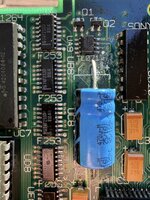
Thank you so very much for each of your input. To explain what I've done:

1. Cleaned and reflowed UF8, UE8 and UD8.
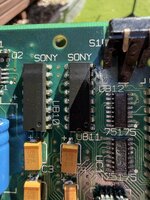
2. Cleaned and reflowed both the SONY chips.
3. Cleaned and reflowed UD12 and UE12 where the pins look corroded.
Cleaned and reflowed pins that looked corroded around UJ11.

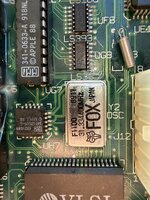
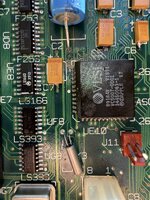
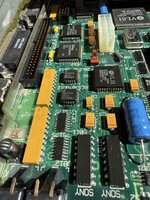
Lots of pictures of work performed attached.

Outcome - same screen and scratchy sound.

What's my next option?

Thanks

Sonny
 

Attachments

  • IMG_2728.jpeg
    IMG_2728.jpeg
    4.1 MB · Views: 22
  • IMG_2727.jpeg
    IMG_2727.jpeg
    3.9 MB · Views: 17
  • IMG_2731.jpeg
    IMG_2731.jpeg
    3.9 MB · Views: 15
  • IMG_2730.jpeg
    IMG_2730.jpeg
    3.8 MB · Views: 13
  • IMG_2729.jpeg
    IMG_2729.jpeg
    3.6 MB · Views: 12
  • IMG_2726.jpeg
    IMG_2726.jpeg
    3 MB · Views: 13
  • IMG_2735.jpeg
    IMG_2735.jpeg
    3.9 MB · Views: 12
  • IMG_2732.jpeg
    IMG_2732.jpeg
    3.1 MB · Views: 13
  • IMG_2734.jpeg
    IMG_2734.jpeg
    3.2 MB · Views: 24
No, didn't remove the chips. Hoping I could reflow without the hassle of removing. This is going to be a big job :-(

With regards the screen issue specifically, I would tone out the connections to UD8 using the schematics - are there any broken traces?

If not UD8 might be faulty - new parts are available.

Could the scratchy audio be dirt/corrosion inside the headphone jack? It has a contact closure that reroutes sound to the internal speaker when no miniplug is inserted. Try spraying contact cleaner into the jack, and/or plugging and unplugging a miniplug several times.
 
Last edited:
As croissantking said, your sound issue might be something as simple as a dirty audio jack. I would cover all the simple stuff first and trace your way back.
Looking at your pics, another issue I see is that some of your caps aren't soldered to the pads. Are you using enough flux? Make sure your tip is heating both the pad and the cap at the same time. If you add some solder to the tip before applying heat to your capacitors, you will 'tack' the cap in place. That way, you can place the cap, which makes it easier to solder the other side. After that, i'd check the op amp and amp (q1, q2, and ua9). As others suggested, i'd desolder and clean your sony chips. If you socket them you it will be easier to troubleshoot later. If you still have an issue, i'd pull the asc chip (ue10) and clean the pads / chip legs. It's right next to the leaking caps, so sometimes, it needs that. Hopefully, it won't need to get to that, but that's the normal troubleshooting path i'd follow. You also need to be checking traces as you go through the process. You can have small micro cracks where the traces meet the pads that can give intermittents or broken traces.

Your video issue is a totally different problem altogether. I'd check your video rom and socket first. It's the easiest to check, so I'd start there. After that (as others have suggested), i'd check the video mux. It takes direct damage from the caps, so it is probably the issue. Pull your 253's and check your traces, vias, and either test the 253's or replace them (74f253's are cheap/easy to get). I usually replace any /all chips that were exposed to electrolyte just to be on the safe side (and erase possible issues from the troubleshooting process).
 
Yeah, looking closer at the caps I think you are right. I inherited this SE/30 and the re-cap was done by the previous owner. I'm going to have another go at them over the weekend. Well done for spotting the solder job or lack there of!

I'm also going to do a bit of buzzing for continuity on UD8. Seems like the culprit in many cases. I'll also probably remove for a trace inspection.

Thanks for all the fantastic advice and I'll report back once I've done the work.
 
Last edited:
Well, I finally got some time to re-look at the Mac SE/30. I reflowed all the caps and found one cap that wasn't soldered at the end. They are all now done and still getting the horrible screen issue.

Next I'm going to start work on the UD8........

Will report back.
 
Hi All,

Just a quick update. I have removed IC's UD8, UE9 and UF8. Cleaned up the pads and it all actually looks fairly good per photos.

Unless anyone can see an issue I'm going to replace all these ICs with a bunch I bought from MOUSER.

Anything else before I start soldering?
 

Attachments

  • IMG_3128.jpeg
    IMG_3128.jpeg
    1.1 MB · Views: 8
  • IMG_3126.jpeg
    IMG_3126.jpeg
    1.1 MB · Views: 8
  • IMG_3127.jpeg
    IMG_3127.jpeg
    1.1 MB · Views: 14
Nothing obvious, but i will check continuity between the pad itself and the trace, sometimes it is hard to catch a broken one.
 
Back
Top