• Hello MLAers! We've re-enabled auto-approval for accounts. If you are still waiting on account approval, please check this thread for more information.

Mac Plus turns off after short time

I really doubt it has anything at all to do with the flyback transformer, that is on the secondary side of the power supply. Look for film capacitors between live and ground near the input power connector.
There aren't any filter capacitors between the AC mains and the ground as these are Y2 EMI/RFI filter capacitors while the Mac Plus only has 3x X2 filter caps who sit between the mains near the power switch. However since these are behind a fast 1.5A blowfuse, it's unlikely they trip a standard RCB.

There are different types of circuit brakers in houses: the standard one's, RCB, only switch out on overload or short circuit, however others watch for loss between the fase and the ground,RCBO's,: I think it will be this one's that trip in your house.

Can you confirm this ? Otherwise post brand and model/type number of the circuit braker.

I also think there's a fault somewhere on the Analog boards where there's a loss between the mains and the ground, the AC circuit before the transformer is most obvious, however a loss on the DC side to the ground can also trip these RCBO circuit brakers.

 
No need to fear the CRT. The zap from that feels like a strong static electricity shock on a dry winter day. It doesn't feel good and should not be handled carelessly, but it's very unlikely to kill you.
Obviously you've been lucky-CRTs are known to be lethal under the wrong cirumstances. I would always discharge it before handling it (use a grounded screwdriver and touch it against the CRT).
Weird that others haven't reported the same thing with Plus or other Compacts. Also defies probability that 7 machines would exhibit the same problem simultaneously.
It is possible that these Pluses have been stored under certain conditions that could cause this. And most likely they could have been stored, or possibly even used (although not as likely), together for a long time, so could all have been under the same circumstances.
 
There are different types of circuit brakers in houses: the standard one's, RCB, only switch out on overload or short circuit, however others watch for loss between the fase and the ground,RCBO's,: I think it will be this one's that trip in your house.
Had a look- it's a Lanson LAN45RCD240. Looks like an RCD which is looking at the current difference between the active and neutral.

Storagewise- have turned these Macs on for about 5 or so years and have been stored away in the same storage room in the garage.

 
Had a look- it's a Lanson LAN45RCD240. Looks like an RCD which is looking at the current difference between the active and neutral.
It's the combination of a circuit braker with integrated safety switch. It will be the safety switch, probably a 30ma one which is very sensitive when there's a difference between the ground and the active that trips the braker.

So recap the Analog board including the 3x EMI/RFI capacitors and all the film capacitors. So a full recap except for the ceramic dish one's as there only rarely go bad.

Definately replace this one's with identical one's:

http://uk.mouser.com/ProductDetail/Kemet/PME271M647KR30/?qs=sGAEpiMZZMv1cc3ydrPrF85GIl804cbNz76Q8vgSP44%3d

and

http://uk.mouser.com/ProductDetail/Kemet/PME271Y447MR30/?qs=sGAEpiMZZMv1cc3ydrPrF85GIl804cbNf9hsfZMK6uI%3d

Have a close look at the plastic casing of these 3x EMI/RFI surpression capacitors: do you see cracks in it, especially in the 2x smaller blocks ?

 
Obviously you've been lucky-CRTs are known to be lethal under the wrong cirumstances. I would always discharge it before handling it (use a grounded screwdriver and touch it against the CRT).
I have yet to hear of a single case of someone being electrocuted by the EHT in a small CRT monitor. Note that this is NOT an excuse to be careless, you *can* get hurt, but the biggest risk is tearing your hand open or falling and cracking your head on something when you jump back. *ALWAYS* discharge the CRT with a grounded screwdriver or probe, and attach a cliplead between the anode contact and the ground strap around the tube while you work on it as a small charge will often build back up from other charged parts of the tube. Again this residual charge will probably not hurt you, but if you get zapped and drop the tube on the floor, the resulting implosion might. Many people focus on the EHT for the CRT, not even realizing that the big electrolytic bulk filter(s) in the power supply pack a far more lethal punch despite being "only" a few hundred Volts. Use common sense and caution, but don't fear it. You are not going to have a giant lightning bolt jump out and strike you dead just by resoldering the flyback or yoke connector pins.

There aren't any filter capacitors between the AC mains and the ground as these are Y2 EMI/RFI filter capacitors while the Mac Plus only has 3x X2 filter caps who sit between the mains near the power switch. However since these are behind a fast 1.5A blowfuse, it's unlikely they trip a standard RCB.
The fuse makes no difference in regards to the GFCI(USA)/RCD(UK, etc). You don't need an overload to trip these, just a small amount of leakage to ground/earth. In fact you can bridge neutral to ground and it will instantly trip the GFCI despite that there will be no sparks. If you have a capacitor between live and ground or neutral and ground, and that capacitor is just a hair too leaky (electrically speaking) and/or your GFCI is a tad too sensitive then you may trip it. A sure test of this as mentioned earlier is to temporarily isolate the ground/earth pin on the power cord and see if it still trips. You can also perform a leakage test by setting a multimeter to measure AC milliamps and connect it between the (now isolated) ground connection on the computer and a good ground connection in the power socket. Most GFCI breakers are designed to trip when leakage exceeds 5mA.

 
Hi all. Thanks for all the replies.

Just a quick post to say I am still waiting for a few replacement caps (which I have already removed from a couple Plus's in anticipation).

I ordered from a local site which showed stock and ready to ship. Turns out in stock/ ready to ship means they will be sent from another country (UK) when the local arm places their order....

Next week I am assured after ringing today.

Will post as soon as I get them soldered in!

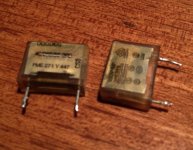
Here are some of the caps I took out- the cases are split front and back.

c33_c36.jpg

 
so those caps being bad is causing your issues, because with out them, your mac backfeeds noise onto the ac line?

pretty interesting.

i would get a inductive current meter, here you can buy them for like 7 or 8 bucks at harbor freight.

open your Breaker box and see how much current is flowing through the breaker your on, maybe half the house is on one breaker?

Maybe you have special breakers installed? ones that are stupidly sensitive by design to detect such feedback.

Post the model / name of the breaker on your circuit? maybe a picture of your breaker box?

 
i would get a inductive current meter, here you can buy them for like 7 or 8 bucks at harbor freight.open your Breaker box and see how much current is flowing through the breaker your on, maybe half the house is on one breaker?
That won't really tell you much, since we know it isn't overcurrent causing the trip. If the Mac were drawing enough current to trip the branch circuit, the power cord would be getting hot. It has to be leakage current from hot to ground, bypassing neutral, and it's probably only a few mA, far too little to measure with a clamp meter.

 
Sorry guys but I can't do any more now till the weekend because I am away with work now.

Maybe it's just as well I can't play with this stuff everyday otherwise the frustration would set in!

Thanks,

Tim

 
Here are some of the caps I took out- the cases are split front and back.
just[/i] like another common computer issue I've heard about. In the BBC Micro's power supply, there are three capacitors just like those which will crack just like that. Again they're filter capacitors, and again the Beeb will run without them. But it's quite common for them to go BANG!!! all over your Beeb's logic board when they first crack (they can also smell/make smoke as a slightly less destructive way of failing).
 
I just want to say that I have a EU 230v Macintosh Plus and the same thing have happened to that one a year or two ago.

The house circuit fuse blows after a few minutes. I've tried it several places and it's the same. I've opened it and the same caps as in Timbo's picture were cracked.

I haven't ordered new caps yet because I'm a little bit unsure on what to replace them with...

IMG_2546.jpg

 
I haven't ordered new caps yet because I'm a little bit unsure on what to replace them with
I did post links from Mouser earlier in this topic where you can still buy the identical film capacitor. I think Digikey offers them as well.

Replace them and you're good to go for another 15 years :)

 
I did post links from Mouser earlier in this topic where you can still buy the identical film capacitor. I think Digikey offers them as well.Replace them and you're good to go for another 15 years :)
Yes, but I was thinking maybe I should change all of them before they started exploding/leaking. I have the international 230v board and I have had some problems finding replacements for every part because they seems to differ from the cap lists people have made in other replacement threads. So I need to sit down and find other types with the same properties, because it seems hard to find the exact same cap :)

 
Yes, but I was thinking maybe I should change all of them before they started exploding/leaking. I have the international 230v board and I have had some problems finding replacements for every part because they seems to differ from the cap lists people have made in other replacement threads
My Macs are also International 230 volts versions. I have already recapped all of them in the last years ( so logic, analog, PSU ).

Finding exact replacements is often not that easy if you want to make it look right as for example a 100uf 200v capacitor from 25 years old is much larger than one with identical specs today.

So I measured all the original one's and looked for replacements that where about the same size so they look right on the Analog board.

The solution was choosing for the same capacitance but higher voltage and going for the more expensive 5000 or 7000 hours caps.

I made an inventary of each board in Excell including the part number of the replacement caps.

To avoid trouble: I replaced all the film and axials capacitors as well as you can see in this discussion: they can brake down too.

PM me what you need and I will send you the file.

 
Well, a few capacitors I was awaiting arrived this morning and I quickly soldered them in.

Success so far- I have left the Plus turned on now for over an hour with no issues. Works fine now.

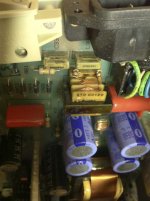
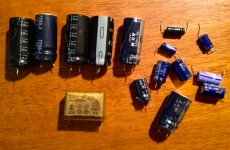
Here is a picture of what I have replaced on the Analog board (in addition to those in the previous picture).

I certainly haven't replaced all the capacitors (C1 included because I haven't got them yet) but this seems enough to get going again.

Away with work now for another four days but on the weekend I will have a go at just replacing those two cracked filter caps and see if it makes a difference.

By the way, they are 240v boards I am playing with.

I was also wondering- can faulty diodes give similar problems? I haven't replaced any but they are probably getting pretty old too.

Oh, and for Loom- I ordered those filter caps locally through Element 14 but they actually came from the UK to me.

capacitors.JPG

 
I was also wondering- can faulty diodes give similar problems? I haven't replaced any but they are probably getting pretty old too
Chances are very thin that a faulty diode would cause problems like yours. Then the diode must make contact to the ground from the Mains, which is very unlikely.

Anyway: test the diodes, a cheap DMM can do this without desoldering them from the PCB.

Definately replace the C1 capacitor as well.

 
As some have mentioned, it's fairly common for these to fail, sometimes rather spectacularly. As long as the replacements are X2 rated, of equal or greater voltage rating, and similar capacitance they will work. You don't need to find exact replacements although it's nice when you do.

As a temporary test it's fine to remove them. It will likely cause interference on nearby AM radios but few people listen to AM radio anymore anyway.

 
few people listen to AM radio anymore anyway
I listen to WJR 760 all the time :)

Or WSGW(online) (but they are news radio 790 in bay city), for Coast to Coast :)

Alex Jones is on (online) Shortwave and AM and FM. - Huge Audience. 3+ million

Rush Limbaugh has a Massive audience, over 20 million listeners.

I'm 33 and i'm starting to feel slightly old :)

Anyways, that makes sense, your home wiring would essentially turn into a big RF antenna :) (with out proper filtering)

I wonder if the Tempest macs can withstand and EMP?

 
re AM interference -

Yesterday I was booting up my IIsi with a SVGA LCD monitor. Another PC nearby was attached to an external audio amplifier. During the IIsi boot period, I was getting a clear signal from a local AM station showing up on the PC-attached audio. When the IIsi display stabilised on the SVGA monitor, the signal disappeared. I'm guessing that the VGA cable was acting as some kind of retransmitter, with the length of that cable coincidentally matching the AM station bandwidth. Strange that there was no connection between the Mac and the PC, but the signal was retransmitted.

Rick

 
It's a fairly common problem. It's likely just a poorly shielded VGA cable and one of the signals is close to a multiple of the frequency you were tuned to.

I was recently playing with a FPGA board and found that it emits quite a lot of RF leakage, stomping over my reception of the 128.000 MHz AM aircraft band which happens to be 4x the 32 MHz master clock on the FPGA. I loaded a Commodore SID implementation into the FPGA and could then hear the SID tunes loud and clear on the scanner. Last year I was messing around with a small Tesla coil I had built, and we discovered it was stomping all over one of the local AM talk stations. My friend tuned it in his truck and could hear the Tesla coil down the street. RF is nifty stuff but keeping it just where you want it can be a real pain.

To clarify, there *are* people who still listen to AM, but they are certainly in the minority. Dozens of unfiltered computers buzzing away in the neighborhood could cause some problems, but running one vintage machine occasionally for a couple weeks while you wait for new caps to show up is unlikely to cause any harm. If it's interfering with something you're trying to listen to, just shut it off.

 
Back
Top