Hey all. I'm hoping someone can help me. I acquired a Mac IIx, did the standard recap and repaired some traces, pretty standard work. However, the NUBUS is not working. The machine is otherwise healthy, boots to floppy and SCSI, responds to ADB, etc.
I checked traces and everything seems fine. When probing the NUBUS slots and the Nuchip, I get the proper clock signals, /RESET, VCCs, and grounds are properly connected. During startup, I see the standard activity of the NUBUS probing for cards using /START, /TM0, /TM1, /AD0, /AD1, and /ACK. But no subsequent communication. I suspect that the NUBUS probing fails to detect a card for some reason.
One theory I have is that the /START and /TM0 assertion is not properly detected by the card due to excessive voltage fluctuation/ringing. According to NUBUS specs, the LOW (asserted) signal should be below 0.8v, while HIGH (unasserted) should stay above 2.0v. But on my IIx, the ringing is causing fluctuations well outside that range. I don't have another IIx to compare it to, but on my IIfx, the signals look very different.
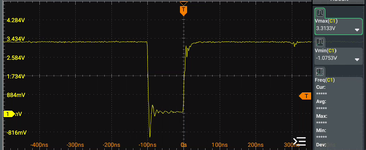
The first picture is the /START signal on the IIfx asserted by the NUBUS master. I have the trigger set to roughly 0.8v, and you can see that the LOW (asserted) voltage stays well below that.
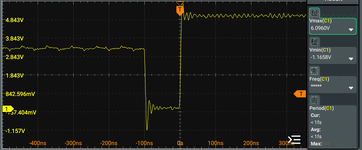
And this is the IIx /START signal. As you can see, it rings well outside the spec, which is why I believe the probing fails.
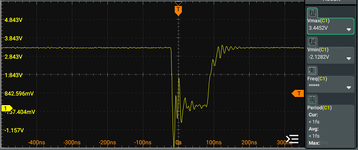
The signals from the Nuchip are clean, and they are also clean on the inputs and outputs of the G1 buffer. So this ringing has to be introduced somewhere between G1 output and the NUBUS slots. The only other component in series is the RP8 resistor pack. I replaced both G1 and RP8, with no change in behavior. I also checked nearby 0.1uf bypass caps, as well as grounds and other inputs/outputs on those ICs. I'm quite confused as to what could be causing this.
Not sure where to go from here. I could also be going down a completely wrong rabbit hole - perhaps Mac IIx NUBUS is more tolerant than the specs suggest?
Any help would be greatly appreciated.
P.S. Before anybody asks, I did try, and multiple known good PSUs and multiple know good video cards in different slots. The tests were all performed without any cards connected, and then with known good cards connected. The signaling did not change, and the cards never responded. The cards are getting a clock and voltages and they do get warm (I'm assuming they are just waiting for initialization).
I checked traces and everything seems fine. When probing the NUBUS slots and the Nuchip, I get the proper clock signals, /RESET, VCCs, and grounds are properly connected. During startup, I see the standard activity of the NUBUS probing for cards using /START, /TM0, /TM1, /AD0, /AD1, and /ACK. But no subsequent communication. I suspect that the NUBUS probing fails to detect a card for some reason.
One theory I have is that the /START and /TM0 assertion is not properly detected by the card due to excessive voltage fluctuation/ringing. According to NUBUS specs, the LOW (asserted) signal should be below 0.8v, while HIGH (unasserted) should stay above 2.0v. But on my IIx, the ringing is causing fluctuations well outside that range. I don't have another IIx to compare it to, but on my IIfx, the signals look very different.
The first picture is the /START signal on the IIfx asserted by the NUBUS master. I have the trigger set to roughly 0.8v, and you can see that the LOW (asserted) voltage stays well below that.
And this is the IIx /START signal. As you can see, it rings well outside the spec, which is why I believe the probing fails.
The signals from the Nuchip are clean, and they are also clean on the inputs and outputs of the G1 buffer. So this ringing has to be introduced somewhere between G1 output and the NUBUS slots. The only other component in series is the RP8 resistor pack. I replaced both G1 and RP8, with no change in behavior. I also checked nearby 0.1uf bypass caps, as well as grounds and other inputs/outputs on those ICs. I'm quite confused as to what could be causing this.
Not sure where to go from here. I could also be going down a completely wrong rabbit hole - perhaps Mac IIx NUBUS is more tolerant than the specs suggest?
Any help would be greatly appreciated.
P.S. Before anybody asks, I did try, and multiple known good PSUs and multiple know good video cards in different slots. The tests were all performed without any cards connected, and then with known good cards connected. The signaling did not change, and the cards never responded. The cards are getting a clock and voltages and they do get warm (I'm assuming they are just waiting for initialization).
Last edited: