• Hello MLAers! We've re-enabled auto-approval for accounts. If you are still waiting on account approval, please check this thread for more information.

Mac II that doesn't like to start up

pathw

6502
I have a Mac II that requires some coaxing to start up after it hasn't been used for a few days (or weeks). Once started, and then shut down, it starts up immediately when tried again. The initial start up issue can take 1 - 30 minutes before resolving itself  (not especially accurate as I am annoyed at the time and sometimes give up and come back later and try again). Today (after being off for a few weeks), the first few tries failed, then I went and did something else for a few minutes, and it started up after the second try after returning.

This appears to be independent of whether it has been plugged in while it is off, and it is not getting any worse. It has been this way for at least a few years now.

Almost "feels" like there is a capacitor that needs to be recharged, and trying to start the system starts the recharge process.

System has not been recapped - this is one of the early Mac IIs with the better quality capacitors. Last I looked, I did not see any issues with the board. I have not looked inside the power supply though. The PRAM batteries were also changed a few years back, though perhaps this needs to be done again - doesn't seem to represent a PRAM battery issue however.

In any case, if anyone can explain what is going on, I'd appreciate it.

Thanks.

 
The system does need to be recapped. There are a couple of large Axial caps that do need replacing. That's a given. I have a IIfx, and it needed a recap even though 905% of the board had Tantalum caps on it, there was 3 of those #$&%@!! bleeding caps on the power supply area of the IIfx board AND 2 Axial caps that needed replacing too. So go in there and look real carefully and you will find bad caps in there that need replacing.

Also, the batteries need replacing as well. Some of those board have soldered batteries. That is not a problem because you can put in a battery holder in its place and then put in a replacement battery in there.

Fixing these two things SHOULD fix the problem you are having.

 
without good batteries the system will fail to start.  If you look up jump starting a II on google lots of you tube videos on it.

 
Mac IIs need recapped. The soft-start circuit is a known trouble spot on these and its because of capacitors, and batteries. 

 
Thanks for all of the comments. Just to reiterate - it is not failing to start (yet), and the issue has not been getting worse over the last few years.

I'll try the jump start test first, just to check that the replacement batteries have not started to fail prematurely.

 
FWIW - Changing SCSI drives seems to have solved my start-up problems. Perhaps the one drive was trying to draw more power at startup than the PS was consistent at providing?

 
Thanks for all of the comments. Just to reiterate - it is not failing to start (yet), and the issue has not been getting worse over the last few years.
It does not matter if it falling apart yet or not. I had similar problems with my IIfx and when I replaced the 3 bad caps in the start up circuit and the 2 Axial (large) caps plus the batteries, I have yet to have another problem since and that was over two years ago.

Just because you do not have problems now, does not mean that you will not have bigger problems later - chances are you will if you leave things as is and continue as you are. You need to recap the board. Period. There is no arguing with this, it has to be done. Not the whole board but the 3 or so caps on the start up circuit, which will be in those little silver cans even if the rest of the board is solid state Tantalum caps. The IIfx was like this - all Tantalum caps except for the 3 caps in the start up section. I replaced them with Tantalum caps and its been great since!

A Cap can fail as an open circuit or as a shorted cap. As an open circuit, electricity will never go to where it has to go. A Shorted out cap will have the circuit on all the time which is bad as well and drain out your battery even when the system is off. In either case, it will not turn on.

Of course, there is also the issue of cap goo rotting out your traces which may or may not have happened (yet), but you wont know until you remove the cap and inspect the traces under the cap. A rotted out trace will act like a open circuit cap, which in the start up circuit area, will not start up your machine. And a lot of times in other areas of the board, other traces go under but not connect to the cap as part of the wiring and they can rot as well.

To Jump Start a Mac, get a 2-AA or AAA battery holder for 3V. Put the black (negative) wire to the metal of the Powersupply. And then touch the white wire on the PSU/Logic board harness with the red wire from the battery pack. The White Wire is on the right side end of the harness. This should turn Mac II 95% of the time.

 
Last edited by a moderator:
> Not the whole board but the 3 or so caps on the start up circuit, which will be in those little silver cans even if the rest of the board is solid state Tantalum caps.

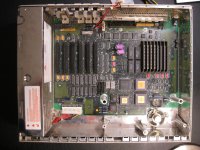
Where are these again? This is a Rev. A Mac II board. I've looked and don't see anything.

o_inside_empty.jpg

 
hmmm... the plain mac II has no SMD lytics. Anyways, U9/U31 I believe are responsible for the soft power circuit. 

 
Last edited by a moderator:
techknight - does this change your diagnosis of a possible problem with capacitors associated with the soft power circuit? What are the failure modes of tantalum capacitors - anything visible? Thanks.

 
Tants short circuit. they usually dont open or do anything strange like that. 

If this were a IIx or a IIfx then I would have said for sure caps because ive changed a number of them, plus re-ran traces. 

This being a plain II, I never saw one until now. So that makes me think a voltage or even IC issue. 

Question: When it "doesnt" work, what doesnt it do? no clicks or power-on at all? 

Here is a test. Once the machine warms up enough to be able to startup and shut down consistently, Freeze-spray the two ICs I had mentioned, one at a time until the fault re-occurs. One of the ICs in that unit is a likely cause. 

Of course it could very well likely be power supply related too as its full of caps. But cant be too sure unless you rule out the logic board. 

 
Last edited by a moderator:
Thanks for the many thoughts. Since the problem has disappeared (for the moment) since I swapped hard drives, I'm leaning toward the power supply being the culprit (or perhaps the original hard drive is failing, though that seems like a strange behavior for a failing hard drive). To answer your question:

> what doesnt it do? no clicks or power-on at all?

Didn't do anything - no clicks or power-on at all.

 
Well if it does it again, easiest way to check is meter the connections to the power supply, if you get a standby signal coming from the logic board, but your other rails fail to come up or come up very briefly before flatlining, its time to take a look at the power supply. 

 
My II had SMD's so that must be way early to have radials, or just wherever it was produced.  The batteries are later looking like they were chaged out at some point.  If they dont have over 3 volts you wont get startup.  The one closer to the ports is part of the startup power if I remeber correctly.  

If you look up on google there is a II jump start for power on that will work if the battery is dead or other board issues to at least rule that out.

 
Macdrone, thanks for the comments. I already found the jump start instructions, and Elfen also included the instructions in his last post.

Batteries were replaced 3 years ago, so "should" be okay. If it becomes difficult to start again, this will be the first thing that I check. (Not excited about putting back in the old hard drive, but could do this to be able to reproduce the problem, assuming that this in fact was what caused the problem to disappear.)

 
Last edited by a moderator:
Back
Top