Follow along with the video below to see how to install our site as a web app on your home screen.
Note: This feature may not be available in some browsers.
Hello MLAers! We've re-enabled auto-approval for accounts. If you are still waiting on account approval, please check this thread for more information.
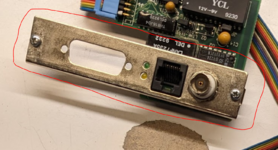
Is there anyone who has this bracket in a drawer and would like to sell it to me? I prefer someone in Europe due to shipping costs. I live in the Netherlands myself. (Photo courtesy of forum member zigzagjoe)
Is there anyone who has this bracket in a drawer and would like to sell it to me? I prefer someone in Europe due to shipping costs. I live in the Netherlands myself.View attachment 63275
How's your metal working? If I was in your shoes I'd make one out of some sheet metal. Aluminium is easier to work, but stainless steel would be better.
Print a template (verify its dimensions in x and y, scale and print a second time, because printers aren't accurate or consistent in each axis), drill the holes and confirm they're in the right place, chain drill out the hole for the RJ45 port, shape them with a file, then use brass standoffs to mount it.
Its a good one to start with. Its not too bad. Do you have an angle grinder or a dremmel?
The trick to getting a straight edge is to stick the template to the metal, then clamp a big thick bit of scrap metal to the small part you're working on lined up with the edge you're cutting. Your tools will easily remove the part you're working on, but will take much more time to grind away the big scrap. Once you're close to the target line, you can quickly move the tool up and down using the scrap as a straight edge guide and get a really clean line on your part.
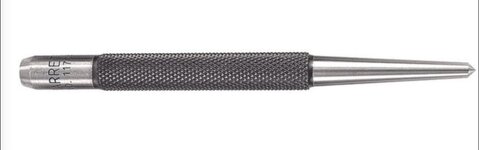
When drilling holes, use a centre punch first so the drill doesn't wander. You can do this using the paper template. Mark the centres of holes in the drawing.
Drill holes slightly over-size to give yourself a little tollerance.
Oh, its easy enough. Couple of hours tops with no experience. I'd recommend getting a centre punch. They'll be a <insert single unit of local currency> second hand, and a good cheat to make it easy to drill holes in the right place in metal. Don't get a fancy one, just a stubby pencil shape in steel.
Another option is to design one as a PCB and order it made. It works well. You'd end up with 5 of them and it would cost about $15 probably. The homemade option is cheaper.
You might be able to find a local company that could laser cut it also. The original has a 90 deg bend on the bottom of it to prevent flex when plugging things in, but you probably could do without that if you use extra-thick metal. I should have another one of these boards soon that I'll take a scan of.
The other annoying part is the specialized nut that goes over the Tbase2 BNC connector is a major part of holding the board to the bracket - it is likely to be annoying to find.
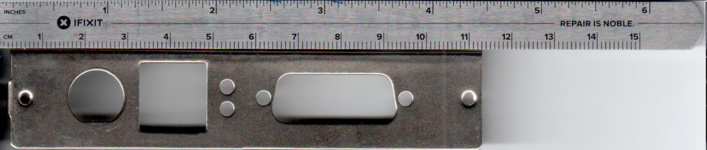
Here's a scan of the appropriate bracket. With a bit of work in an image editor to measure things, you should be able to turn this into something workable.
This site uses cookies to help personalise content, tailor your experience and to keep you logged in if you register.
By continuing to use this site, you are consenting to our use of cookies.





 I'd recommend getting a centre punch. They'll be a <insert single unit of local currency> second hand, and a good cheat to make it easy to drill holes in the right place in metal. Don't get a fancy one, just a stubby pencil shape in steel.